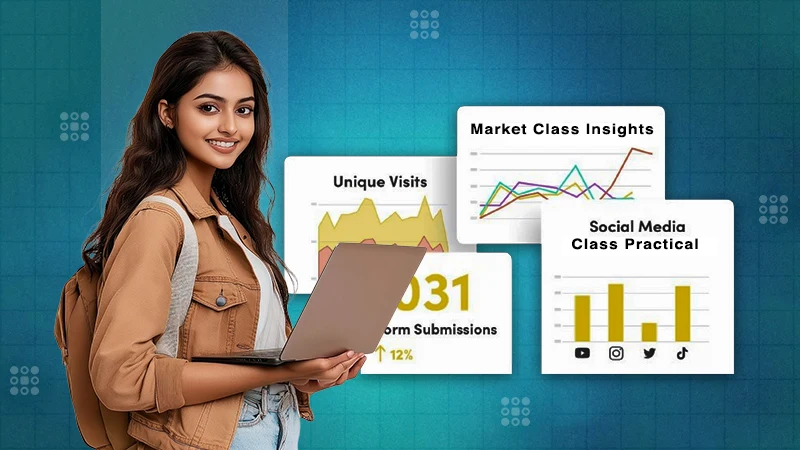
The live marketing situations often face high-stakes, stressful, and immediate. The evolution of the role of the employer has led to the requirement for businesses to begin to train their future workforce in hands-on, experiential learning environments.
Despite the fact that the theories developed by scholars and educators serve as the foundation for marketing education, there are many changes in the way consumers behave and interact that cannot be adequately represented in these traditional methods.
By learning to work with analytics dashboards, collaborating in agency work environments, and developing collaborative relationships with others, experiential learning experiences provide students with the confidence to pursue their careers and become leaders. This article will discuss why engaging in real-world experiences and projects is the most significant aspect of modern marketing education.
KEY TAKEAWAYS
- Practical experience turns theoretical classroom concepts into valuable, ready-to-use professional marketing skills.
- Hands-on platform use allows students to adapt quickly to changing digital algorithms.
- Working with actual clients builds the problem-solving mindset required for career success.
The Gap Between Theory and Real-World Marketing
It is possible that the knowledge you gain in a classroom context will provide you essential foundations; yet, it is frequently limited to concepts and frameworks alone.
Unlike in real life, youngsters can grasp models while they are using a pencil or crayon, but this doesn’t apply in all situations. As a result of settings in which they are competing against real audiences, actual campaigns, and judgments that are time-sensitive, this distinction becomes readily obvious.
The gap between theoretical marketing and its practical execution can be bridged by exposure to real-world marketing. As the students engage in actual projects, the concepts that they were learning go out of the slides and into skills in the past that they can directly use.
Search, mail, social, and analytics dashboards are just a few examples of worst areas current wave of marketing can be found flexing its wings. The terrain is always shifting, and they are in many ways the best suited to it.
As a result of this, it is not much smoother to sustain such discipline for the purpose of study. Students cannot succeed and learn when they try to learn without having any practicals.
Hands-on experience can demonstrate the learner what platforms are really like in practice. This also allow them adapt more quickly if something like features, algorithms, or user action changes unexpectedly.
Data-Driven Thinking is Learned Through Practice
You have stepped into the globe of modern marketing, where data interpretation drives decision-making rather than intuition. The concept of metrics is something that students learn about and read about in a book.
However, when you really go through the procedure of conducting an analysis, the entire idea is placed in a completely other context. When the outcome of actual events is at risk, the figures take on a different vibe.
Students can think more in an instrumental manner as a result of the examination of real performance data. In turn, this benefits them from the insights derived from the real data. Learning in this way fosters confidence in the use of analytics for the purpose of formulating and assessing strategies.
Practical Experience Builds Problem-Solving Skills
Many times, the marketing part of it does not work as planned. It’s all too often that campaigns do not work, messages get out in the wrong way, and audiences do not respond as you expect. It is hard to function with the level of thinking required for classroom-based scenarios.
As students have an opportunity to engage in the practice, they are motivated to refine their tactics and apply what they know. With time, it helps in building problem-solving abilities, which are critical for professions where intense attention to detail is a requirement.
Collaboration Reflects How Marketing Teams Operate
When it comes to marketing, labour is not so often done alone. The teams responsible for design, content, search paid media, engine optimisation, and strategy collaborate in order to accomplish shared objectives. It is not possible to achieve this level of coordination with the help of different kinds of educational activities that we typically engage in.
Students are offered with a sense of the realities of working in a team through the use of this practical experience. In the same way that they would in a professional environment, they find out how to communicate work in a centralized manner around goals and deadlines.
Real Clients Create Real Accountability
The level of accountability that is brought about by real tasks is something that academic assignments may not be able to fully imitate. Customers have specific expectations. In addition to providing comments, they are worried about more than simply the grades. The students’ view points on their work are altered as a result of this.
Observing how professionals perform their jobs, such as working with a team in a London SEO agency, can offer students with valuable learning opportunities. In addition, it allow students to acquire an understanding of how client connections impact marketing decisions.
From Learning to Leading
Indeed, due to their exposure to applications, casual students are transformed into professionals who work in the real world. In an industry that is constantly evolving, it fosters you to think differently, boosts your self-confidence, and enables you to adapt to new circumstances.
Real-world experience is not only supportive for learners who are trying to create an impact that is defined by their skills; instead, it is the difference between knowing marketing and being prepared to execute it.
Ans: While theories lay the groundwork for marketers, they do not take into account all of the unknown elements found in a competitive marketplace.
Ans: Experiential experience gives students the opportunity to try out marketing strategies on a real audience using real time data.
Ans: Yes, employers typically prefer to hire applicants with proven success using digital tools.
Ans: While working on real life projects, students will develop their ability to analyze data, collaborate in teams, and solve higher order problems.