“The child is both a hope and a promise for mankind.” – Maria Montessori (Italian physician and educator)
Think back to your earliest memories; what do you remember, the smell of finger paints or the sheer thrill of the playground?
According to the Center on the Developing Child at Harvard University, more than 1 million new neural connections are formed every second in the first few years of life. This article is not just about the daycare of preschool; it’s about the architectural blueprints of your adult personality.
The environments we inhabited as children decide how we process fear, and we actually connect with others. It is how we view our own potential decades later.
Key Takeaways
- Social habits that are formed in childhood often resurface during high-pressure events like reunions.
- Early environments shape your adult confidence and can also be the root of imposter syndrome.
- Flexible thinking is cultivated in open-ended learning spaces instead of rigid environments.
Emotional Safety and Confidence Development
You can label your first learning space as your first world. If that space felt secure, you likely grew up with a secure base to explore from. However, when there is a lack of support in those spaces, the seeds of self-doubt are sown early.
This often manifests in adulthood as imposter syndrome, that nagging feeling that you are not actually qualified for your job or life, regardless of your success. By understanding that these feelings often stem from early environmental pressures, you can start by rewiring your confidence.
Social Dynamics and Relationship Patterns
Early learning spaces are the spaces where we first test social physics. You learned how to share, how to handle rejection over a bin of plastic blocks, or how to lead. These patterns are surprisingly sticky.
Have you ever noticed how people get back to their childhood selves at high school reunions? It is because those early hierarchies and environmental cues are etched into our long-term social coding.
- Conflict Resolution: Was dialogue or punishment encouraged in your ealry spac?
- Empathy Building: Early play areas taught you to read the room before you could even read a book.
Did You Know?
Freidrich Froebel created the concept of Kindergarten, who believed children should be nurtured like plants.
The way we interacted with our peers under the guidance of a teacher directly influences how we now navigate through complex office politics and professional hierarchies.
Learning Styles and Problem-Solving Approaches
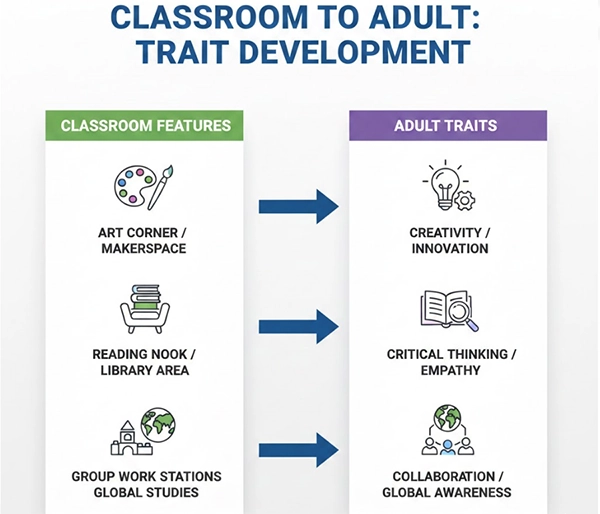
Classroom layout shapes a child’s cognition. Open-ended play environments build the flexible thinking skills that are necessary for adult life problem-solving. If a rigid upbringing limited your creativity, you can still provide a better foundation for your child.
Early childhood settings that focus on dynamic layouts encourage students to experiment and collaborate. By valuing discovery over rote learning, these spaces ensure that the children develop the adaptability that is needed to navigate complex challenges.
This will ultimately transform how children perceive and interact with the world around them as adults. The image below shows how classroom features become adult traits.
Authority, Structure, and Independence
Early learning spaces introduce us to the concept of ‘The System. ’ This is where you first came across the rules that were not set by your parents.
- Autonomy: Spaces that allow children to choose their activities build future leaders.
- Compliance: Overly structured spaces might create excellent task managers but may stifle original innovation.
It can potentially condition you to wait for external permission instead of seizing the initiative to pioneer groundbreaking ideas in your professional life.
Fun Fact: The brains of children are twice as active as adult brains, making their environments twice as impactful!
Memory, Identity, and Long-Term Reflection
Our identity is often a collection of stories we tell ourselves about our childhood. A positive early learning space offers you a narrative of capability. Recollecting a childhood achievement from age five functions as a psychological anchor for adult resilience.
This memory acts as a hidden reservoir of strength, offering the necessary perseverance to navigate the high-stakes complexities and challenges faced throughout maturity.
Why Early Learning Still Matters in Adult Life
The adult world considers our childhood years as mere recreational activities, yet we spend our earliest years engaged in work through play. The practice of learning spaces analysis allows us to identify our learning triggers and core strengths while gaining insight into our behavioral responses to various situations.
The process of removing hidden childhood obstacles leads us to achieve our complete potential with a clear understanding.
FAQs
Ans: Emotional safety and the freedom to fail without any fear of judgement is what makes learning space unique.
Ans: Yes, it can be through self-awareness and intentional change in habits in adulthood.
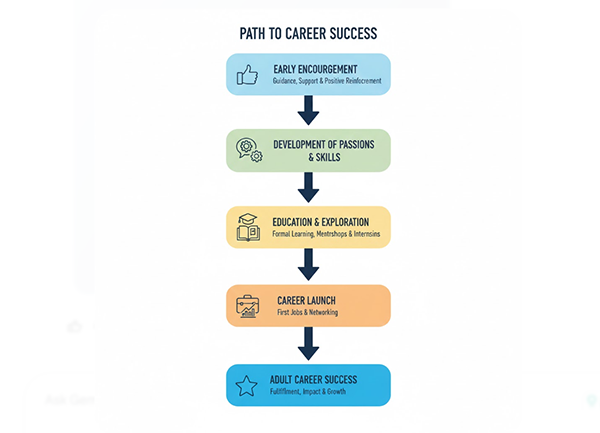
Ans: Yes, they do. These environments validate early competence, resulting in lifelong interests.