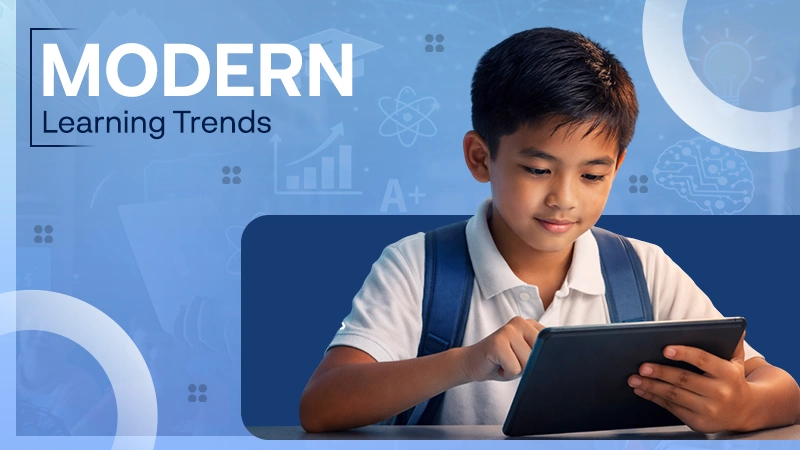
The old model of education, with the teacher at the front and students in rows, is a thing of the past now. With the evolution of modern learning, many things have transformed and changed.
Furthermore, the tools that students use to revise, the way they develop their skills, and education trends that influence more changes continue to advance. But these are all welcome changes as they benefit people in many ways.
Let’s take a detailed look at how the education and learning sector continues to grow and unfold with new techniques and what the future holds for all of us.

Key Takeaways
- New education trends of personalization and micro-credentials have taken center stage in learning
- The focus is set on actual skill development instead of an optional path to a necessary way to grow
- E-learning platforms have found different and unique ways to make students focus on their own interests
- Students who thrive in adaptability can succeed in this ever-evolving modern learning world
Education Trends: What’s Actually Happening?
One trend dominates: personalization. No two learners are the same, so why treat them that way? Adaptive algorithms now tailor lessons in real-time. A student in Nairobi might study calculus through a gamified app, while another in Oslo debates philosophy on a virtual forum.
Another trend? Micro-credentials. Gone are the days of a long four-year degree path. People are not stacking bite-sized certifications that develop real professional skills over prioritising theoretical concepts like in the past.
Then there’s the shift to hybrid models. Not just “online or offline,” but a fluid mix. One day you’re in a lab, the next you’re on a VR headset exploring ancient Rome. The walls of the classroom have dissolved.
Online Learning: More Than a Pandemic Blip
Remember when everyone thought online learning was temporary? It wasn’t. The global e-learning market is projected to hit $933.5 billion by 2032. That’s not a trend; it’s a tidal wave.
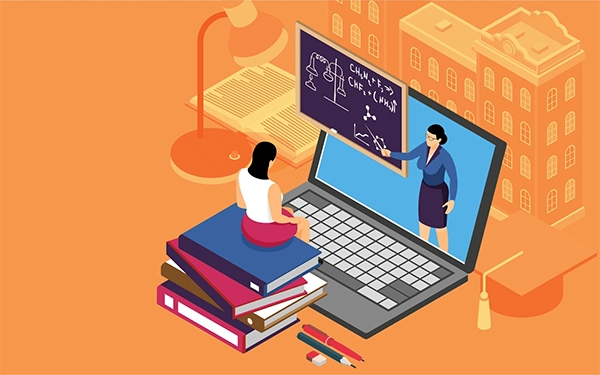
But let’s be real: online learning was never just about watching and understanding videos on a screen. It’s synchronous, asynchronous, and everything in between. Students in rural areas now have access to Ivy League lectures. A mother can earn a certificate during her child’s naptime. The barriers are crumbling every single day.
Critics say it lacks a human connection. They’re not wrong. Yet, new platforms are weaving in social elements—live breakout rooms, peer-to-peer feedback loops. Leading this digital shift are forward-thinking platforms like University.com, which bridge the gap by combining structured academic rigor with highly interactive learning. It’s evolving faster than anyone predicted.
Skills Development: The New Currency
Hard skills have a shelf life now. A coding language you mastered five years ago might be obsolete. So, what’s the focus? Adaptability. Communication. Critical thinking.
Here’s a staggering number: the World Economic Forum estimates that 50% of all employees will need reskilling by 2025. That’s half the workforce. Skills development has shifted from “nice-to-have” to “survival.”
But it’s not just about a technical takeover. Emotional intelligence has become a hot commodity, with AI being able to draft, write, and produce codes but can it navigate a tense team meeting? No. That’s a skill that human posses, and its demand and value keep increasing every day.
Let’s talk digital tools. Not the fancy ones. The ones that are actually used in real environments. Interactive whiteboards, collaborative docs, and AI tools or tutors that never sleep.
Even a mathsolver can dramatically increase productivity and improve understanding of problems. The beauty of technology is that it’s available anytime, anywhere.
Consider this: 86% of teachers in a recent survey said digital learning tools are essential for student engagement. But engagement is tricky. A flashy app can distract as much as it educates.
The best tools? They’re invisible. They work so seamlessly that you forget you’re using technology. That’s the goal.
Fun Fact
Short and focused learning bursts (under 5 minutes) are being preferred over long training sessions, catering to the shorter attention spans of students and expanding micro-learning as an option.
Coursera, Khan Academy, Duolingo—the names are endless. Each platform has its niche defined, where one focuses solely on university-level courses and another on learning languages through memes.
What’s interesting? The rise of niche platforms. Forget the giants. Now there are platforms dedicated solely to teaching beekeeping or ancient calligraphy. The market has become hyper-specialized.
And they’re not just for individuals. Corporations are buying subscriptions in bulk. Upskilling employees through e-learning platforms has become standard practice. In 2022, corporate spending on such platforms exceeded $30 billion globally.
Learning Technology: The Quiet Engine
Underneath it all is the tech itself. The cloud makes resources accessible even from a $50 smartphone. AI predicts and analyzes how you learn, where you pause, and what you rewatch. All these insights come together into a personalized path made specifically for you.
But there’s a dark side. Privacy concerns are real. A student’s data is a gold mine. Schools and providers must navigate ethical minefields. Not everyone is careful.
Yet, the promise is undeniable. Learning technology can level the playing fields. A visually impaired student can use screen readers; a dyslexic learner can use text-to-speech. Inclusion is no longer an afterthought—it’s built in.
Student Skills: What the Next Generation Needs

Forget memorization. The modern student needs curation skills. There’s so much information out there; knowing what to ignore is a superpower.
Collaboration across various cultures is another. A group assignment may involve peers from three different continents, none of whom speaks the same first language. This demands patience, digital etiquette, and clarity.
Resilience. That’s the unspoken skill. Learning today is nonlinear. Courses crash. Internet lags. Motivation dips. Students who thrive are those who adapt without breaking.
Where We’re Headed
So, what’s the takeaway? Modern education is messy. It’s a patchwork of old and new, digital and physical, individual and communal. There’s no single formula.
But the direction is clear. Learning is becoming lifelong, lifewide, and deeply personal. The tools will keep changing. The trends will shift.
What remains constant? The human desire to understand, to grow, to connect, as technology is just the amplifier.
FAQs
Ans: E-learning platforms have harnessed the power of modern technology and learning techniques, with them becoming hyper-specialized, and companies investing in these to train their employees.
Ans: Yes, online learning has become available for all who wish to spend time and develop their skills, from children living in rural areas to mothers pursuing new subjects. Everyone is able to access and learn everything in a matter of minutes.
Ans: The best kind of technology is the one that is so deeply integrated into a platform that you forget it’s there and use it as a new normal every day without thinking about it twice.
Ans: The most popular education trends of today’s time are micro-credentials and personalization. Both of these provide people with tailored and specialized learning.