“Education is the most powerful weapon which you can use to change the world.” – Nelson Mandela (Activist and former President of South Africa)
Have you always desired to assist others, but have been prevented by your busy schedule every day? Well, you’re not the only one. The process of learning how to assist communities has always involved giving up everything else. This means attending classes at a physical campus to attend lengthy lectures that were often boring.
Thankfully, times have changed, and there is an entirely different picture. This paper highlights the benefits of digital classrooms for various learners and society in general. It discusses how modern training methods have become very convenient for people.
You will also be able to learn how to balance the entire process effectively with work and life. Lastly, we are going to explain the importance of such training for our communities.
Key Takeaways
- Online classes let you study around your busy daily schedule.
- Digital school lets anyone learn from any location worldwide.
- You can practice what you learn at your job immediately.
- Accessible training helps more caring people enter the field quickly
Why Flexibility is No Longer Optional
The traditional college system was designed for one specific group of students. It was designed for individuals who had enough leisure time to organize their day according to school hours. But what happens when you have a regular job, a family to raise, and a social obligation to serve the community?
In such a case, this traditional schedule will definitely not fit you. The modern busy lifestyle makes such a rigid schedule an obstacle in development, rather than its advantage.
There is no point in putting everything on hold in order to attend a school lesson. This fact shows how crucially important the ability to adjust a studying process becomes.
Modern students require opportunities to study early in the morning, late at night, and sometimes even during lunch breaks at their workplace. Without such a beneficial opportunity, many talented and committed people will never get the chance to build their future careers in this particular area.
This also indicates the growth towards modern learning. To understand this better, learn the impact of modern online learning on everyday learning.
How Online Graduate Study Fits Real Life
Entering advanced courses will not oblige you to abandon all your responsibilities. Nowadays, colleges realize how much useful experience their students possess due to being mature individuals. Instead of giving you a choice to select between financial benefits and self-development, online MSW allows to perform both things simultaneously.
This radical shift changes everything about your learning process. You do not need to study some community problems from boring textbooks only. This way of getting acquainted with issues means that you discuss these topics in online chat rooms and observe the same problems happening in reality.
Thus, this type of education connects the individual study process with the interests of society and provides society with the necessary professionals. In addition, you acquire knowledge during the night and apply the gained information the very next morning to serve other people.
Education becomes more practical, quicker, and more useful than ever before. This is a chance for you to develop your career and not lose anything at all.
Fun Fact: The first social work class in the United States was taught at Columbia University in 1898, with just a handful of students in one classroom.
The Growing Need for Trained Social Workers
Our neighborhoods are plagued by complex challenges each and every day. Issues related to mental well-being are on the rise, networks of support are insufficient, and vulnerable populations cannot access essential services. To address such deep-seated concerns effectively, there is an urgent need to provide a continuous supply of highly skilled professionals.
The old campus of most colleges is inadequate both in terms of physical space in classrooms and the number of faculty members to produce sufficient numbers of graduates to meet the overwhelming demand. Online classrooms allow overcoming such limitations. Thus, universities are capable of educating large teams of compassionate problem solvers in all corners of the globe.
By attending online courses, anyone from any city is enabled to serve their local community. There is no need for students to relocate to major cities to pursue education anymore. Instead, excellent education is delivered right to those who wish to serve their communities. Thus, such a shift enables meeting job shortages much quicker and providing emergency assistance where necessary.
Learning Does Not Stay Separate from Work
One of the most positive aspects of modern online learning is that the separation between homework assignments and actual work is almost completely erased. Now you do not just have to memorize some idea that will be tested after weeks of doing absolutely nothing else but remembering it.
No! With modern education, you will know a concept by Tuesday and apply it in practice on Wednesday.
- Active Testing: See what ideas work in reality and which need improvement.
- Deeper Retention: Lessons will stay in your mind forever because you will relate them to people and situations, not to some texts.
- Constructive Friction: Real-life issues will give you invaluable troubleshooting skills.
These factors make your everyday studying process extremely exciting and fulfilling. You will feel like you are spending your time effectively and getting results from all your actions. Moreover, each assigned reading or an online class discussion will be directly connected to your everyday activities.
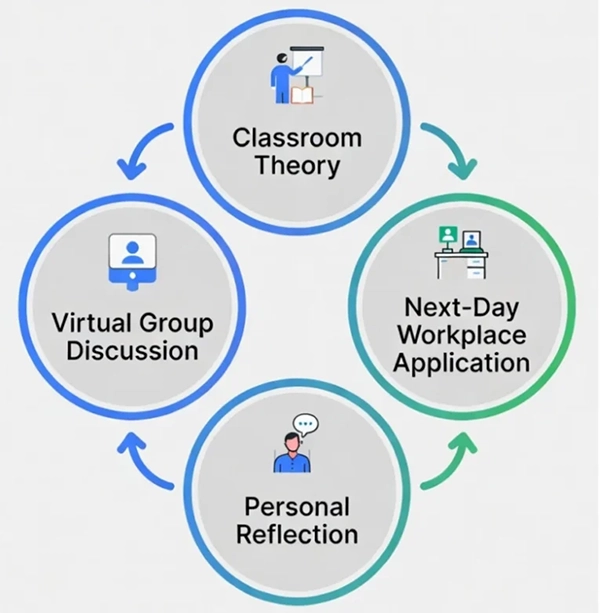
The circular diagram above demonstrates the process of a continuous learning cycle from theories learned in class, practice in the work environment, reflection, and finally discussions within groups
Technology Is Changing More Than Access
Moving from classroom-based classes into the online world not only moves the location from which you learn but changes entirely how you acquire knowledge as well as interacts with fellow professionals in the industry.
Through the utilization of technology in education, learners will be able to come up with practical visualization cases and develop very professional presentations for community-related projects in their areas.
Technology affects everything that is part of the contemporary classroom setting, from communication with the lecturer, collaboration in group projects, and managing weekly goals. You have to be highly organized and technologically competent when taking up these courses.
The skills gained through the use of technology in education will be immensely beneficial in your future career. Through this process, you prepare yourself to deal with remote team collaboration with confidence.
Did you know?
Social work careers are on the rise, increasing the importance of training programs that offer convenient access
Challenges That Do Not Disappear
“In the midst of difficulty lies opportunity.” – Albert Einstein
Be realistic; learning in an online environment is not an easy task. Since you do not attend physical lessons anymore, the discipline and organization will suffer from your loss of routine. In the absence of the professor who stands next to you, it becomes extremely tempting to put off your assignment. This is something that could ruin your whole academic life.
Moreover, forming deep bonds with people using the internet requires lots of effort. Being a social work major means that one needs to establish strong connections. Thus, it is essential for an online student to participate in web conferences as well as take part in group discussions and excel in his/her practical experience.
The online program demands lots of self-discipline and self-control. It makes you manage your schedule independently each day of your studying. Although it is challenging to push yourself to learn alone at home, facing such obstacles definitely pays off because it builds up your strength and readiness for any future situation.
A Shift That Reflects a Larger Change
The emergence of online social work education represents the biggest shift in today’s society. People in pretty much any field today prefer opportunities that take into account their time. Therefore, all programs should know about people’s responsibilities and should concentrate more on practical experience rather than on theory.
At last, there will be a need for those social workers who can react instantly to challenges, adjust in case some changes occur, and cope with changes perfectly. Once you obtain your online degree, you will demonstrate that you are someone whose qualities allow you to assist other individuals and improve people’s lives around the globe.
In this way, it becomes evident that it is not necessary to obtain your education in a definite location. This option will prove your readiness to adapt to the new realities of today’s labor market.
FAQs