
“The quality of an education system cannot exceed the quality of its teachers.” The landmark McKinsey report on education popularized this idea. But there’s another truth that’s just as important: the quality of a school system also depends on the leaders who build, support, and improve it.
It’s the educational leadership that decides the future of schooling. In practical terms, it decides every staffing decision, policy rollout, and support system that teachers rely on. That makes the doctoral path an aspiring administrator chooses more than an academic credential. It influences the kind of problems they’ll be equipped to solve throughout their career.

When educators consider pursuing a doctorate, the question becomes: an EdD and a PhD? Many assume the choice comes down to prestige or personal preference. In reality, these programs prepare graduates for fundamentally different roles.
The distinction matters. It’s the supervision preparation that ultimately affects whether school policies translate into meaningful classroom practice or remain well-intentioned documents that never achieve their purpose.
This article explores what separates the two doctoral leadership tracks, why the distinction matters for system-level decision-making, how effective administration determines whether individualized student supports are implemented successfully, and what prospective educational leaders should consider before choosing a doctoral path.
What Distinguishes the Two Doctoral Leadership Tracks
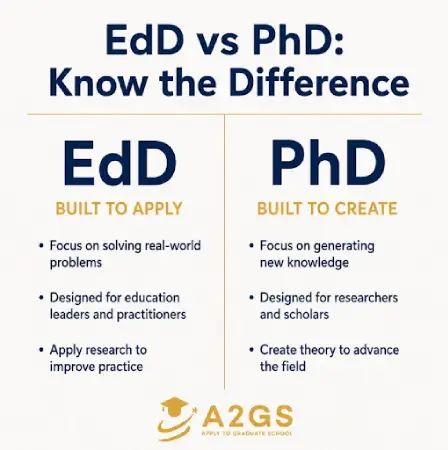
One path is oriented towards applied practice. It focuses on solving real operational problems within a school system, building policy, managing staff, and translating research into daily practice that teachers and students actually experience.
The other path is oriented toward original research. It typically prepares someone for research or academic roles rather than day-to-day system leadership, with training centered on generating new knowledge in the field.
This dissimilarity matters enormously for anyone choosing a doctoral path in education. Both tracks carry a doctoral title, but they prepare someone for genuinely different kinds of work once the degree is complete.
Knowing the difference between EdD vs PhD programs early on helps prospective students avoid choosing a path based on assumptions. Rather than prestige, actual fit becomes important.
The infographic summarizes the distinction between the two paths:
Why This Distinction Matters for System-Level Decision-Making
A manager trained in the applied, practitioner-focused track spends their doctoral training working directly on the operational and policy problems they’ll continue solving once in a leadership role. This builds habits and frameworks suited specifically to that ongoing vocation.
This preparation shows up in concrete decisions once someone actually leads a system. How a district allocates staff, how policies get translated into daily classroom routine, and how quickly a system responds when something isn’t working all trace back to this training.
This supervision preparation directly affects whether the systems built to support individual students function as intended. Those systems depend entirely on leadership decisions about staffing, training, and oversight, none of which happen automatically.
This is why some school systems consistently struggle to implement even well-designed guidelines, while others adapt quickly. The difference often traces back to the operational preparation of the administration team, not to the quality of the policy itself.
A well-written policy sitting on top of an operationally unprepared leadership team rarely delivers the outcomes it promises. The gap between good intentions and actual classroom results often lives exactly here.
How Strong Systemic Leadership Determines Whether Individualized Plans Are Followed in Practice
An individualized support plan specifies the particular accommodations and assistance a student with a distinct learning need requires. It’s developed collaboratively between educators, specialists, and family to meet that student’s needs specifically.
A plan is only as effective as the system’s capacity to actually implement it. Teachers need training, time, and support to follow through, and all of that depends on decisions made well above a particular classroom.
When a school system’s leadership doesn’t have the operational fluency to build this capacity, individualized plans risk becoming paperwork. They satisfy a legal requirement without really changing what happens for the student day to day.
This gap between document and practice is exactly where supervision preparation matters most.
A supervisor with strong operational training recognizes this gap and builds the staffing, scheduling, and training systems needed to close it. A leader without that training may not even recognize the gap exists until a family raises concern.
What This Means for Anyone Choosing a Path Into Educational Leadership
Future educational leaders benefit from choosing a doctoral path based on the kind of work they actually want to do. Assuming one path is simply more prestigious than the other misses what actually matters for future effectiveness.
Individuals aiming for a system-level oversight role should weigh the practical, operational training the applied track provides. That preparation directly shapes how well they can support the students in a system they’ll eventually lead.
Picking between these paths is not abstract. It eventually shows up in whether a struggling student’s individualized plan gets followed consistently or quietly ignored once it’s signed.
Conclusion
The leadership track a school director chooses isn’t just a credential decision. It shapes the operational competence that determines what actually happens in classrooms, long after the degree itself is earned.
Firm systemic supervision is what turns an individualized plan from a document into a functioning support. That leadership capacity is built well before someone ever steps into the role, through the specific doctoral training they chose to pursue.
FAQs
Ans: An EdD (Doctor of Education) is designed for practitioners who want to lead
schools, districts, or educational organizations by solving real-world challenges. A PhD in
education focuses on conducting original research and preparing graduates for academic, research, or
university teaching careers.
Ans: For educators planning to become principals, district leaders, or education
administrators, an EdD is often the better fit because it emphasizes organizational administration,
policy implementation, and operational problem-solving.
Ans: By influencing staffing, professional development, resource allocation, and
policy implementation, effective leadership creates the conditions teachers need to deliver
high-quality instruction and consistently support students’ individual learning needs.