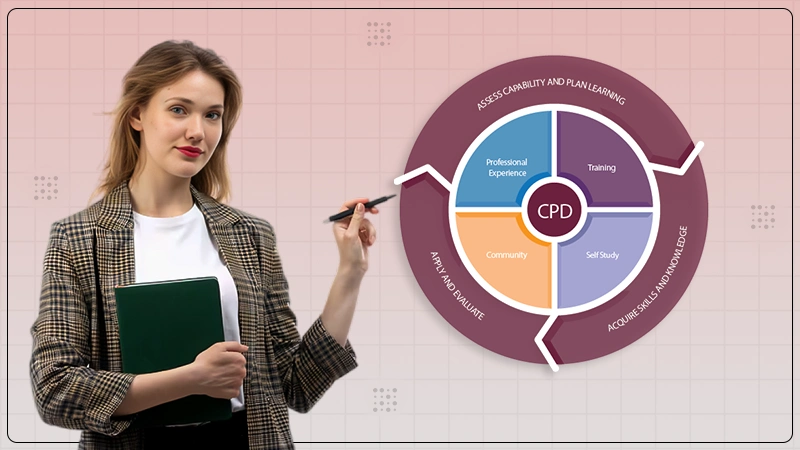
Teaching remains one of the most reputed and most evolving professions, which constantly requires evolution with the times and conditions. Classrooms today are quite different from the classrooms that existed earlier.
Today, classrooms are integrating new technologies and diverse learners, where teachers are expected to bring a change in their academic standards for the betterment of the students.
In such an environment, teachers cannot solely rely on their initial training. They require Continuous Professional Development training that can help them refine their skills and remain relevant and effective. Continuous Professional Development or CPD plays a crucial role in making sure that the teachers not only keep up with the changes but also grow as educators and teachers.
CPD is not just a mandatory requirement now; it is more like a commitment to personal growth and professional excellence. It empowers the teachers to get familiar with the emerging trends and bring the required changes in their methods so that they can respond confidently and creatively to the needs of their students. CPD, if employed as a consistent part of a teacher’s career, creates a foundation for high-quality instruction and lifelong learning.
How Continuous Professional Development Improves Classroom Teaching Quality?
The foundation of CPD is to prepare teachers so that they can create better learning environments. When teachers participate in regular trainings, whether it is through learning communities, seminars, or peer collaborations, they learn how to directly influence classroom practices.
Continuous Professional Development encourages teachers to reflect on what works for them and what doesn’t. The findings can lead to improvements to further make lessons more engaging and coherent, smoother classroom dynamics and stronger student participation.
Keeping up with Changing Curriculum Standards and Policies
Education systems have regularly gone through reforms and introduced updated curricula, changes in assignments and new learning expectations. CPD consists of the tools and understanding required to navigate the changes smoothly.
Practice-based CPD sessions allow the teachers to unpack curriculum updates, realign their planning methods as well and clarify the learning outcomes. Through CPD programs, teachers gain clarity on how they should implement the guidelines in daily teaching without any disruption and confusion. Instead of looking at the directives as rigid rules or policies, teachers learn how they can add them into their lesson design, ensuring consistency across various schools, promoting equality and also execute the new expectations smoothly.
Adapting to New Teaching Technologies and Digital Tools
In digital classrooms today, with new tools, the new normal is emerging, where teachers are expected to utilise a range of sophisticated tools, including interactive whiteboards. While technology offers incredible opportunities, it can be overwhelming for teachers to adapt to the new changes.
Continuous Professional Development can help teachers close this gap and become more familiar with the new tools and use technology with purpose. Moreover, with the increase in hybrid and remote learning environments, the demand for digital fluency has also increased.
Teachers who are trained through CPD programs are efficient in managing virtual classrooms, conducting online discussions and including digital literacy skills in their respective subjects.
Strengthening Subject Knowledge and Instructional Strategies
Experienced teachers can benefit by revisiting their subject-area expertise and adding new discoveries and content developments to their study plan. Through CPD, teachers can improve their mastery of subjects and refine the strategies they use to teach students. Participating in workshops allows teachers to explore updated content, find more ways to make lessons more accessible and deeply analyse the complex topics.
CPD not only improves content but also strengthens the pedagogical skills, helping teachers assess students accurately and support the diverse learning styles. These improvements can drastically increase the teacher’s contribution to deeper student understanding and enhance academic achievement.
Did You Know?
The Ripple Effect Research indicates that Collective Teacher Efficacy has a 1.57 effect size on the success of the students, which is 3x more powerful when compared to socioeconomic status. This shared confidence can be built by CPD.

Supporting Career Progression and Leadership Development
CPD is also a gateway to future opportunities, like the one offered by NPQ qualifications with AISL Academy. So that teachers who dedicate their time to learning and improvement, which often places them in roles beyond the classroom, such as department heads, mentors, coordinators, administrators, etc.
Leadership-oriented CPD enhances communication, team management, decision-making and conflict resolution skills, allowing the teacher to advance professionally. It also enhances the ability of a teacher to collaborate with colleagues, guide students and also handle responsibilities more confidently.
Continuous Professional Development boosts the careers of teachers, as when they feel more valued and capable, they have a clear idea and sense of their purpose and commitment, leading to a stronger teaching workforce.
Conclusion
Continuous Professional Development is not just a professional obligation, but is an encouragement for better teaching, allowing teachers to bring stronger student outcomes and move towards meaningful career growth. Investment in CPD empowers teachers to remain informed, inspired, and adaptable.
CPD ensures that the teaching profession witnesses growth and adapts to new technology, whether it is refining teaching methods or preparing classes using digital tools. Continuous Professional Development can turn out to be one of the best decisions to improve the education system, guaranteeing students’ success.
Frequently Asked Questions
Ans: Definitely not, it not only helps new teachers build foundations but also helps experienced teachers to stay updated and evolve teaching strategies.
Ans: CPD consists of flexible and bite-sized activities such as peer observations, webinars, and reading research, which can be fitted easily into a busy schedule.
Ans: In many cases, yes. Some institutions link pay upgrades to CPD hours. CPD is essential for both promotions as well as higher-paying leadership roles.