Digital technology that was once seen as a boon for society and student growth has now become a growing concern for both parents and teachers.
According to PubMed, approximately 41.3% of students exceeded 2 hours of daily screen time before 2020, which increased to 59.4% after the pandemic.
Following that, parents and teachers must employ strategies such as the ‘Our Generation doll’ for kids and extracurricular activities for students to divert them from digital screens.
While there is no exact formula for all the students, an intentional, purposeful, and strategic balance between screen and life can definitely sort things out.
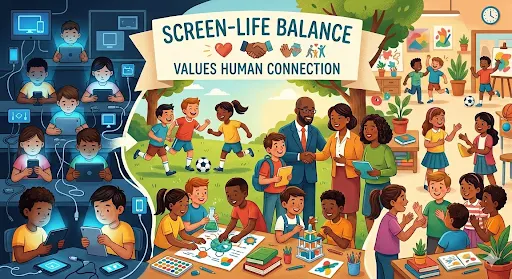
Keep reading to explore how schools can connect with parents and create a balanced culture of screen and life that values human connection.
Key takeaways
- Students who don’t consider breaks while using screens often deal with both physical and mental issues.
- Adopting the right culture and strategies in schools can ensure a screen-free routine for students.
- Physical learning and social interactions boost students’ social skills and even make them perform better in their studies
Why Screen-Life Balance Matters in Schools
In today’s digital world, screens have become a crucial part of students’ daily lives. But always being involved with them can cause various physical and mental health problems.
The students who don’t consider breaks and use screens for a long time often deal with eye strain, memory issues, and bad body posture. And other mental effects of prolonged digital screen usage are the most common ones, including stress, anxiety, and sleep quality.
Apart from the imbalance of natural sleep cycles, prolonged device usage affects how one student interacts with other people and learns about social skills. This indirectly affects their future capabilities to achieve their goals.
To avoid this, screen life balance is crucial in a student’s life.
Surprising Fact
Researchers have shared that the average child aged between 6 and 14 years spends 2.7 hours daily on screens, and nearly half exceed the daily usage limit. This shows how fast digital exposure is becoming a part of students’s lives. (Source: Springer)
Building a School Culture That Supports Screen-Life Balance
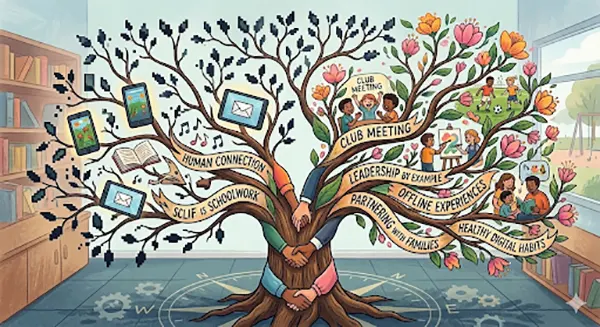
For both teachers and parents, adopting smart strategies and setting the right boundaries is crucial for the management of students’ screen time. Explore these three effective strategies that support screen-life balance in schools:
Leadership Pedagogy: Setting the Right Example
Leaders are the ones from whom students learn. In schools, when principals and teachers prefer a face-to-face conversation over an email, students adapt to it. It is a way to share that human connection matters and is a part of schoolwork.
Other small choices, such as staff meetings to avoid bringing mobile phones into classrooms, supporting mobile-free classroom visits, and celebrating teachers who run low-tech classes, can create an effect.
Classroom Practices to Encourage Interaction
The main idea should not be banning digital screens; rather, it should be about designing lessons that make screens an optional choice. When the activities demand more talking, discussing, and collaboration, students will definitely alter screens.
When students analyze the flow of talking, listening, and then understanding, they get more attracted to screen-free learning patterns.
Encouraging Offline School Experiences
Offline should never feel like a traditional theme of schools. The interactions should be depicted as conscious human interactions. Clubs, sports, social drama practices, community service, and hands-on projects provide an experience and learning that screens barely do.
When offline experiences are more enjoyable and engaging for students, students love to repeat them.
Partnering With Families to Build Healthy Digital Habits
Teachers need to collaborate well with the families of students to ensure the integration of healthy digital habits into the routine lives of students. They should ask parents to:
- Make a family media plan while setting the rules about when to use, how much to use, and how to limit it.
- Create family schedules where there are times when there is high interaction of family members and low interaction with digital screens.
- Begin an open-minded conversation with social media, sharing its pros and cons.
- Organize times when family members watch quality content together. Also, setting privacy settings and security levels.
Practical Steps to Create Better Screen-Life Balance
For students, creating a balance between social life and digital life is crucial to avoid distractions and achieve goals. Here are some practical steps to create a better screen-life balance:
- Setting a healthy daily routine that helps to analyze clearly when to study, when to eat, and when to use a screen. This is putting limitations on your screen time.
- Using tools to manage screen time. We are often unaware of our screen timings. Being aware of it helps minimize it better.
- Involving parents and teachers to add as a surveillance layer. So that you can’t cross limits even when you want to.
- Balancing online friends and real-life friends. A limit should be known to step back.
Conclusion
Enhanced screen time is a harsh reality for today’s school students, but it definitely need not be overwhelming. By using the right strategies, getting students involved in physical actions, making them learn through social gatherings, and other activities, can ensure students understand the importance of screen-life balance.
Furthermore, the screen-life balance that guarantees the appropriate use of screen time is ensured when parents cooperate as required.
Technology is a part of today’s student life, but what makes a difference in its effects is how and to what extent it is used.
Ans: Too much screen time directly affects learning capabilities, sleep, and social skills.
Ans: Schools should organize physical sports, study programs, and social activities to attract users from digital screens.
Ans: Parents should encourage outdoor activities while limiting students’ screen time and support building healthier digital habits.