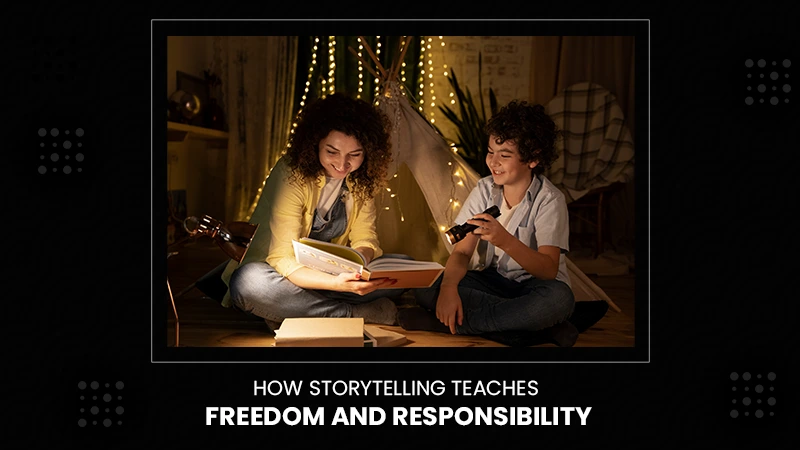
From bedtime stories to classroom read-alouds, storytelling has always played a powerful role in how children make sense of the world. Long before kids can articulate abstract ideas like freedom or responsibility, they encounter them through characters, conflicts, and consequences woven into stories. Children may not yet grasp political philosophy or civic theory, but they can understand why a character’s choices matter, why rules exist, and what happens when personal desires collide with the needs of others.
For parents and educators who care about raising thoughtful, independent young people, storytelling offers far more than entertainment. It provides a framework for exploring moral agency, personal liberty, and accountability in ways that feel accessible and meaningful to children. When used intentionally, stories can help kids develop a deep, lasting understanding of freedom and responsibility that shapes how they see themselves and their role in society.

Why Stories Speak to Children So Effectively
Children are natural storytellers and story listeners. Their brains are wired to learn through narrative, pattern, and emotion rather than abstract explanation. A lecture about “rights and duties” may go over a child’s head, but a story about a character who faces a difficult choice invites empathy and reflection.
Stories work because they place ideas in context. Instead of presenting freedom as a definition, stories show what freedom looks like in action. Instead of listing rules, they demonstrate why responsibility matters. Through narrative, children experience situations vicariously, learning from characters’ successes and mistakes without real-world risk.
This emotional engagement is key. When children care about characters, lessons stick. The values embedded in stories often become part of a child’s internal compass, guiding behavior long after the book is closed.
Freedom as Choice, Not Absence of Rules
One of the most common misconceptions children develop is that freedom means doing whatever they want. Stories are uniquely suited to challenge this idea in a developmentally appropriate way.
In many narratives, characters are given choices. Some choices expand their freedom, while others limit it. A character who uses freedom wisely may gain trust, opportunities, or independence. A character who acts selfishly or impulsively may face natural consequences, such as losing privileges or harming relationships.
These story arcs help children understand that freedom is not the absence of limits, but the ability to choose within them. Freedom comes with the power to decide and the obligation to accept outcomes. This idea is far more compelling when shown through story than when explained as a rule.
Programs like The Tuttle Twins use storytelling to introduce children to big ideas about liberty, choice, and personal agency without overwhelming them. By grounding abstract concepts in relatable adventures, stories help kids see freedom as something active and meaningful, not chaotic or reckless.
Responsibility as Cause and Effect
Responsibility can feel like a heavy word to children, often associated with chores or punishment. Storytelling reframes responsibility as cause and effect rather than obligation alone.
When characters make decisions, stories show what follows. A character who tells the truth may face short-term discomfort but gain long-term trust. One who avoids responsibility may experience escalating problems. Over time, children learn to connect actions with outcomes.
This narrative approach is especially effective because it avoids moralizing. Instead of telling children what they “should” do, stories let them observe patterns. Kids begin to anticipate consequences on their own, which is a crucial step toward internal responsibility rather than compliance based on fear of authority.
Learning Moral Reasoning Through Perspective
Stories also shape how children understand responsibility toward others. By stepping into a character’s shoes, children practice perspective-taking, a foundational skill for ethical reasoning.
When a story presents conflicting needs or values, children are invited to consider multiple viewpoints. A character’s freedom may clash with another’s safety or well-being. These moments encourage kids to think beyond themselves and recognize that responsible choices often involve balancing personal desires with respect for others.
This kind of moral complexity is difficult to teach through rules alone. Stories create safe spaces for children to wrestle with gray areas, guided by narrative rather than judgment. Over time, this builds empathy and a more nuanced understanding of social responsibility.
The Role of Consequences Without Fear
Well-crafted stories demonstrate consequences without resorting to fear or shame. Instead of punishment being arbitrary, it flows logically from the story’s events. This helps children see responsibility as fair and predictable.
When consequences make sense within the narrative, children are more likely to accept them in real life. They learn that outcomes are not about adult control, but about how the world works. This understanding supports healthy independence, as children begin to self-regulate based on anticipated outcomes rather than constant supervision.
Stories that respect children’s intelligence in this way foster trust. Kids feel empowered to make choices, knowing that freedom and responsibility are connected, not opposed.
Storytelling as a Bridge to Civic Understanding
As children grow, stories can gently introduce broader ideas about community, cooperation, and civic life. Tales about groups working together, respecting shared rules, or standing up for fairness lay the groundwork for understanding social responsibility.
Rather than framing society as a set of imposed rules, stories can show it as a network of individuals whose freedoms coexist. Children learn that rules often exist to protect freedom, not suppress it. This insight is crucial for developing thoughtful citizens who value both independence and cooperation.
By encountering these ideas early, children are better prepared to engage with more complex discussions about rights, laws, and governance later in life.
Choosing Stories With Intention
Not all stories teach the same lessons. Some reinforce the idea that authority is always right or that rules are arbitrary. Others present freedom without accountability. Parents and educators play an important role in selecting stories that offer balanced perspectives.
Look for stories where characters face meaningful choices, experience realistic consequences, and grow through responsibility rather than simply being rewarded or punished. Discussion after reading can deepen these lessons, allowing children to articulate what they noticed and how they felt.
Asking open-ended questions like “What choice would you have made?” or “What could the character do differently next time?” encourages critical thinking and personal reflection.
Conclusion
Storytelling is far more than a tool for literacy or entertainment. It is one of the most powerful ways children learn about freedom, responsibility, and their place in the world. Through stories, kids explore choice, consequence, empathy, and accountability in ways that feel natural and engaging.
When children regularly encounter narratives that respect their ability to think and reason, they develop a healthier understanding of freedom as something earned and maintained through responsible action. These lessons, learned early and reinforced often, shape not just behavior but character.
In a world full of complex choices, stories help prepare children to navigate freedom wisely, with confidence in themselves and consideration for others.