
“Understand. Don’t memorize. Learn principles, not formulas.” — Richard Feynman (Physicist)
The Nobel laureate stated the difference between rote memorization and true comprehension. The latter being clearly better than the former.
And the paradoxical truth about perfect memorization is exactly this: Don’t memorize at all. Understand the principles so deeply that you no longer need to memorize formulas.
There are many tips and techniques to do that so that you never forget the chemistry concepts again. A study found that mnemonics saved 50% students on probation from failing. You can go ahead with this DIY method, or an even easier way is to get yourself enrolled in chemistry tuition.
In this article, I’ll list many great methods and techniques you can use to memorize those hard-to-remember chemistry concepts easily. The following sections list methods for visual, active recall, mnemonics, group study, practice, and review.
KEY TAKEAWAYS
- It’s almost impossible to memorise all of the chemistry concepts and formulas in the syllabus.
- Some tips, tricks, and methods can help greatly in this.
- Visual techniques, active recall, and mnemonics are some of the methods, to name a few.
- However, understanding the concept in and out remains the main goal.
Understand the Concept Before Memorising
Memorising doesn’t mean rote learning. You still have to understand the concepts. Once you understand the why of that reaction, be it through visual roadmaps, mnemonics, or active recall, it stays with you for life.
A clear understanding reduces cognitive load. When your fundamentals are clear, you can intuitively predict outcomes. No need to memorise every reaction.
Some practical and effective strategies to achieve that are:
- Creating color-coded flowcharts for reaction pathways
- Using memory palaces for organic chemistry
- Utilizing spaced repetition for formulas
To control cognitive overload, break down complex chemistry into smaller, manageable parts.
Using the method of “chunking”, you can master intricate topics like thermodynamics, organic mechanisms, and chemical bonding like a piece of cake. Focus on just one piece at a time. Of the topic, not cake.
Use Visual Learning Techniques
Visual techniques are very good at clarifying your conceptual understanding of chemistry. These techniques include:
- Drawing 3D molecular structures (ball-and-stick)
- Color-coding periodic table trends
- Creating concept maps to link reactions
Even mnemonics are a visual instrument in a way. “LEO the lion says GER”. Painted a picture in your mind, right?
Visual tools and storytelling transform abstract formulas into memorable, organized mental images.
Practise Active Recall
Active recall means retrieving information from memory. 80% of students who use active recall report improved retention, showing that retrieval practice converts fragile familiarity into durable memory pathways.
To identify knowledge gaps, do self-testing through:
- Flashcards
- Blurting (writing down everything remembered about a topic)
- Mapping organic reactions
- Teaching concepts aloud
Mnemonics also help in memorizing chemistry concepts efficiently.
For example, the mnemonic “OIL RIG” is used to remember the definitions of oxidation and reduction in redox (reduction-oxidation) reactions. It stands for:
- Oxidation Is Loss (of electrons)
- Reduction Is Gain (of electrons)
See how mnemonics turn complex rules into memorable phrases.
On the other hand, you can also create personal memory aids through active writing, flashcards, stories, and visuals.
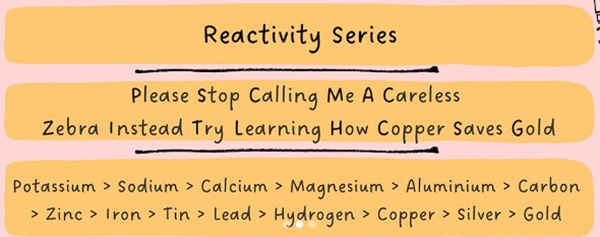
Here’s another mnemonic for the Reactivity Series:
Use Practice Questions to Reinforce Learning
Practicing past paper questions can also reinforce your chemistry understanding. Make sure to do that under timed conditions. The topics that take disproportionate amounts of time are your weak areas.
Again, the focus should be on understanding mechanisms instead of memorizing equations. And then try to apply those learned concepts to solve problems in exam questions. This becomes a loop: improving your overall subject understanding while you retain the specifics.
With this practice, you also get used to the exam format.
Review Concepts Regularly
Spaced repetition is a great method for memorizing chemistry concepts effectively. It involves reviewing topics again and again at increasing intervals (1 day, 1 week, 1 month).
There are two iterations of the method that are popular among students:
- 2-3-5-7 Method: Review a new topic in 2 days, then 3 days, then 5 days, and finally in 7 days to solidify memory.
- 7-3-2-1 Method: Review the material today, then in 2 days, then 3 days, and finally 7 days.
For simplicity, you can schedule your revision on weekends. First, diagnose your weak points to know where most of your revision time should go. Harder topics should be reviewed more frequently (4-5 times); you can have longer intervals for the ones you know well (2-3 times). Block multiple short (20-40 minute) time periods for the revision, instead of a long single marathon. For better revision planning, work backwards from your exam date.
Study with Friends or Discussion Groups
Collaborative methods like studying difficult topics in study groups are also good. It doesn’t matter if you’re on the teaching end or learning end; the topic understanding gets strengthened regardless.
To make it fun, use quizzes or flashcards to test each other’s knowledge.
In group study, you get to hear alternative explanations of topics. Who would stick with a difficult explanation when you get an easier one? Solving problems together makes memories with your peers, and the concepts also get memorized at the same time.
But ensure that the group study agenda is clear from the get-go, or else you can fall into the trap of passive, ineffective study sessions.
Final Thoughts
Even a single chemistry formula is so hard to grasp, and then there are numerous formulas to memorise. It’s almost impossible and a fool’s errand to try to remember them in the traditional rote learning fashion.
Methods like visual tools, active recall, and mnemonics make it practical to understand all the chemistry concepts with ease. If it feels a little overwhelming, it’s highly recommended to get yourself enrolled in a coaching like Mavis Tutorial Centre.
Wishing you an effortless journey through the Periodic Table! You’ve got this.
FAQs
Ans: Use different swords for different chemistry monsters: mnemonics for the periodic table, acronyms like OIL RIG for reactions, and stories for complex formulas.
Ans: For formulas, practice active recall using flashcards and also use mnemonics. Yet, focus on understanding rather than rote memorization.
Ans: Master your syllabus, consistently revise, and practice previous years’ questions.
Ans: Use the mnemonic phrase: Hi He Likes Beer But Could Not Offer Full Nine, Naughty Maggie Always Sings Perfect Songs Clearly Around Kind Cats.