When all the sectors evolve simultaneously, the need for new and better technology becomes obvious.
This is where modern engineering comes into play, catering to the demands of innovation along with precision.
The global market today is not just driven by the supply forces and quantity demanded, but also is moving towards the idea of customer satisfaction, which has become the core ideology for any business flourish.
This simultaneously impacts engineering as a profession, as well as drives individuals in it to focus more on business and customer problems and not just isolated innovations.
Read further to know how this happens!
Key Takeaways
- Modern engineering analyses the complexities in the technological system and analyse hoe to deal with it
- Thetrends of engineering are changing, turning from a technical outlook to a customer-centric and business-oriented one.
- From technical skills to real-world problem solving, the skills that make you a business-demanding engineer
- Studying the rising demand patterns for engineering roles that are business-aligned.
Increasing Complexity of Modern Technology Systems
Modern AI and cloud-based systems are robust and solve many business problems, yet they are considerably difficult in practise.
Some of the real-world deployment challenges include:
- AI Deployment Challenges: AI models behave differently with real customer data instead of ideal behaviour. Even drift, latency issues, and integration failures are commonly occurring in the sector.
- Cloud and Enterprise System Integration: Companies operate mostly on fragmented systems like ERPs, CRMs, custom APIs, and legacy databases. Thus, integrating them becomes challenging.
Hence, there’s a need to meet with the real-world complexities.
It should cater for the needs of :
- Limited infrastructure
- Inconsistent data formats
- Compliance policies
- Security guidelines and
- Operational workflows.
So, companies need engineers who are proficient in applied engineering, yet are equally efficient in other aspects as well.
Engineering is becoming more business and customer-centric
With the evolution of the modern markets, modern engineering is not just limited to the soft skills of coding and debugging, but is also focused on a customer-centric outlook.
The core reason behind this idea is to build a system as per the business goals and customer requirements.
This involves a series of procedures such as :
- Workflow mapping
- Feedback mechanism
- Holding important discussions
- Having stakeholder conversations, etc.
Customer feedback has turned into an important part of engineering models, because it not only reflects the satisfaction of the customer but also traits such as architecture choices, data modelling decisions, and other integration strategies as well.
Thus, the engineering role is now transitioning to FDEs, AI, and applied systems engineers who bridge the gap between technology and business decisions.
Why Software Engineering Skills Alone Are No Longer Enough?
In a tech-savvy world, just having high-end technology doesn’t make sense; it is the practical applications and advantages of the technology that businesses look for.
Therefore, the modern systems require engineers to build technology that aligns with their business goals, which means having just the software skills won’t work.
Besides, companies need professionals who provide ROI, value provision, system adoption, and understand customer constraints, as these influence engineering choices.
This makes alignment of the soft skills with other qualities as well equally important and necessary.
Forward Deployed Engineer vs Software Engineer
The difference between forward deployed engineer and software engineer lies in the factors under considerations such as customer interaction, output, success metrics, etc. As can be seen in the table :
| Factor | Software Engineer | Forward Deployed Engineer |
| Focus | Coding and updates | Implementation and outcomes |
| Environment | Internal engineering setup | Real-world customer systems |
| Responsibility | Technical delivery | Technical and business alignment |
| Output | Features, code | Deployment, working solution |
| Success Metric | Deplpoyed | Value delivered |
Skills Needed for Engineers Working on Business Problems
To work successfully in rewarding careers, engineers now need a comprehensive skill set where both technical and non-technical skills matter. These include:
- Technical Skills: Engineers require a grip on technical knowledge. Followed by the knowledge of software engeenering they must have the knowledge of cloud architecture, system design, APIs, etc. Additionally, proficiency in debugging and optimisation is essential.
- Business and Communication Skills: An ideal technicalexpert is one who can explain it to the non-technical audience.
Thus, having good business acumen and communication skills, along with the credibility to meet the stakeholders’ expectations, is a plus.
- Systems Thinking and Real-World Deployment: Another important quality that is required in engineers is the ability to map workflows, analyse the constraints, and create strategies for development.
- Real-World Problem-Solving: Modern engineers should diagnose issues under pressure, adapt to diverse environments, work with incomplete data, and yet make quick decisions and be responsible for those.
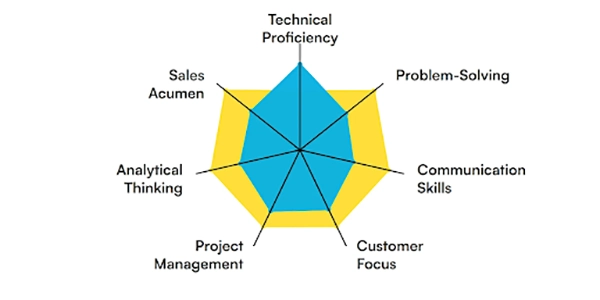
Such skills are now shaping the next generation of engineering careers. The other skills required can be seen in the infographic :
Growing Industry Demand for Business-Aligned Engineering Roles
Enterprises are adopting AI and automation much more rapidly owing to convenience, cost-cutting, and better outputs.
Thus, the demand for business-aligned engineers is increasing who can:
- Manage complex rollouts
- Work for business and technical domains simultaneously
- Integrate systems under pressure
- Ensure the deployments provide measurable value
Firms involved in AI, automation companies, cybersecurity product firms, enterprise SaaS, logistics, digital infrastructure, and e-governance need such modern engineers.
As structured learning ecosystems emerge around applied engineering, institutions like FDE Academy are focusing on preparing engineers for deployment-centric roles.
Final Words
With a change in the sectors and evolving mechanisms of AI and other technical software, the expectations from engineers have also evolved.
From just being good at software skills to enhancing customer experience, having the knowledge of AI, and building innovations as per requirements and use.
Therefore, to excel in this massive change, it is important to have a hybrid skillset and meet the business goals.
Ans: The biggest problem facing engineers today is likely to be the work shortage posing livelihood risks, the problem of risk management, and knowledge transfer.
Ans: Engineers play an important role in analyzing the existing processes and finding innovative solutions.
Ans: Modern engineering plays an important role in designing structures, technology, and creating new inventions.
Ans: Computers can prove to be helpful in building designs, controlling manufacturing data, and other areas as well.