“The heart of nursing is found in the hands, but the mind must be trained wherever it finds a spark.”
Nursing school is not just about textbooks and hospital hallways. The medical education landscape has shifted rapidly to meet the new needs of a digital world.
According to the American Association of Colleges of Nursing (AACN), there are now 964 schools of nursing reporting data on their baccalaureate and graduate programs. This illustrates a massive national infrastructure designed to move theoretical learning beyond traditional classrooms.
However, the question is how do you learn to save a life from a laptop? You might worry that clicking through a module won’t prepare you for a 12-hour shift in the ER.
This article explores the high-tech world of medical training, showing how future nurses prepare for their clinical rotations and transition from their living rooms to the bedside with confidence.
Key Takeaways
- Success comes from combining digital theory with physical practice.
- VR and simulations allow for ‘safe’ mistakes before attending to real patients.
- Clinical hours are usually completed right in your own community.
- One-on-one guidance remains the gold standard for skill mastery.
The Blended Model of Nursing Education
The modern approach is not strictly online or offline; it is a seamless blend. You master the pharmacology and anatomy through interactive portals, that let you focus your energy on the physical demands of the job.
By selecting online nursing programs, you gain the flexibility to study theory even at midnight so that you can be fully present at the clinic at 6:00 AM.
You can learn at your own pace and dive deep into the ‘why’ behind treatments. Flexible scheduling also allows you to balance work, life, and your calling.
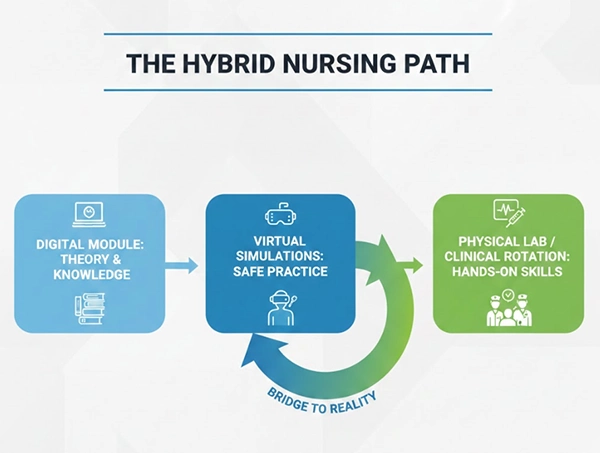
The visual illustrates how your digital curriculum feeds directly into your hands-on training.
Virtual Simulations as a Launching Point
Even before you touch a patient, you are likely to treat a digital one. Virtual Reality (VR) and screen-based simulations allow you to rehearse.
These tools challenge your decision-making speed without the risk, helping you, as a future nurse, prepare for clinical rotations by sharpening your diagnostic eyes.
- You can see how one wrong choice can affect a digital patient’s vitals.
- Learn from your errors in this controlled and stress-free environment.
Local Clinical Placements
You might be wondering whether you need to travel to the university’s home base. Usually, the answer is no. Most of the online programs partner with medical facilities right in your zip code.
This localized approach allows you to build professional networks right where you live. By securing clinical spots nearby, you can get hands-on experience in familiar environments.
This ensures that your training is both high-quality and convenient for your daily life.
Did You Know?
Most accrediting bodies need at least 500 to 900 clinical hours for a nursing license, regardless of whether your degree is online or offline.
Skills Labs and Intensives
Online tools surely are great, but some things must be done in person. Many programs host intensives, weekend marathons where you fly in or meet at a regional hub for real-life experience.
You get to practice IV starts, wound care, and physical assessments on high-fidelity mannequins that breathe, cry, and even give birth. These sessions turn knowledge into muscle memory.
It ensures that when you finally step into a hospital, you don’t hesitate and your hands perform the tasks with required precision and confidence.
Fun Fact: The first nursing school was established in 250 BC; however, only men were considered ‘pure’ enough to attend.
Preceptorships and Mentorship
You’ll get paired up with a ‘Preceptor,’ a seasoned RN who closely watches your every move.
This mentorship bridges the gap between a student and a professional. It shows you exactly what it takes to handle the daily challenges of nursing life.
Your mentor provides you with real-time feedback and clinical wisdom that no textbook can replicate. This will help navigate complex patient care with a steady and guided hand.
Community Engagement and Public Health Projects
For real-world experience, it is not necessary that you go to a hospital. You may find it at a local flu clinic or a school health fair. These projects will teach you the ‘social determinants of health,’ understanding that a patient’s environment is as important as their chart.
Your neighborhood interactions teach you to represent different community groups while delivering complete health solutions that treat underlying health conditions.
Professionalism in a Digital Age
The process of studying through online platforms helps you develop a hidden skill, which is digital fluency. It helps you navigate digital content smoothly. Your skills provide you with a competitive edge as hospitals are transitioning towards 100% electronic health records (EHR) and telehealth systems.
You are already familiar with the art of visual collaborations and data management, which serve as essential tools for operating modern smart-wards.
Your technical expertise enables you to handle software issues efficiently, allowing you to dedicate your time to more important things like ensuring your patients’ well-being.
Challenges of Distance Learning
Distance learning presents various challenges for the students. The absence of a physical classroom requires you to show self-discipline and be concentrated throughout your studies.
- Success in a remote environment demands a higher degree of self-regulation and proactive engagement.
- Time management is essential, and so is setting boundaries so that your coursework doesn’t completely overwhelm your personal life and mental health.
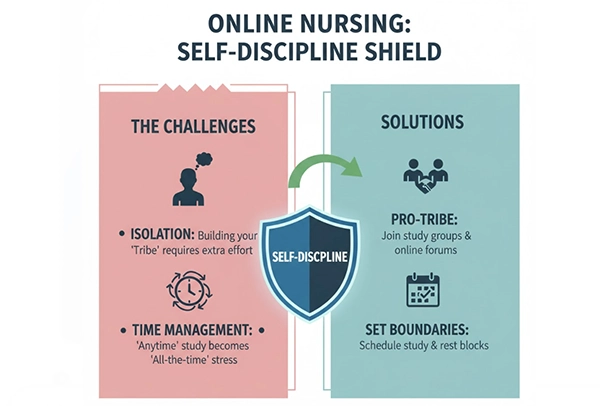
Mastering these challenges and creating a self-discipline shield, as shown in the image, will transform online learning into a superpower for your mental health and academic success!
Final Results: Competent, Confident Nurses
By the time you sit for the NCLEX, you are not just someone who studied online. You are a clinician who has logged hundreds of hours in the real-world, backed by the best technology education has to offer.
This unique combination of digital mastery and hands-on grit makes sure that you step into your first professional role ready to lead, heal, and excel.
FAQs
Ans: Schools provide placement coordinators who will help you in finding local clinical sites.
Ans: Yes, accredited degrees are treated exactly like traditional ones.
Ans: No. Clinical rotations must be performed in person with a patient.