
The only long-term financial market that most of the people are invested in, knowingly or unknowingly, is property and real estate. For most of the Americans, their house is the largest asset they own.
That being said, many people also enter this market proactively in order to make some profits. Unfortunately, most of them possess considerable confidence but limited knowledge.
Just the knowledge of prices isn’t how you win this game. It requires much more: knowing how value increases or decreases, how markets function, and how important timing the trades is.

In this article, we will talk about all this, so you can enter the property and property market with enough confidence and knowledge, so that it doesn’t add to your debts.
KEY TAKEAWAYS
- Property is a financial asset, probably your largest one.
- To play in the property market, you need to be literate about: valuation, supply-demand, timing, and transaction structure.
- You should also learn risk management and predicting market behaviour.
Property as a Financial Instrument
Your home is not just a shelter; it is a financial asset with inputs, outputs, and risk. Purchase price is only the starting point. Ongoing costs, opportunity costs, and liquidity all shape real value.
Key financial components include mortgage structure, interest rates, maintenance expenses, taxes, and insurance. These variables determine net cost over time. Ignoring them leads to distorted assumptions about appreciation and return.
Property should be evaluated the same way as any long-term asset. With discipline. With data.
How Market Value Is Actually Determined
Market value is not an intrinsically fixed metric; it can be estimated only through negotiations. Prices are set at the margin, based on recent transactions between willing buyers and sellers.
Comparable sales matter more than asking prices. So does timing. A home’s value can shift materially within months due to interest rate changes, inventory levels, or buyer sentiment.
Liquidity also matters. Property is illiquid by nature. The ability to exit quickly often requires accepting a discount. This reality shapes strategic decisions, especially during transitions.
For homeowners prioritizing speed and certainty, working with cash home buyers in Phoenix is one way to reduce market exposure and eliminate financing risk. Cash transactions compress timelines and remove common points of failure, such as appraisals and loan approvals.
The following infographic lists the things to check if you want to calculate the valuation of a property yourself:
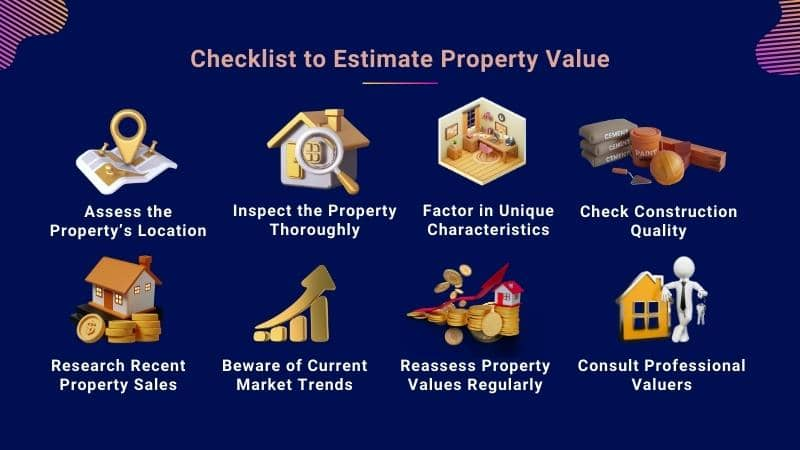
Alt: Checklist to Estimate Property Value
Understanding Supply, Demand, and Constraints
Real estate markets are primarily local, but national and global forces do have a slight influence on them. For example:
- Interest rates affect affordability.
- Employment affects demand.
- Zoning affects supply.
Supply is slow to adjust. Construction takes time. Permits lag demand shifts. This creates cycles. Shortages push prices up. Oversupply pushes them down.
Demand is more elastic. It responds quickly to financing conditions and economic confidence. When rates rise, demand often drops before supply adjusts.
Understanding this imbalance helps explain volatility.
Market Timing Versus Time in the Market
Market timing can seem confusing, even daunting. But nobody can indeed predict exact peaks or bottoms. However, you do get a sense of whether conditions are favorable or unfavorable.
High transaction costs make frequent trading inefficient. However, ignoring timing entirely is also costly. Entry and exit points affect leverage, cash flow, and risk.
Practical timing considerations include:
- Interest rate trends
- Inventory levels
- Days on market
- Buyer competition
- Local employment signals
These indicators guide decisions without requiring speculation.
Valuation Beyond Price Per Square Foot
The popular metric of price per square foot can sometimes seem to be an insufficient tool. And why now, it clearly ignores many important property aspects such as:
- Layout
- Condition
- Location quality
- Functional obsolescence
True valuation considers usability. Floor plans. Deferred maintenance. Energy efficiency. Renovation potential. These factors affect buyer perception and future costs.
Investors and informed homeowners adjust price expectations based on these variables. Casual buyers often do not. Education closes this gap.
Transaction Structure and Risk Management
You can arrive at a fair final price only by going through all of the transaction phases properly. The structure needs to be foolproof, otherwise:
- Financing contingencies introduce risk.
- Appraisals can fail.
- Inspections can derail deals.
Cash transactions reduce these risks but may trade off some upside. Traditional listings may maximize price but increase uncertainty and time on market.
Risk tolerance should guide structure. There is no universal best approach. There is only alignment with objectives.
Behavioral Factors in Property Decisions
When it comes to financial decisions, most of us can get influenced by our hearts rather than our brains. And in case of tangible asset classes like property, to which most of us get attached, emotions run even higher:
- Anchoring to past prices.
- Overvaluing improvements.
- Fear of missing out.
These biases distort judgment. But markets do not reward emotion; they reward clarity.
Education helps separate signal from noise. It encourages decision-making based on fundamentals rather than headlines or anecdotes.
Learning Through Small, Practical Signals
You get practical knowledge through observing small details in the big picture, such as:
- How long do listings sit?
- How do prices decrease?
- How do buyers respond to minor changes?
Even everyday objects reflect this thinking. Lower in the learning stack, items like custom coasters are sometimes used in real estate offices or training settings as subtle branding tools. They reinforce presence without permanence. Like staging, they influence perception at low cost.
Details matter. In markets and in messaging.
Property as a Long-Term System
Property ownership is not a once-and-for-all decision. It is a system of things to do spread over a long time period:
- Financing.
- Maintenance.
- Market cycles.
- Exit planning.
Practical education connects these elements. It replaces assumptions with structure. It reduces surprise.
Those who understand property as a system make fewer reactive decisions. They plan exits earlier. They manage risk better.
Building Real Market Literacy
Just like all markets, property market also rewards informed players. Not optimists or pessimists: Informed actors.
Understanding property, value, and timing is not about speculation. It is about control. Control over outcomes. Control over risk.
That literacy is practical. It is learnable. And it pays dividends far beyond a single transaction.
Conclusion
In conclusion, I want to say that property is your most important financial asset, as most probably it’s the largest one you own.
But to properly play in the property game, you need to have considerable knowledge about: valuation, supply-demand, timing, and transaction structure.
Before entering the market professionally, you should also learn risk management and how market players behave to predict the same.
Ans: The four types of properties are: residential, commercial, industrial, and raw land.
Ans: You can find the current market value of a property by analysing recently sold similar properties in the area or checking government circle rates. Hiring professional appraisers is a good option for accurate estimates.
Ans: The 333 rule in real estate states that you should limit your property search to just 3 neighbourhoods, 3 houses per neighbourhood, and 3 aspects/priorities (e.g., location, price, size, etc.)