“Success is the sum of small efforts, repeated day in and day out.” – Robert Collier (American Author)
In a busy clinic, split-second decisions rely on instinct and not on textbooks. The process of professional practice allows healthcare workers to develop the physical skills that are required for accurate patient treatment.
You need to develop a method to transfer your knowledge into ability if you want to become a trustworthy professional. CCMA practice tests are the most effective way to gauge readiness. They act as a mirror that reveals knowledge gaps and reflects your standing before you encounter the actual high-stakes exam.
Key Takeaways
- Consistency will help you achieve; daily short sessions beat occasional marathons.
- Use practice tests, hands-on drills, and flashcards.
- Analyze your errors and treat every wrong answer as a roadmap to improvement.
- Simulate conditions; train your brain to handle the clock well
Understanding the NHA CCMA Exam
To conquer this hurdle, you first need a clear map of the territory you are about to cross.
What the Exam Covers
The NHA CCMA exam puts 150 questions in front of you to test your knowledge of clinical procedures, law, and administration. You need to master vitals, EKG placement, and phlebotomy to become a versatile healthcare professional.
Getting the 390 passing score confirms your clinical readiness and professional competence.
Did You Know?
Research shows that ‘active recall,’ which means testing yourself, is up to 300% more effective for long-term retention than passive reading.
Why Preparation Goes Beyond Reading
Healthcare requires interactive components, which makes hands-on practice essential. The students need to move beyond textbooks and experience real-world situations to learn patient positioning and clinical skills.
This ensures that you provide high-quality care with confidence when every single second counts.
The Power of Repetition in Learning
Repetition and the ‘Spacing Effect’ bridge the gap between theoretical knowledge and clinical action.

- Reinforcement Builds Confidence: Initial practice quizzes often cause anxiety; however, by the 10th attempt, anxiety is replaced by familiarity.
This repeated exposure helps you build confidence and competence, ensuring that you enter the testing center calmly.
- Muscle Memory and Skills Retention: Repetition encodes patterns such as dosage calculations into long-term memory.
This prevents knowledge from evaporating as soon as you close your books, ensuring that you retain your vital clinical information.
- Identifying Weak Areas Early: Frequent testing identifies your weak spots, such as pharmacology, allowing you to focus on difficult topics instead of familiar ones.
This targeted strategy is how you become confident and skilled for your exam day.
Making Practice Effective
Not every practice is the same. If you mindlessly go through the questions, you will not get the results you need. To succeed, you require a structured approach.
Schedule Consistency
You need to treat your brain like a muscle. Instead of an eight-hour cram session, you should set a daily 30-minute practice appointment.
Consistent and short-burst repetition is more effective for long-term retention than marathon studying, which allows your mind to properly absorb and store complex clinical concepts.
Simulate Real Exam Conditions
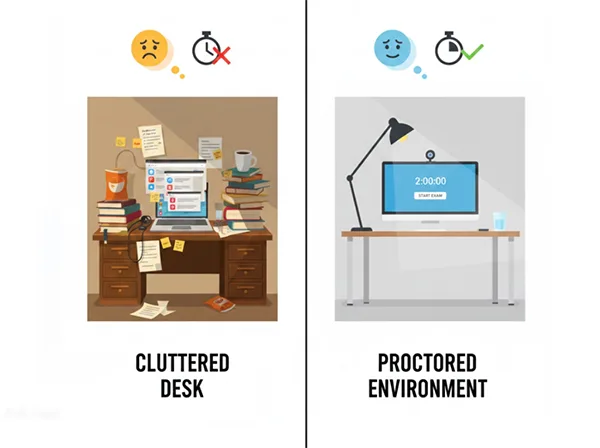
Clear your desk and set a timer! Practicing under realistic conditions builds stamina, sharpens your focus, and prevents late-exam fatigue errors. This ensures that you remain precise and alert when you are actually solving the most challenging 150 questions of the certification marathon.
A cluttered desk has a different impact than a proctored environment, as visible in the image.
Mix Theory and Practical Practice
Mastering the CCMA needs diverse tactics. You can use flashcards for terminology and to revise things through teaching, and you can also join study groups.
Focus on clinical simulations and practice drawing vitals till they become your second nature. Also, mentally list the procedural steps to comprehensively shift your approach from passive reading to professional clinical instinct.
Common Mistakes to Avoid
Don’t mistake familiarity for mastery. Acknowledging an answer is not the same as recalling it.
- Make use of multiple platforms to master varied question phrasing.
- Use flashcards to move beyond passive recognition and learn actively.
- Find out the ‘why’ behind every answer and build a habit to analyze things.
- Resting is essential for daily learning.
Fun Fact: After WWII roles, medical assistant roles surged to help doctors manage the massive influx of returning veterans.
Turning Practice into Confidence
Ultimately, repeated practice will make you feel like the exam day is just another day of your life, and you won’t feel stressed. This will happen when you are already familiar with all the material, and you won’t be afraid of the ‘unknown.’
You are no longer just a student; you are preparing to become a medical professional; therefore, you need to prove your worth through clinical excellence and confidence.
FAQs
Ans: Generally, yes. A basic calculator is provided for dosage calculations required.
Ans: At least 3-5 full-length tests should be taken throughout your study weeks.
Ans: CCMA focuses more on clinical skills, whereas other certifications lean heavily into administrative tasks.