“Online learning is not the next big thing, it is the big thing”.
-Donna J.Abernathy(Author and Researcher)
The easier it is to spend, the harder it gets to earn. Ever wondered why a course with similar content looks expensive for you and cheaper for others?
Well, your answer is that many learners pay more for online courses because they simply don’t know when and where to find the best deals. Others, leading you to go straight to the market, influence rates over real prices.
And you get charged extra for the same knowledge as others.
Sounds frustrating? No worries, just some key points to recall, and you are all set to combat the online learning deals!
Key Takeaways
- Price differences in online courses.
- How platforms influence what you pay.
- Timing your enrollment to reduce costs.
- Making the best use of deal platforms
- Alternatives for learning
- Avoiding overpayment through evaluation.
- Making smart decisions without rushing
- Building a long-term strategy.

Why Online Course Prices Differ So Widely
With time, online education made a strong foothold in the system, due to which today we witness the diverse changes in prices from affordable options to courses that could cost you a fortune.
And because of this price differentiation, it becomes important for everyone seeking knowledge be well aware and understand how course platforms influence what you pay.
How Course Platforms Influence What You Pay
Different platforms have their own way of influencing you to buy from them, such as through subscriptions, one-time payment models, collaborative schemes, etc, that require you to pay for these courses on price quoted without hesitation.
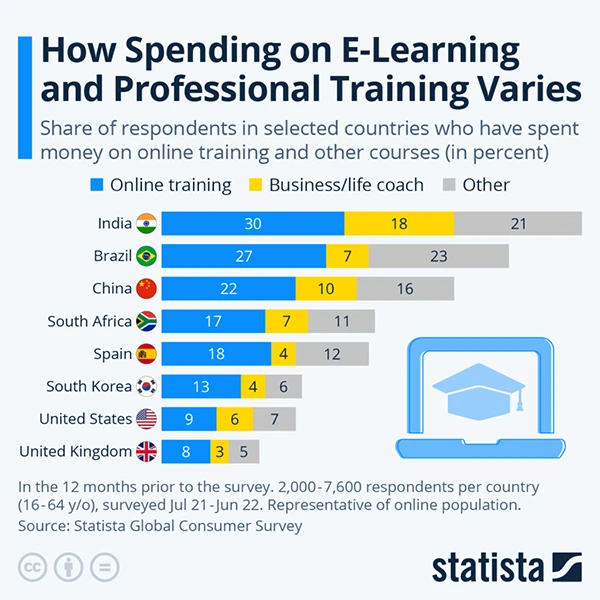
This could be best understood with the infographics that show spending on E-learning within different countries.
Timing Your Enrollment to Reduce Costs
As we get away with the platform’s influence on what we pay, the next big problem is how to reduce the costs of your enrollments.
This requires a smart and tactical solution, such as utilising festive cards, new user coupons, and bringing in loyalty cards. Also, SaveMyCent could be your go-to option.
Another bonus act could be making the best use of the deals!
Using Deal Platforms the Right Way
Discounts are everyone’s favourite, so here are some catches you could utilise for securing your discounted course.
Free coupons, percentage-based discounts, fixed amount discounts, gift offers, special day discounts, etc.
Optimising proxycoupons could save you great deals as well, with discounted prices and great offers.
Fun Fact 70% of teachers polled said they saw an increase in student engagement when using educational video games.-(Research.com )
Alternative Ways to Learn Without Paying Full Price
Budget is one of the greatest constraints for online learners, as some courses appear very expensive.
In such cases, you can apply some hacks, like looking for scholarships, going for an offline book bundle, or making your employer pay for it if it makes you a better employee.
Another aspect to consider is evaluating the real value by checking its credibility and analysing whether it aligns with your job or educational goals to avoid overpayment.
Avoiding Overpayment by Evaluating Real Value
In order to extract the real value of online courses, you must consider checking their practical applications in your life, and analysing the costs on different platforms, followed by a cost comparison for the same course.
This could help you with saving money and ensure optimum utilisation of every penny.
Making Smart Decisions Without Rushing
In order to make smart decisions, you must ensure identification of the decision, gathering information, considering alternatives, choosing the best option, taking action and finally reviewing your decision.
It helps you compare and make a wise choice. Similarly latest SaaS courses equip you with the important software to enact in the necessary way possible at a reasonable price, ultimately helping you to make a smart choice.
Building a Long-Term Learning Strategy
Building a long-term learning strategy could make you one of a kind in the crowd.
And it is a piece of cake that could be attained with just a few steps, such as establishing a productive learning environment, setting a schedule for assignment completion, and seeking virtual interactions with your peers.
These steps could not be proven useful in a long-term learning strategy, but will also help you attain your future goals.
Conclusion
Online learning can be a win-win situation when you entail planning with learning because smart work goes a long way.
So, make your days count and years worth. Happy learning!
FAQs
Ans: Yes, many schools do offer this option.
Ans: Many degrees, such as Bachelor’s or Master’s, take equivalent time as in-person degrees, whereas others could offer you a flexible range.
Ans: No, most online degrees hold the same accreditations as an offline degree.
Ans: Instructors are required to give the same amount of time and energy to online students as they would to in-person students.
Ans: Yes, online resources could help you in tutoring resources and materials, attain knowledge and be successful.