
The changing digital landscape has significantly reshaped how learning is delivered and consumed. Today, digital evolution in technology has definitely improved learning and made it much more effective, easier, and faster.
But when the same technology is misused and becomes responsible for building unethical strategies, learning gets drastically manipulated.

Supporting the same, research by ScienceDirect found that without teacher guidance and defined pedagogical strategies, tech tools can’t reliably develop skills. This shows the importance of pairing a strategy to deepen understanding.
Keep reading to explore why strategy must lead technology in modern learning.
Key Takeaways
- Technology becomes more powerful when it has a clear purpose driven by effective strategies.
- More tools do not guarantee better learning, but the right use of tools definitely does.
- An effective strategy ensures the right use of investment of time, money, and effort.
Why Strategy Matters in Modern Learning
Strategy serves as the foundation of any successful learning advancement that actually drives how effective the outcomes will be. It shares the true meaning of various available tools, platforms, and complex technologies for modern learning.
Just adopting a new tech won’t provide better results. And that’s exactly where tools like OneAdvanced ensure the real goal is served properly. Hence, it helps to merge proven learning methods with engagement.
Also, mentors and teachers can build strategies to guide learners effectively to avoid wasted efforts and confusion while learning.
How Strategy Actually Drives Learning Outcomes
To learners, strategy might look like a superficial thing in modern learning. But in reality, experienced users know the true difference in results after relying on an effective strategy. Let’s explore some of the common ways to drive outcomes:
Defining Clear Learning Goals First
Before depending on any tech, first ask a common question to yourself – What is my true goal behind using it? Moving forward with the technology without having clear goals is like going grocery shopping to buy a sports car.
While it might look fancy and attractive, the end result will not fulfill the desired goal. And this is the reason why many researchers have shared the improvement in outcomes when defined objectives are used.
Aligning Tools with Real User Needs
Fascinating or aesthetic tools don’t mean the platform is fit for every learner with a different pace. Every tool is designed to help a specific range of students. So, it’s better to understand the needs and the objective behind the tool or tech; if that seems to match your pace and learning pattern, then only go for it.
Otherwise, the output or the results may vary greatly from what is mentioned or promised by the tools or the technology.
Measuring Success Beyond Adoption Rates
High adoption does not guarantee high impact. A solid strategy is what defines the real outcomes, such as mastery of a skill or retaining knowledge. If the results are considerable and metrics are really visible, then only rely on that specific technology to boost your learning.
Common Risks of Ignoring Strategy
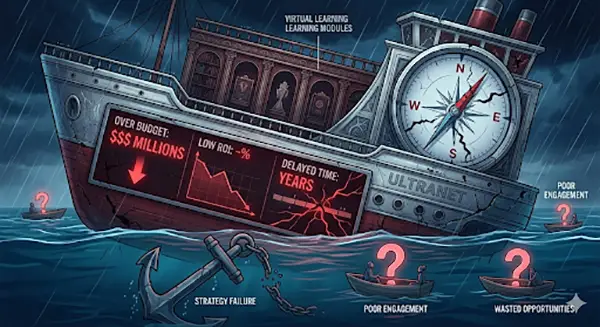
Moving without a strategy or ignoring a strategy is the same as setting sail without a compass: the speed might be attractive, but the direction may not be correct. In modern learning, this often comes across as a waste of resources and potential.
Let’s explore two of its major disadvantages:
Wasted investments and low ROI
Many organizations have spent millions on platforms that were never used by them, or they were not capable of serving the real-world learning goals. Along with the cost, wasted investments also include time, efforts and lost opportunities.
Surprising Fact
Australia’s Ultranet LMS project exceeded its budget limit significantly with minimal adoption because strategic planning was their second thought. (Source: Wikipedia)
Poor engagement and retention
Even the most interactive platforms fail to serve their true meaning if the learners don’t see the real value. Engagement driven by aesthetics often fails early, while with strategic alignment, technology can serve actual understanding with high retention.
Turning Technology into a Strategic Advantage
Technology becomes more powerful when it has a clear direction. Choosing the right tool, matching it with your real-life goals, and continuously improving based on the results turns tech from a simple tool to a reason for success. In fact, companies that align technology with strategic goals are 2.5x more likely to achieve their goals.
When strategy leads things, every feature and every engagement becomes more meaningful and fruitful. In learning, technology can answer questions, but when it is intentionally used, it supports smart decisions and true outcomes.
Conclusion
Modern learning is not just about having the advanced tools—it’s about making those tools work with clear objectives. Technology without a strategy might seem attractive and appealing, but it often fails to serve the expected results. By considering a strategic approach in technology for learning, it ensures the investments are meaningful, and learners stay engaged for a long time.
Hence, strategy is the driving force that transforms technology from a regular helping agent to a true partner for learning. When leaders adapt to technologies integrated with strategies, learners get a great opportunity to improve and bring impact.
Ans: Yes, using too many tools without having the required clarity, the learner gets overwhelmed and reduces focus.
Ans: If learners are understanding better or saying they are engaged, it means the tech is working properly.
Ans: It means deciding your goals first, then choosing tech that actually helps you reach them