As the emergence of AI has transitioned into a trend, everything has changed, including how students study and focus on their academics. A 2025 HEPI survey found that 88% of students have used GenAI for assessments, and 92% use some kind of AI tool.
Due to the robust availability of these utilities, every complex pattern of syllabus becomes easy to understand. When exams are right above your head, you need study help that’s accurate and course-specific.

This is where a study-focused platform like Studocu can help. In this blog post, we are going to closely analyze how Studocu combines AI tools with a large library of 50M+ student-shared documents, used by 60M students each month.
Let’s begin!
Key Takeaways
- Understanding why generic chatbots can give wrong or “off-syllabus” answers.
- Exploring how Studocu AI stays closer to your course materials and study context.
- Looking at the benefits of mock exams, pushes active recall with quizzes + instant feedback.
- Uncovering how the student library helps fill gaps when your notes aren’t complete.
The Problem with “Generic” AI in Education
To see why study tools can feel more useful than generic chatbots, it helps to know where chatbots can go wrong, especially during exam prep.
Most popular chatbots learn from a huge mix of online text. That can be helpful, but it also creates risks when you’re studying for a specific exam. Students fear receiving erroneous results (also known as “hallucinations”) and being accused of cheating, according to the HEPI survey.
- Made-up facts (hallucinations): The AI may appear confident but provide inaccurate information.
- Course mismatch (context collapse): The AI doesn’t automatically know how your professor defines a concept or what your rubric expects.
Interesting Facts
Approximately 86% of education organizations now use generative AI, the highest adoption rate of any industry.
The “Grounding” Advantage: Accuracy Over Creativity
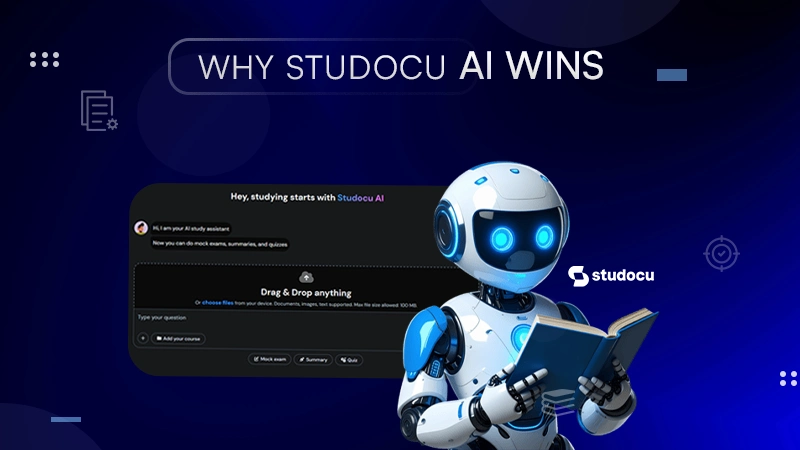
One big difference with Studocu AI is that it’s designed to use study context, your materials, and course-related resources, so your practice stays closer to what you’re learning.
When you use Studocu’s AI tools, the goal is to work from the materials you’re studying, like your uploaded notes, slides, and course documents you choose from the library. That helps keep the session focused on your coursework instead of pulling in random information from across the web. It makes your study time feel more relevant and less like guesswork.
Use Case:
Imagine a Psychology student studying cognitive dissonance.
- Generic AI: Might give a broad, Wikipedia-style answer.
- Studocu AI: Can use the student’s uploaded lecture slides to create practice questions on the topics that show up in those slides. That makes practice feel closer to the exam, because you’re training on what your course actually emphasized.
Leveraging a Library of 50 Million Resources
AI tools work best when they have the right study material to work from. Many “chat with PDF” tools only use what you upload, so if your notes are incomplete, your results will be incomplete too.
Studocu adds another option: a large, community-driven library with 50M+ student-shared documents, used by students each month. That means you can fill gaps when you’re missing a lecture or you want another explanation of the same topic.
The “learn together” effect:
If your notes aren’t complete, you don’t have to panic. You can look for notes from other students who took the same course or a similar course, then use Studocu’s AI tools to generate quizzes or mock exams from that material.
Example: An Engineering student is struggling with thermodynamics. They find a highly rated summary and use it to create a practice exam. To “borrow someone else’s brain” is not the goal. This is to ensure that the subject finally makes sense by providing practice questions and another clear explanation.
Active Recall vs. Passive Chat
A lot of AI tools feel like a search engine: you ask, it answers, and you move on. That can be useful, but it can also keep you in “reading mode.” For exams, most students need more than answers; they need practice recalling information under pressure.
Studocu focuses on active practice, testing yourself instead of only reading.
- AI Mock Exams: Studocu can turn your notes, slides, or chapters into exam-style questions with a timer, scoring, and feedback.
- Instant Feedback: After you submit, you can see what you got right or wrong and read explanations and expected answers.
This shift, from “tell me the answer” to “help me practice”, makes AI feel less like a shortcut and more like a study partner that keeps you engaged.
Academic documents aren’t always simple, as they can include dense formatting, tables, and many symbols, especially in STEM subjects. Some tools lose meaning when they turn PDFs into plain text.
Studocu’s Mock Exams feature supports technical notation by rendering formulas and equations in LaTeX, helping keep math and science practice readable.
Use Case:
A Chemistry student uploads notes with reaction equations and formulas.
- A generic summarizer might oversimplify the content.
- With Studocu Mock Exams, formulas can stay in proper notation, so practice questions don’t lose key details.
Conclusion
When you’re choosing an AI study tool, raw “AI power” isn’t the main thing that matters. What matters is context, does the tool help you practice the content you’ll actually be tested on?
Studocu supports this by letting you work from your uploaded materials and (if you choose) course-related documents from a huge library of student-shared resources. In order to make your preparation feel less like passive reading and more like actual exam practice, it also promotes active study through mock exams and quizzes with feedback.
Ans: Studocu AI is designed to use study context, like your uploaded notes and relevant course documents you choose, so explanations and practice questions stay closer to your coursework.
Ans: Yes, Studocu has a large library of student-shared documents, and you can use AI tools to generate quizzes and mock exams from materials you select there.
Ans: Yes, Studocu Mock Exams can render formulas and equations using LaTeX, so math and science practice stays readable.
Ans: It depends on your course rules; many students use AI to study because it supports learning. It becomes a problem if you use AI to produce answers during an exam or to submit work that your course expects you to write yourself.