AI is purging many jobs, but experts also say that it will generate many newer roles at the same time.
We currently don’t know what those jobs will be or what their names will be. The only thing we know is that those new roles will heavily lean on data, algorithm and AI skills.
This begs the question whether our education system is adapting to the future career needs or not.
The students today need to go all in with data and AI. They need to think more clearly, understand systems, and how tech shapes daily life better than their earlier counterparts.
The demands have changed so much even today. The talent shortage is so high that Outlook Business reported that for every 10 open AI roles, there is only 1 qualified engineer. Now you can imagine the future.
In this article, I’ll tell you all about what the future holds in terms of work and jobs, and how you, as learners, should adapt your learning to be prepared for it.
KEY TAKEAWAYS
- AI is redefining the job landscape.
- The future roles will heavily deal with AI and data.
- Students can continue to focus on mathematics and collaboration skills.
- Newer skills involve framing better questions and ethical judgment in the context of the real world.
Why Data Literacy Now Matters
Data is everywhere around us, regulating our lives. From grocery prices to election ads. This paints a picture that students must be learning about datasets in school. But we know that’s not the case.
When news stories mention AI writing essays or generating deepfake videos, the real lesson is not fear but literacy. Learners need to understand where information comes from, who collects it, and how algorithms make decisions that affect jobs, loans, and even music recommendations.
Teachers can start with simple habits such as asking students to question charts in social media posts or analyze how streaming apps suggest shows. These activities quietly train the same thinking used by data scientists. When curiosity replaces passive scrolling, learners begin seeing numbers as clues rather than mysterious code.
Math Foundations Still Matter
One of the only traditional subjects that will survive the AI purge might be mathematics. Universities and employers will continue to value strong math foundations as data work depends heavily on reasoning.
People assume that only programmers can get AI jobs. But in reality, it’s statistics, probability, and modeling that are shaping the field. Programs such as a bachelors in applied mathematics often prepare learners to interpret messy data, test assumptions, and translate numbers into useful decisions for businesses, hospitals, and research labs.
Parents and counselors can encourage math confidence early by linking formulas to real situations. Budgeting a school event, tracking sports statistics, or comparing climate trends gives numbers meaning. When students see mathematics as a language for explaining the world rather than a stack of worksheets, they build the mental habits that future AI careers quietly demand.
Teaching Students to Ask Better Questions
AI is very good at answering. But you need to ask great questions in order to get great answers. Prompting is not memorizing commands. It needs the skills to frame problems as best as you can. In classrooms, this can involve designing survey questionnaires or using spreadsheets to identify patterns.
Questioning skills also reduce misinformation. When they start asking questions like: who trained the model, what data was used, and what aspects are missing, they start treating AI as something built by humans for humans. That habit prepares them for workplaces where curiosity often matters more than memorized tools.
Real World Projects Beat Abstract Lessons
When there is a real-world example or counterpart, you grasp things faster, including data skills. Imagine learning it through local air quality, bus delays, or neighborhood food prices. Won’t numbers that tell stories about everyday life make them easier to grasp? These projects mirror how analysts work in city offices, newsrooms, and health agencies.
Schools can partner with community groups to provide datasets that feel meaningful. For example, a simple project mapping safe bike routes can teach cleaning data, visualizing patterns, and explaining results to nontechnical audiences. The experience builds confidence and shows that data careers are less about staring at code and more about solving practical problems.
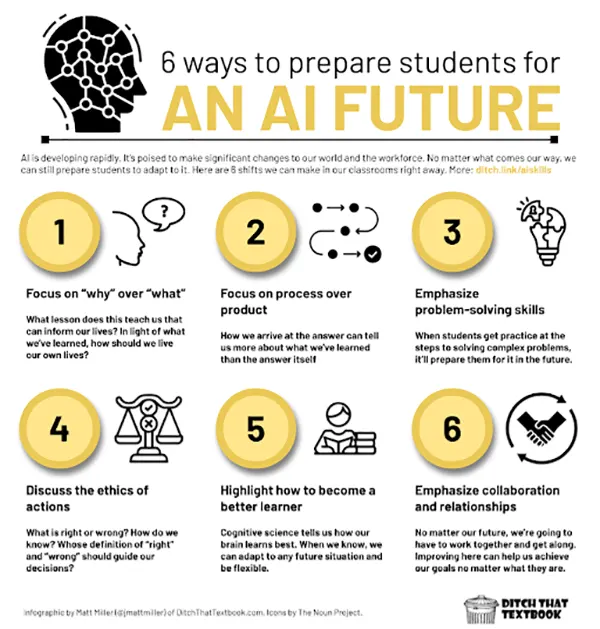
The following infographic summarizes all the skills that future jobs will demand, and present learners should focus on:
Ethics Belongs in Every Data Lesson
AI is trained on existing data. If that data is not screened for bias, that seeps into the model itself. And guess what? It’s pretty common. Students entering AI fields must understand that data decisions can reinforce inequality or help reduce it.
This makes ethical judgment skills valuable among potential employees. Ethics training in conjunction with technical skills would ensure that policy measures and tools for policing, credit scores, or healthcare access are reasonable.
Classroom discussions might analyze famous cases where algorithms failed, such as image systems misidentifying people or recommendation engines pushing extreme content. By studying these moments, you learn responsibility early. Data literacy not only helps you climb the career ladder, but make this world a more equitable place.
Collaboration Across Subjects
Data and AI can intersect with any number of subjects besides computer science. History teachers can analyze census trends, biology classes can model disease spread, and journalism clubs can examine misinformation networks online. Modern workplaces operate like this now. Combining the expertise of many to fulfil tasks end-to-end.
When students collaborate across subjects, they learn to translate technical ideas into everyday language. That ability matters because the most valuable analysts often act as interpreters between engineers, managers, and the public. Schools that encourage teamwork help learners practice communication skills that software alone cannot replace.
A new AI tool launches every week, claiming to write, analyse, design, and code better. Educators understand that new applications and use cases will emerge, but the core will stay the same. Students benefit more from learning core habits such as organizing data clearly, checking results carefully, and explaining conclusions with evidence.
Consider how spreadsheets remain useful decades after their invention because they teach structure and logic. The same principle applies to modern AI tools. When learners understand the reasoning behind a model, they can adapt to whatever software replaces today’s popular systems.
Guiding Students Toward Future Roles
Coding stopped being the only career option involving data and AI years ago. Now there are data storytellers, AI auditors, model trainers, policy analysts, etc. Aware learners who know about these roles can make better career decisions and even craft never-before-seen roles.
Schools can invite professionals for short virtual talks, organize internships with local tech teams, or encourage students to publish small research projects online. Exposure to real careers replaces vague ambition with direction and shows teenagers that the data economy is built by people with many different talents.
Preparing learners for data and AI careers is less about predicting the exact tools of 2040 and more about building adaptable thinkers today. The students who thrive will be those who read numbers carefully, question algorithms confidently, and connect technology to human problems. Recent debates about AI generated news, automated hiring, and digital privacy show that technical skill alone is not enough. Society needs professionals who understand both code and consequences.
Helping students practice these habits now ensures that tomorrow’s breakthroughs are guided by thoughtful people instead of rushed experimentation. Classrooms that nurture patience, skepticism, and creativity will quietly produce the leaders who decide how artificial intelligence serves communities, businesses, and everyday life going forward together.
Ans: First, upskill to work alongside AI, and second, cultivate unique human aspects.
Ans: Make them adaptable, critical thinkers, and emotionally intelligent.
Ans: Focus on maths and Python, while working on real-life projects.