“AI is not going to replace marketers. But marketers who use AI are going to replace marketers who don’t.”
Consider the last scroll you did on social media. Why did you pause? Because there was no wall of text for sure but a visually interesting photo or a fast-moving video. In modern times, you have mere seconds to catch the eye of your audience before scrolling continues to happen.
Being a marketing student or a professional developing a portfolio or a marketing campaign, you understand that the major challenge lies in designing impressive visuals and spending too much time on that.
Here AI comes into play. The present article reveals how innovative technology can help change the way you approach the creation of marketing graphics. Such platforms now become not an option anymore, they become the necessary instruments for survival in this profession.
You will find out which particular software solutions are widely used nowadays in creating brand and social media templates fast and easily.
Key Takeaways
- AI literacy is now a mandatory skill for marketing grads
- Marketers now focus on strategic curation over manual graphic production
- Teams can instantly update live visual assets using real-time data
- Anyone can quickly bring creative concepts to life during pitches
It will no longer be enough to have great phrases or strategies; marketers should also be able to create something that requires a set of unique skills today. Students searching for a job in marketing should include experience with AI in their resumes because it will become a mandatory requirement for most employers.
Professionals would have no choice but to work with such advanced tools if they want to satisfy the need for new content each day. Smart software becomes the ultimate weapon of choice in creating great marketing ideas and concepts. Instead of spending four whole hours removing backgrounds from pictures, adjusting their sizes, or changing color contrasts, you can leave all those mundane tasks to AI and have them done within less than thirty seconds.
AI leaves your mind free to think about more important things, like creating new strategies, knowing your target audience, or storytelling. As a student, you get an opportunity to create an impressive portfolio featuring realistic ads or product mock-ups without spending four years studying art at school.
As a professional marketer, you can create multiple versions of your ad and try them out to choose the best variant within seconds. With the help of technology along with human ideas, these platforms create high-quality design accessible for everybody.
Did You Know?
Our brain perceives visual information 60,000 times faster than written text information.
Let us analyze the effect of this technology on your everyday workflow by listing the most innovative solutions that are available now. Of course, the market features plenty of different applications, but only several of them address specific marketing-related challenges.
For example, when it comes to creating particular pictures during a brainstorming session, GPT Image 2 will come handy. While traditional solutions require switching from a designing program to a chatbox, this one integrates all necessary functions into your conversation. Therefore, you may be able to adjust any photo, improve its lighting, and place a logo without any additional hassle.
As for videos, another application called Vyond allows students and professionals to create professional-level animations by means of typing a couple of lines of text. Thanks to such tools, you do not have to spend thousands of dollars on hiring a voice actor or purchasing expensive software. In turn, typing your script, selecting characters, and waiting a couple of minutes will bring a stunning animated video to you.
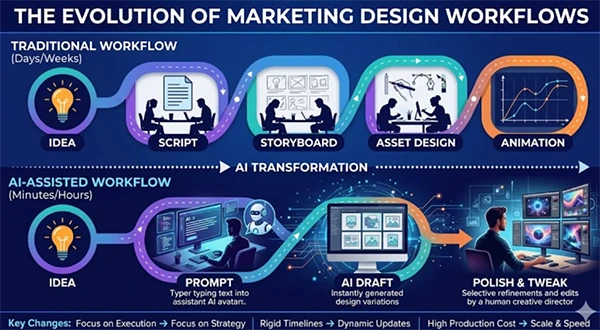
As you can see in the diagram above, AI skips the slow, boring parts of design so you can finish your projects much faster.
How AI Is Changing Digital Marketing and Content Creation
They not only generate aesthetically pleasing designs but also transform the way content creation processes occur. Before, marketing was all about a linear sequence, the writer came up with the text, the designer prepared its presentation, and the buyer put up the advertisement.
Now the linear process turns into an instant loop where marketers are able to monitor the data, track audience behavior, and modify ads by using artificial intelligence.
- Easily personalized: Create your own visuals tailored for different groups of consumers instead of using the same generic banner.
- Instant localization: Make changes to backgrounds, clothing, or text in an image depending on country or language.
- Easily prototyped: Any member of the team can easily visualize their ideas and present them within a matter of seconds.
That said, the need for investing money in expensive marketing software becomes obsolete. The winning recipe consists of having original creative ideas.
Management of social media is not easy because of the fact that each of them requires its own specifications, sizes of the layout, and style. Therefore, one has to create huge amounts of graphics on a regular basis.
Fortunately, there are several brilliant solutions for that such as Canva AI 2.0 and Piktochart AI. Rather than changing sizes of the same design for Instagram Stories, LinkedIn headers, and YouTube thumbnails separately, one has to just type the text or at least provide a few key points.
AI instantly generates the full set of graphics, which looks great on mobile phones thanks to the automatic choice of color palette, proper icons and layout. Finally, this software takes into account the official brand guidelines. Once the user uploads his unique hex codes of colors, fonts, and logos, it becomes impossible to misuse them because the AI tool automatically guarantees strict conformance to these guidelines for each and every variation of the graphic.
This saves time from making unnecessary mistakes while creating graphics and enables social media managers to raise the frequency of their posts.
Fun Fact: In June 2022, Cosmopolitan published the first ever AI-generated magazine cover featuring an awesome space astronaut in only 20 seconds.
With literally hundreds of applications appearing each month, there is always the danger of spending money on something useless. Therefore, in order to make an informed decision, one has to look beyond superficial marketing and understand how the product works in practice.
First and foremost, consider whether the platform supports context-based editing. Unfortunately, most basic generators only work in one direction: one enters a prompt, gets an image, and if anything needs to be changed, the entire process needs to be started all over again.
This is why one should aim at finding interactive platforms, where the user can pick up an object and apply any changes needed: recoloring, removal of background, adding proper text, etc.
Next important aspect worth paying attention to is commercial licensing issues and safety. When creating something for a client or building a professional portfolio as a student, the last thing one wants is problems with copyrights and legality of his/her images. Hence, the best generators clearly state sources of training data used.
Also, explore the essential cybersecurity practices for remote and online students.
Future of AI-Powered Visual Marketing and Creative Careers
As AI is advancing at an unprecedented rate, a key question arises regarding its effect on human designers and creative jobs. In the years to come, it will be those with the “creative director’s mind” who thrive. Whereas machines can excel in terms of speed when it comes to image variation, resizing and creating images per se, they cannot replicate human empathy and strategic thought that goes into each creative project.
For example, a computer cannot know how and why a particular joke may connect with an entire community or how the emotional aspect of an advertisement creates brand loyalty in people’s minds. Thus, creative jobs are becoming more oriented towards curation, writing prompts and branding strategy rather than manual editing.
In conclusion, the students mastering these platforms now will enter the workforce not as junior professionals, but as skilled and agile managers of creative content creation machines. While technology will evolve, the human need for storytelling will remain the same.
FAQs
Ans: Yes, but first see the terms of the application. The paid version permits doing so while the free one does not.
Ans: No. They will take care of the repetitive parts of designing but cannot match human creativity and vision.
Ans: Combining them with your own brand colors and text