Have you noticed the way collaboration has changed over the past few years? Blackboard classes are turning into digital learning spaces, and offices are switching to hybrid environments where teams operate across locations and time zones.
In fact, Gartner has shared that around 70% of employees now work at least part of the time remotely.
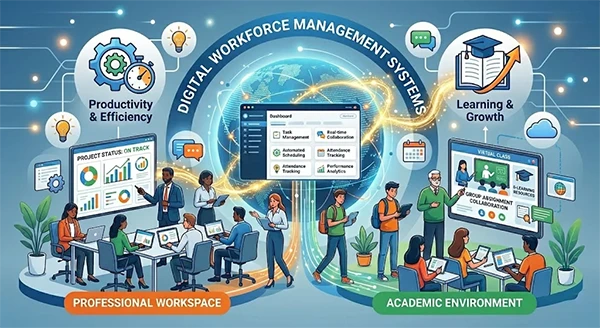
In such advanced environments, managing things manually is not a practical solution. To resolve this, organizations are now relying on digital workforce management systems to improve communication, monitor growth, and support collaboration more efficiently.
Continue reading to learn more about digital workforce management systems for academic and professional environments.
Key Takeaways
- Digital workforce management systems support communication, task management, and collaboration.
- Automation avoids the need for repetitive administrative work, helping teams to save time and avoid mistakes.
- Remote and hybrid environments depend more on workforce technology to maintain smooth communication and operational continuity.
Understanding Digital Workforce Management Systems
In simple words, digital workforce management systems are platforms integrated with modern technology that help to manage people, tasks, schedules, communication, and even the complete workflow in a single place.
For the last many years, these systems have been truly popular in corporate environments, and they are coming out to be equally important for the academic culture too. In which students, teachers, and the management faculty work under seamless coordination.
This results in a properly organized environment where teams can boost productivity instead of administrative confusion.
In almost every industry, collaboration plays a crucial role. Whether it is related to a university project or a business campaign, modern workspaces that have remote employees need smooth communication and coordination.
Digital workforce systems boost collaboration improve collaboration by helping users to:
- Collaborate on updates in real time
- Share tasks clearly
- Manage deadlines
- Access files from anywhere
In both the professional and academic workspaces, these results in a smooth collaboration across teams without delays or communication gaps. In remote and hybrid teams, this results in a clear difference.
Platforms like ZenHR help businesses to align HR operations, employee management, and manage attendance and workforce coordination through centralized digital solutions.
The Role of Automation in Modern Workforce Management
Automation is one of the major advantages of workforce technology is automation.
Manual processes often feel frustrating, consume much time, have higher error risks, and create unnecessary workload for both the team members and managers. Automation allows organizations to avoid repetitive tasks while boosting efficiency and precision.
The major tasks that have been enhanced greatly are:
- Track attendance
- Get instant reports
- Approve leaves and assign tasks
- Update schedules
This not only saves time but also improves overall operational performance.
Interesting Fact
McKinsey has shared that employees spend around 20% of their workweek searching for internal information or trying to locate colleagues who can help with specific tasks.
The team often runs behind in productivity, both in terms of growing operations and productivity. When communication is not clear, deadlines are missed, and work is unorganized, productivity typically suffers a lot.
With the help of digital workforce tools, one can overcome these barriers through required visibility across projects and responsibilities. Using centralized dashboards and management systems, teams can:
- Monitor present tasks
- Define priorities
- Lower workforce delays
- Get instant updates
When everyone gets easy access to shared information and operations workflows, productivity is boosted by default.
Supporting Remote and Hybrid Learning Environments With Technology
Remote and hybrid workflows are becoming a standard over time. Not as a temporary solution but as a long-term part of education and professional working space.
This working approach has asked for a digital system that supports flexible collaboration without hurting communication or affecting efficiency.
Management platforms help remote operations by mobile support, digital attendance systems, and remote task tracking.
There is no one-size-fits-all workforce platform for businesses. One needs to identify their own specific needs and then choose one that smooths operations and provides long-term scalability.
Here are some essential features:
- User-Friendly Interface: Platform should be simple to use.
- Real Time Communication: Built-in messaging allows teams to stay connected.
- Reporting and Insights: Data-driven insights for better decision-making.
- Security and Data Protection: Strong security measures are essential for protecting the organization.
There can be other features that might be required as per the organization and its routine operations.
How Workforce Systems Enhance Communication and Task Coordination
In most of the corporate spaces, poor communication often becomes a major reason why the project falls behind, and teams become unproductive. Workforce management systems support communication by keeping things organized and arranged in a single place. This way, updates, tasks, and their schedules come to a single place.
This results in fewer misunderstandings, improved response time, and organized projects. In educational spaces, this results in a more connected environment where both the students and teachers are informed about assignments, schedules, and other updates.
Future Trends in Digital Workforce and Learning Technologies
The future of digital workforce management seems to be continuously evolving as AI is advancing with its technology, automation, and cloud features.
The future ones are expected to have:
- AI-powered recommendations
- Smarter automation tools
- Enhanced cybersecurity features
- Remote collaboration tools
The future of the workforce and academic management is likely to put more emphasis on flexibility, automation, and personalization.
Conclusion
Digital workforce management systems are changing the way academic institutions and businesses operate. By improving the communication between the teams, automating the repetitive tasks, and smoothing the remote communication, the platforms allow building platforms that are more productive and connected.
As the hybrid teams and digital environment grow, organizations that align with the modern workforce management technology will gain more growth and better collaboration in the future.
FAQs