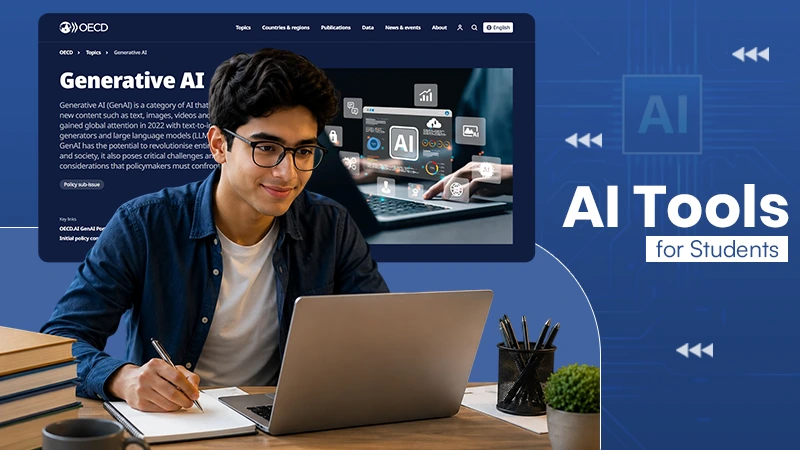
In this AI-driven world, not learning to better utilize AI is a curse on students’ futures. While 3 out of every 4 students are already using AI tools, many of them are not making the most out of them.
AI can do far more than answer textbook queries. It can help students conduct detailed research, prepare for interviews, build relevant skills, and move on predictable career paths. The key is to use AI alongside one’s own thinking, creativity and knowledge – not as a shortcut to copy and paste AI-generated content.

Want to prepare smarter for a more competitive future? Read more to learn better utilize AI tools for a streamlined academic and professional life.
Key Takeaways
- AI is truly appreciable when it helps to widen your ideology, think better and have a strong perspective – not to get tasks done completely through it.
- Prompts decide the depth, purpose, and accuracy of the results given by AI tools. Detailed prompts mean better results.
- Students investing their time and efforts to learn AI skills today will be better equipped with better career paths tomorrow.
Shift From Traditional Learning to AI-Assisted Learning
AI has truly transformed the way students used to learn a few years back. Instead of diving into books for hours and struggling alone to tackle a strong concept, students can use AI to get instant and reliable feedback with personalized learning styles.
Which says a 24/7 personal guidance!
And for those who want maximum results with bare minimum efforts, they can use smart AI tools that generate AI prompts automatically.
When used the right way, AI tools can save time and help to:
Conduct Research More Efficiently
Research is one of the most time-consuming tasks – going through multiple sources, comparing the evaluations, organizing information, setting a fixed tone and much more. With the smart use of AI, this detailed process can be turned into a small and effective one by:
- Summarizing long articles
- Generating better questions
- Serving complex topics concisely
- Suggesting unique angles to projects
With a bunch of credible information available easily, one can source credible facts and statements to make the research more effective and valuable – all in the least time possible.
Improve Understanding, Writing and Communication
Struggling to explain what you know is the most common problem with students. AI can help them by fixing grammar, adding tonality, giving strong vocabulary and improving overall readability.
It can also serve tough and complex topics with clear definitions and explanations. If working with essays, emails and reposts, AI can provide better structure without easily understandable headings.
Students who regularly deal with assignments or blogs can use well-crafted AI creative writing prompts to improve storytelling and creative thinking.
Personalized Learning With 24/7 Support
Every student has a different learning pace and style. Some betters learn with real-world examples while others prefer step-by-step explanations.
AI meet varied preferences by understanding the needs, learning style and grasping capabilities. Above this, it is ready to answer your every query 24/7, whether an academic vague query.
Consider it as an educated friend with experience, who is always ready to help.
To become part of this AI-driven world, explore 5 agentic AI courses to deploy AI agents in real workflows.
Best Practices to Get the Most from AI
AI will answer your query anyway. But to get the best results, one should be aware of the right approach to use it. Some simple habits that make a significant difference include:
- Write detailed prompts instead of unclear and random ones.
- Ask AI to make you understand the concept instead of just providing answers.
- Always verify shared facts before using them.
- Integrate human understanding and experience with robotic tone.
- Use AI to get context and structure things – not to cheat.
- Keep improving prompts to get better answers every day.
Remember, AI works best when it is made part of your learning journey, the complete journey.
Leveraging AI to Make Better Career Decisions
In this era, AI is not just helping with academics. It is also helping students to better prepare for their future.
Various career based AI tools help students to:
- Find a relevant career based on your personal interests and aspirations.
- Build ATS friendly resume and cover letter to stand out in the competition.
- Practice questions that have the highest chances of being asked.
- Be aware of the most relevant and in-demand career options in the industry.
- Get personalized tips to move effectively on career paths.
Rather than feeling confused by unpredictable career options, students can use AI to make better decisions confidently. Students can also rely on Next-Gen AI to prepare for high-stakes interviews.
Surprising Fact
More than 77% of the students have shared that they have never received formal AI training – serving as a major reason for not generating better AI results. (Source: Microsoft)
Common Mistakes Students Should Avoid When Using AI
Undoubtedly, AI is greatly useful, but still relying on it completely can result in major issues. Here are some of the most common mistakes to avoid:
- Copying AI generated content without understanding its real meaning.
- Blindly trusting every AI response.
- Ignoring plagiarism and other content policies.
- Depending completely on AI and not building personal skills.
The main goal should be learning with AI, rather than from AI alone. And to join the best AI communities, rely only on trusted sources to avoid scams.
Conclusion
At its core, AI has become a most valuable learning tool for modern students, but its real power is unlocked only when it is used the right way. It will serve you anyway, but how effectively and precisely one gets the answer from it depends on the approach and tactics used.
Moreover, the most practical and beneficial students will not be the ones that completely depend on AI for tasks, but rather are the ones who improve their creativity and critical thinking with AI to create better results.
FAQs
Ans: Students should use AI to get better ideas, improve existing writings and structure the research better – not to completely rely on it.
Ans: Usually, yes, but the accuracy and precision may differ widely. Using specific tools for what they are built to increase reliability.
Ans: No, AI is here to support human tasks and make them better from a human point of view, not to replace them.