“Education is not the filling of a pail, but the lighting of a fire.”
– W.B. Yeats (Poet & Former Senator)
Almost every one of us has spent years mastering the art of the examinations, navigating through the hallowed halls, and probably perfecting the craft of writing an essay at the last minute. However, as you stand on the threshold of the professional world, a question often comes forward as a troubling factor: “Is my degree enough?” The shift from a structured classroom to the unpredictable professional world is not easy for everybody, but it is an evolution of how you process information and deliver value.
To thrive in this evolution, you need to transform yourself from a student absorbing knowledge to a professional who applies the knowledge with precision.
Key Takeaways
- Adaptability is the key; it is your ability to unlearn and relearn that is now more valuable than your initial degree.
- Communication and empathy are the key foundations of your professional longevity.
- Never wait for your company to train you; you need to seek out knowledge independently.
Changing Relationship Between Education and Career Readiness
Gone are the days when a degree or a diploma was a golden ticket to get a stable job; today, the link between what you have learnt in the lecture halls and what you actually do at your office has shifted from ‘content mastery’ to ‘capability mastery’. The employers are less interested in your textual knowledge and more invested in your ability to encounter a sudden problem.
Your education definitely provides the foundation, but your career readiness depends on how you decode theoretical concepts into actionable strategies. It is about closing the gap between knowing what to do and knowing how to do. You can dive deeper into classroom-to-career initiatives and career development programs for working adults, if you wish to learn more about how modern education is evolving in today’s world and what is relevant.
Learning Skills That Bridge the Gap Between Classroom and Workplace

To tackle the challenges at the workplace, which is the wild frontier, you will need a toolkit of skills to bridge the gap between your classroom and your workplace.
- Critical Analysis: The first skill on the list is Critical Analysis, where you need to learn how to assess variables such as cost, time, and human impact.
- Emotional Intelligence: Your GPA will not help you in handling a situation at the board meeting or negotiating with a deadline. For this, you need to develop empathy and self-regulation, which will shape you into a leader.
- Communication: Whether it is a formal presentation or a Slack message, what matters is how you communicate and how you present your complex ideas into clear and persuasive language, which eventually will become the ultimate career superpower.
Applying Academic Learning in Real-World Professional Environments
Your knowledge never becomes irrelevant at your workplace; however, there’s a catch! Applying academic learning is about transferable logic; to apply effectively and for the best results, you need to make this application real by practicing contextual shifting.
Use the research and skills you have to deal with the issue that you encounter at your office. Use your collaborative skills from group projects to manage your teams. The professional world doesn’t ask for your knowledge; it focuses on how you weaponize it. When you come across an issue, all you need to do is ask yourself: “What framework from my studies would apply here?”
Did You Know?
As per LinkedIn, ‘Adaptability ‘ is among the top-most-demanded skills by employers globally.
Role of Continuous Learning in Long-Term Career Growth
The best thing you can do for your future is to stop and begin a student at your office or workplace. What was cutting-edge a few years ago is not very relevant today. Long-term success is no longer just a straight line, but it is a series of pivots driven by Continuous Learning. The world is no longer about getting more degrees; it now places emphasis on micro-learning.
Continuously adding skills and learning new things will keep you relevant in today’s professional landscape and will also assist in long-term career growth. Eric Hoffer has famously said, “In times of change, learners inherit the earth, while the learned find themselves beautifully equipped to deal with a world that no longer exists.” By embracing a growth mindset, you can ensure that you remain an asset to your team and your office rather than a legacy.
Fun Fact: Research suggests that about 85% of the jobs that will exist in 2030 have not even been invented yet!
Digital Literacy and Self-Directed Learning for Modern Careers
Digital literacy is a fundamental aspect in the 21st century, and it is as important as reading and writing. However, it goes beyond the knowledge of using a computer. It includes data fluency, which is the ability to look at a dashboard and understand the numbers, along with digital etiquette.
Moreover, the base of development has shifted from the employer to the employee. Self-directed learning is the ability to identify your own skills gaps and fill them without a professor directing you. As it is said, “You are the CEO of your own learning journey.” Whether it is through podcasts, open-source projects, and webinars, it is your ability to curate your own ‘personal syllabus’, which will determine your career path.
Conclusion: Preparing Learners for Sustainable Career Success
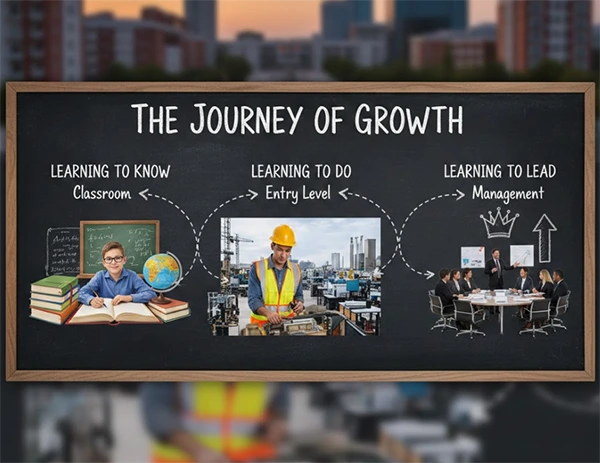
Your journey from the classroom to the career is not just a one-time leap but a continuous bridge-building exercise. By laying emphasis on the transferable skills, mastering digital skills, and never letting your hunger for knowledge, you don’t just find a job, but you build a stable career.
FAQs
Ans: Even if you have no experience, you can highlight ‘soft skills’ that you have gained through volunteering, personal projects, and clubs. You should focus on showing your ability to solve problems.
Ans: A degree offers a foundation to your skills; however, it must be supplemented with some up-to-date skills.
Ans: Identify one basic of your current role or a post that you desire to acquire, and dedicate 30 minutes daily to mastering a tool or concept that helps solve it.