In elementary math, my neighbor’s son received an A2 on his O-Levels. A bright child who excelled in math throughout lower secondary school. According to his parents, additional math would be difficult but doable. He had, after all, always received math scores in the 80s and 90s.
After three months in Sec 3, the boy was failing all of his A-Math exams. Failing, not just getting by with fiftys. He maintained his good grades in E-Math, but A-Math? A total catastrophe. One night, I was asked by his mother, “How is this even possible?” “It’s still math, isn’t it?”
But that’s the problem. More math is not the same as “harder math” or “more math.” It differs greatly from all that students have previously learned. And each year, thousands of Singaporean students are caught completely unprepared by that difference.
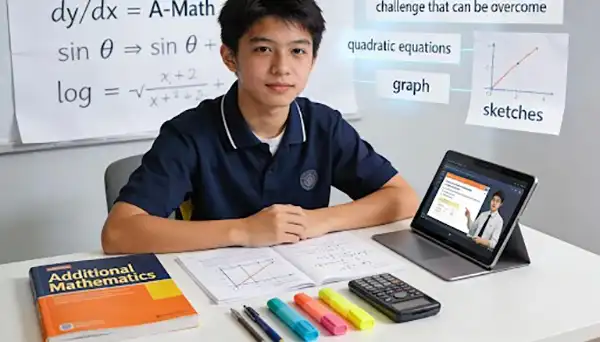
Let’s take a closer look!
Key Takeaways
- Understanding the growth that comes from a maths tutor
- Uncovering some silent mistakes
- Exploring how it makes total sense
- Discovering the real loss that comes from avoiding it
The Jump Nobody Warns You About
Here’s what happens in most Singapore households: Kid does reasonably well in Sec 1 and Sec 2 math. Maybe not topping the class, but solid B grades, occasionally hitting an A. Parents and teachers suggest taking Additional Math because “you’re good at math.”
Then Sec 3 arrives and suddenly nothing makes sense anymore.
Pupils who have never needed assistance before end up staring at questions they are unable to begin. Those who are confident get nervous. The nervous ones begin to completely avoid their homework. Within weeks, they are certain that their decision to take A-Math was a grave mistake.
But here’s the reality: A-Math isn’t an extension of what they’ve been learning. It’s a completely new mathematical language with different rules, different thinking patterns, and entirely different problem-solving approaches.
Elementary Math builds on arithmetic and concrete problem-solving. You can visualize most concepts. Use models. Draw diagrams that make sense. A-Math throws all that out the window and says “now think abstractly about functions, derivatives, and logarithms.”
It’s like spending years learning conversational Mandarin, then suddenly being handed classical Chinese poetry and told to analyze it. Same language family, completely different skill set required.
Why Good Math Students Struggle With A-Math
I’ve watched plenty of strong math students hit a wall with Additional Math. It’s not because they’re suddenly stupid or lazy. The subject demands different cognitive skills they haven’t developed yet.
Abstract thinking becomes mandatory, not optional. In E-Math, you can often get by with pattern recognition and procedural thinking. Memorize the steps, apply them to similar problems, done. A-Math requires genuinely understanding why mathematical relationships work. You can’t just follow steps—you need to see the underlying logic.
Multiple concepts layer on top of each other. E-Math topics are relatively isolated. Learn fractions, move to decimals, learn algebra, tackle geometry. Each chunk stands somewhat alone. A-Math concepts interconnect constantly. Calculus requires solid algebra. Trigonometry connects to coordinate geometry. Miss one foundational concept and suddenly five other topics become impossible.
The questions test application, not recall. E-Math tests whether you learned the technique. A-Math tests whether you can figure out which technique to use when it’s not obvious. The questions hide what they’re asking for. You need to decode the problem before you can even start solving it.
Speed matters way more. E-Math exams give you reasonable time to work methodically. A-Math papers are deliberately time-pressured. You need fluency, not just accuracy. Students who carefully work through every step run out of time, even when they know the material.
This combination—abstract thinking, interconnected concepts, hidden problem structures, time pressure—overwhelms students whose previous math success came from diligence and pattern recognition rather than deep conceptual understanding.
The Warning Signs Parents Miss
Most parents don’t realize their child is drowning in A-Math until report card day arrives with a shocking grade. But the warning signs show up much earlier if you know what to look for.
Your teenager stops attempting A-Math homework. They’ll finish E-Math, complete other subjects, but somehow A-Math worksheets remain blank. They’re not lazy—they genuinely don’t know where to start.
They can’t explain what they’re learning. Ask about E-Math and they’ll say “simultaneous equations” or “circle theorems.” Ask about A-Math and you get vague answers like “some calculus thing” or “I don’t really get it.” That’s not forgetfulness. That’s fundamental confusion about what the subject even is.
Test results plummet, but E-Math scores remain respectable. It is not a general math problem if your child routinely fails A-Math but maintains B grades in E-Math. It’s a comprehension gap in A-Math specifically.
They’re spending hours on A-Math homework without making progress. Not hours doing problems, but hours staring at the page, erasing and rewriting, checking solutions online without understanding why they work. That’s the look of someone lacking the foundational concepts to make sense of the work.
These patterns usually emerge by mid-Sec 3. Some students show signs even earlier, within the first month or two. The longer you wait to address them, the harder recovery becomes because A-Math keeps building on itself.
When Tuition Actually Makes Sense
I’m not someone who thinks every student needs tuition for everything. Plenty of kids do fine in school without extra help. But A-Math is different.
If your child is struggling with A-Math specifically while maintaining grades in other subjects, specialized support probably makes sense. This isn’t about doing better—it’s about preventing a complete breakdown in understanding.
Students taking both sciences (Pure Physics, Pure Chemistry or Combined Science) especially need solid A-Math skills. The subjects overlap significantly. Weak calculus makes certain physics topics nearly impossible. Shaky algebra creates chemistry problems. One weak link cascades across multiple subjects.
Also, here’s something parents often forget: Secondary 3 is already intense. Most students are handling 8-10 subjects, CCA commitments, increased homework loads, and the growing pressure of approaching O-Levels. Adding hours of frustrated A-Math struggle on top of everything else? That’s a recipe for burnout.
Quality Additional Math tuition in Singapore can prevent that breakdown. Not by doing the work for students, but by filling in conceptual gaps and teaching problem-solving frameworks that make the subject accessible.
What Makes A-Math Tuition Different From General Math Help
Not all math tuition works for Additional Math. I’ve seen students attend general “math tuition” where the tutor handles both E-Math and A-Math, and honestly? It rarely helps with A-Math.
The subjects need fundamentally different teaching approaches. E-Math tutoring focuses on technique mastery and practice. A-Math tutoring should focus on concept-building and problem decomposition.
Effective A-Math tutors don’t just show you how to solve problems. They teach you how to recognize problem patterns, break complex questions into manageable parts, and connect different topic areas. They build the abstract thinking skills the school curriculum assumes you already have.
They also understand common misconception patterns. Where students typically get confused with logarithm properties. Why simultaneous equations break down when dealing with exponentials. How to think about rate of change before diving into differentiation formulas.
General math tutors might know the content, but specialized A-Math tutors understand the specific cognitive hurdles students face and how to address them systematically.
The Timing Question Everyone Asks
“When should my child start A-Math tuition?”
Most parents wait until the first test results come back. By then, the kid has missed 2-3 months of foundational content and already developed anxiety about the subject. Playing catch-up from behind is way harder than building understanding from the start.
If your child is taking A-Math, consider starting support early in Sec 3, ideally before the first major test. Not because you expect them to fail, but because preventing confusion is infinitely easier than fixing it later.
Some students benefit from brief intensive help during school holidays before Sec 3 starts. A week or two covering the absolute fundamentals—basic algebra manipulation, coordinate geometry review, introduction to function concepts—creates a foundation that makes the first months manageable.
For students already struggling mid-year, immediate intervention matters more than perfect timing. The longer conceptual gaps persist, the harder recovery becomes because A-Math builds relentlessly on previous topics.
What Actually Helps vs What Wastes Money
Not all A-Math support delivers results. Some approaches just waste time and money while stress levels keep rising.
What helps: Small group or individual tutoring focused on building conceptual understanding. Tutors who can identify exactly where comprehension broke down and rebuild from that point. Programs offering varied practice problems with explanations, not just answer keys.
What doesn’t help: Giant lecture-style classes where one tutor covers material for 20+ students. These replicate school teaching that already isn’t working. Also ineffective: pure practice without concept reinforcement. Students grinding through problem after problem they don’t understand just entrench incorrect thinking patterns.
Definitely doesn’t help: Last-minute panic tutoring right before major exams. You can’t rebuild months of missed understanding in two weeks. It might help students scrape through one test, but the knowledge doesn’t stick.
Online resources can supplement but rarely substitute for actual tutoring. Watching solution videos helps students check their work, but it doesn’t build the problem-solving intuition A-Math requires. Videos show you the path; they don’t teach you how to find it yourself.
The Real Cost of Skipping A-Math Support
Some parents resist getting help because they figure their kid will either figure it out eventually or, worst case, drop to E-Math only. Both options carry bigger consequences than people realize.
Dropping A-Math mid-stream isn’t just about that one subject. It signals to the student that when something gets hard, giving up is acceptable. That’s a terrible lesson heading into O-Levels and beyond. It also limits future academic pathways—many JC subject combinations require or strongly prefer A-Math background.
Struggling through without support while maintaining the subject creates a different problem: chronic stress and declining confidence. Students who barely survive A-Math often develop math anxiety that persists into JC and university, even affecting their attitude toward other analytical subjects.
The financial cost of tuition feels significant until you compare it to potential opportunity costs: limited JC course options, reduced scholarship opportunities, need for remedial work later, or extra years of education if university math requirements become obstacles.
I’m not saying tuition is mandatory for everyone. Some students genuinely do fine on their own. But if your child is clearly struggling and you’re hoping it’ll somehow resolve itself? That hope usually proves expensive in non-monetary ways.
Making Smart Tuition Decisions
If you’ve decided A-Math support makes sense, choosing the right program matters as much as the decision to get help.
Talk to your child about what specifically confuses them. Is it the algebra manipulation? Understanding what questions ask for? Time management during tests? Different problems need different solutions. A tutor who just reteaches school content won’t help if the issue is test anxiety or problem interpretation.
Look for tutors or programs with specific A-Math expertise. “Math tutor” doesn’t automatically mean “understands Additional Math pedagogy.” Ask about their approach to common difficult topics like logarithms, trigonometric identities, or curve sketching. Generic answers suggest generic teaching.
Consider your child’s learning preferences. Some students thrive in competitive group settings where peer pressure motivates effort. Others need quiet individual attention to ask questions without embarrassment. Neither approach is objectively better, but matching the environment to your child’s personality matters.
Be realistic about timelines. If your child is significantly behind, improvement takes months, not weeks. Expect gradual progress—from failing to barely passing, from barely passing to comfortable Cs, from Cs to Bs. Overnight transformations only happen in advertisements.
Beyond Just Passing
Here’s something worth considering beyond grades: Additional Math teaches thinking skills valuable far beyond mathematics.
Learning to break complex problems into manageable pieces? That’s useful in almost any career. Developing abstract thinking abilities? Critical for fields from engineering to economics to medicine. Building resilience when concepts don’t click immediately? That’s a life skill.
Students who learn to handle A-Math’s challenges often develop surprising confidence. Not because math becomes easy, but because they prove to themselves they can tackle genuinely difficult intellectual challenges and eventually master them.
The subject forces students to think precisely, reason logically, and check their own work critically. These metacognitive skills—thinking about your own thinking—transfer to other subjects and real-world problem-solving.
That’s why giving up on A-Math too quickly, or letting a child suffer through it miserably without support, feels like a missed opportunity. The subject can be genuinely transformative when students get the help they need to engage with it successfully.
The Bottom Line
Advanced elementary math is only one aspect of additional math. It’s a radically different topic that calls for distinct cognitive strategies. The majority of students find this transition difficult, not because they are poor mathematicians, but rather because no one teaches them how to think mathematically at this higher level of abstraction.
Recognizing when your child needs support, getting help before confusion becomes crisis, and choosing specialized tutoring over generic math help—these decisions significantly affect outcomes.
Your teenager doesn’t need to love A-Math. But they should be able to approach it without panic, work through problems with reasonable confidence, and see gradual improvement rather than persistent failure.
That’s what appropriate support provides. Not miraculous grade transformations, but the conceptual foundation and problem-solving frameworks that make the subject accessible rather than overwhelming.
If your child is struggling with A-Math right now, you’re not alone. Thousands of Singapore families face this same challenge every year. The difference between students who recover and those who don’t often comes down to whether they got the right help at the right time.
Ans: It includes concepts like curiosity, connection making, challenge, creativity, and collaboration.
Ans: A tutor needs to be able to put your child at ease, encourage academic risks, be non- judgmental, and observant of your child’s strengths and weaknesses.
Ans: The Four Cs stand for Converse, Count, Compare, and Categorize.