Are you a researcher or an academic writer searching for tools that lessen your research workload? Well, you are not alone.
According to the latest survey by Zendy, 73.6% use AI in education, 51% use it for literature review, and 46.3% of students and researchers are using AI in education for writing and editing, showing just how quickly these tools are being adopted.

Therefore, this article aims to highlight the seven academic writing tools that can make research an easy-peasy task and help you with academic writing.
Key Takeaways
Knowing the major tools of Academic Writing
- Grammer Fixer
- Text Summariser
- Test Paraphraser
- Citation Generator
- Plagarism Checker
- AI Detector
- AI Text Humaniser
1. Grammar Fixer
If you are not a native speaker and are writing a research study in English, which is not your first language.
Then, there can be chances that you may make grammatical errors in the content, which can reduce the readability of your article.
The best hack to save time while writing is to use a grammar fixer that can automatically detect spelling mistakes, typos, semantics, or even punctuation errors.
You can simply read the suggestions it provides and correct all the mistakes, saving you several hours on manual checking.
Pro Tip It is best to use a grammar fixer after writing the whole section to maintain the flow. Keeping it active while writing could disturb your writing flow.
2. Text Summariser
Have you ever come across the problem of not revisiting your bookmarked references due to a shortage of time when writing your literature review? Don’t worry, you are not alone.
Every researcher faces a similar issue. So instead of bookmarking everything you see, use an instant text summariser to get the gist of that piece.
It will offer you a precise, bite-sized summary of a 10-page-long document within a few seconds. So you can decide whether to bookmark it or not, and revisit only the useful sources.
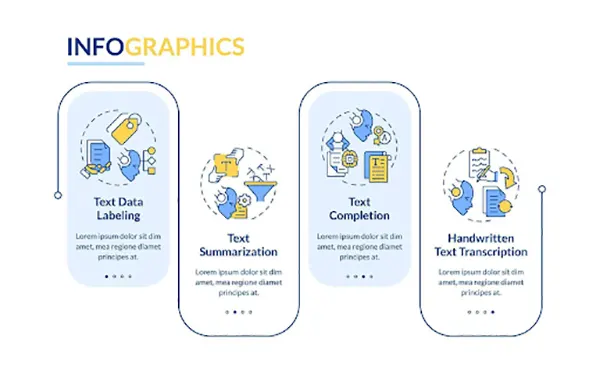
The infographics further explain the text summarisation through the text summariser
3. Text Paraphraser
Sometimes, when adding references written by another researcher. You come across a situation where you can’t cite it as it is; that’s where text paraphrases come to the rescue.
These tools provide you with a more precise version of the reference you can easily use in your work. Researchers usually use AI text paraphrasers to shorten large texts while simultaneously preserving the essence of the content.
Paraphrasing could be useful when you find a long paragraph relevant to your arguments and wish to utilise it in your work. Don’t forget to give due credit to the original authors by adding proper in-text citations, even though you have paraphrased to avoid intellectual dishonesty.
4. Citation Generator
References are the soul of any research study, dissertation, or research paper, because they enhance the academic value. For example-If you are archeological writer, references form the soul of your research work.
That’s why using a citation generator and citation management software, such as Mendeley and Zotero, becomes important.
To add correct in-text citations or even full references at the end of the prose to depict its relevance.
The best part about these tools is that they can provide you with a completely organised list of references, which helps you :
- Reduce your manual workload
- arrange citations in alphabetical order
- Arrange citations in your preferred recommended style.
5. Plagiarism Checker
Plagiarism scores are yet another component that defines the relevance of your work. Many institutions and even top-rated journals usually don’t accept works with a plagiarism score above 10-15%.
That’s why, before submitting your research manuscript, you must pass it through a plagiarism checker to avoidunwanted plagiarism. Almost every institution across the globe uses Turnitin because of its accurate results.
You can use any other plagiarism checker you want to ensure your plagiarism score is less than the accepted percentage to avoid rejections.
Sometimes, even the missed or incorrect citations could raise your plagiarism score, and simply fixing references can make your work acceptable.
6. AI Detector
Educational institutions have raised concerns after receiving work that is written solely by AI tools, raising questions about the originality of works.
This has made an AI check mandatory before the submission of any research article or thesis.
So, if you have even written one paragraph with AI, it could be detected, resulting in major academic consequences and rejection of your work.
Hence, you shall always pass your work through an AI check to avoid any future consequences.
7. AI Text Humaniser
It is not possible to deny the necessity of using AI writing tools, because sometimes it becomes a need of the hour to have sentences or paragraphs written by them.
But it can easily be detected by AI text detectors and lead to serious consequences.
As a solution, you can use an efficient or smart AI text humaniser that can turn your machine-written text into a humanistic piece. Which is usually not detectable, and if tweaked smartly, you can easily pass through the Turnitin AI detector as well.
So don’t hesitate to get your AI-written paragraphs rewritten by any AI text humaniser because of the fear of being detected. Focus on producing high-quality works that are error-free and smoothly readable to get cited more often.
Conclusion
These days, academic writing has become a cakewalk with numerous research tools and applications that facilitate the tiring task of endless research. These applications make your work easy, organised, and fast-paced.
Ans: In most scientific and academic fields, statistics are essential. Without them, research may lack credibility, precision, and meaningful insights.
Ans: Choose a topic of interest, review existing literature form a clear research question, and select a suitable methodology aligned with your goals.
Ans: Academic research seeks theoretical understanding, while applied research seeks knowledge in real-world problems.
Ans: Validation occurs through peer review, where experts assess accuracy and originality. Studies with human subjects often require ethics approval. Approved work is published in academic journals following strict citation and formatting standards.