
“Success is the sum of small efforts, repeated day in and day out.” – Robert Collir (author, publisher, and self-help proponent)
Think of finishing college as standing on a starting line. You have all the knowledge from your books, but now you need to use it in the real world. An academic residency is the path that can turn your classroom learning into real-life skills.
It is like a ‘practice run’ where you transition from being a student to a confident professional. In this article, we will look at how these programs work across different careers and why they matter.
Most importantly, we’ll show you how to find the perfect fit for your dreams. Whether you want to work in a hospital, a school, or a lab, the right residency is the first step you need to take towards a great career.
What Are Academic Residency Programs and How They Work
Think of residency as a test drive for your future, but it is a drive where an expert is sitting right next to you to help. It is a special time where you get hands-on training under close supervision. You are not just a student anymore; you are a professional-in-training who is learning how to do the job for real.
Most of the time, when you start residency, you have already finished your college degree. You will go into a workplace like a hospital, a school, or a science lab to use what you have learned in books.
You will work with mentors who have been doing the job for a long time. The best part is that you actually get paid for your work, even though you are still learning. This system is great because it gives you safety.
You get to make important decisions and do real tasks, but an expert is always there to watch over you and ensure that everything is perfect. It is a transition phase that helps you build the skills and confidence you need to work on your own later.
Now that we know how residencies work in general, let’s have a look at how they change depending on the career path you choose.
Key Takeaways
- Residencies bridge the gap between education and professional practice.
- They exist in various fields like tech, medicine, and education.
- Mentorship and program culture are more important than just the brand name.
- Preparation for admission should begin years before the actual application.
Types of Academic Residency Programs by Field
When people hear the word ‘residency,’ they usually picture doctors in white coats walking through a hospital’s halls. But this is just one part of the story! These programs are conducted in many different places depending on what you want to do.
You may find yourself in a busy classroom, a high-tech science lab, or even a creative studio. Every career has its own unique setting. No matter where you are, the goal is the same: you learn by doing in the real world.
- Medical Residencies
This is the most common path for new doctors. After you finish medical school, you work in a hospital to gain first-hand experience. Whether you want to be a surgeon or a kids’ doctor, the hospital is the place where you learn to treat real patients safely with experts guiding you.
- Teaching Residencies
If you want to be a great teacher, this program will put you in a real classroom for a year. You work with an experienced teacher, and you learn how to plan lessons and manage students. It gives you plenty of practice before you lead your own class.
- Research Residencies
This residency is for those who love science and discovery. These programs usually happen in universities or labs. You will spend your time running experiments and studying new data.
It is a great way to help find answers to big questions and get your work published in journals.
You get the space, tools, and expert advice that are needed to turn your creative ideas into reality in these residencies.
Fun Fact: The term ‘resident’ comes from the fact that doctors in training actually lived in the hospital building.
Key Factors to Consider When Choosing a Residency Program
Selecting a residency program is a lot like dating. You want to find ‘The One’ that truly fits your lifestyle and your future goals. It is a big decision, so you should look closely at these four things:
- Where will you live?
You will be in this program for a few years, so you need to pick a place where you will be happy. If you love the sun, don’t pick a city that is always cold. Some people even look for flexible options like the Argentina digital nomad visa if they want to work from different places after they finish their training.
- Where are the Past Students?
You need to check what people who have already done the program are doing now. If they all have the dream jobs you want, it means that the program is doing an excellent job.
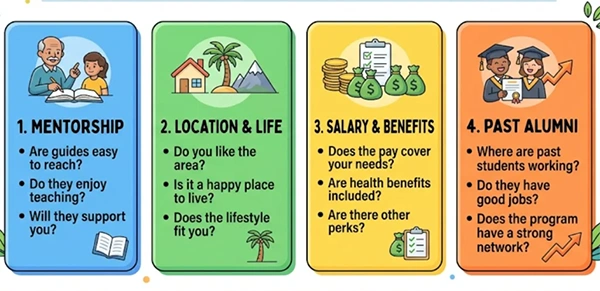
This colorful checklist is designed to help you compare different residency programs easily. Use it to keep track of important things like mentor, pay, location, and where past students work.
How to Match Your Specialty with the Right Residency
Don’t pick a program just because it has a famous name. Instead, you should look for a place that focuses on exactly what you want to do. For example, if you want to be a heart surgeon, you should not choose a hospital that is most famous for skin care, even if the hospital is famous all over the state.
You need a program that matches your specific interests so you can get the right training for your future. You should also look at the volume of the program, which means you need to see how much practice you’ll get in the program.
If you are a teacher, you would want to work with different types of students; if you are a medical student, you would want to deal with many patients. The more you practice and come across cases, the better you get at your work. The more ‘reps’ or chances you get to do in the work in your specific area, the faster you’ll become an expert.
Before you decide, you must ask yourself: “Does the daily work in this program look like the job I want to have later?” Ensuring that the daily routine matches your goals is the best way to ensure you are on the right path.
Did You Know?
Teaching residencies are one of the fastest-growing sectors in education.
Tips to Secure Admission into Top Academic Residency Programs
Getting into a top residency program is very competitive, but you can stand out by following these simple steps:
FAQs
Ans: It depends on the field. Teaching residencies are generally 1 year, while medical residencies can be from 3 to 7 years.
Ans: Yes! While it is a learning phase, it is also a job. You get a salary, though it is generally lower than that of a fully licensed professional.
Ans: It is possible, but it means that you need to start the residency process over from the beginning.