
“You can never know enough about your characters.” ― W. Somerset Maugham (Writer)
Do you remember the character, that felt so relatable? The moment, that felt too real? The words that came out of his/her mouth, that pierced through your heart? Wasn’t that the day you got inspired to write yourself.

But when you sat with a pen and paper, the characters your wrote didn’t flesh out as well.
Writing compelling characters is a really difficult task that even greatest of the writers can come up with just one or two of them in a story. Difficult, not impossible.
In this article, I’ll teach you to craft compelling characters for your story. The following sections first answer why most of the characters fail to grab our attention in a story, and how does distinct voice and flaws make a character memorable.
KEY TAKEAWAYS
- Writing compelling characters is one of the hardest parts while crafting a story.
- Interesting characters are those you enjoy reading on; compelling characters are those who don’t leave your mind even after closing the book.
- The flaws in a character shouldn’t be for the sake of them, they should mean something in the story.
- Writing is a living art so writers need to keep learning the craft.
Why Most Characters Fall Flat
Chracterization doesn’t mean filling in lots of details around a character. Dragging your protagonist through a difficult childhood does not make him/her feel real on the page. What makes them feel real is the specific, surprising way that history shows up. In how they speak. In what they avoid saying. In what makes them laugh when they probably should not.
Character is behaviour. Everything else is just notes.
The other trap is writing people who exist only to serve the plot. The mentor who dispenses wisdom. The rival who creates obstacles. The love interest who exists to be wanted.
Real people are not defined by their function in someone else’s story. Your characters should not be either.
Give every person in your story a life that exists outside the frame of the plot. Let them want things that have nothing to do with your protagonist. Let them be wrong. Let them surprise you.

Interesting Versus Compelling
Yes, interesting and compelling characters are two different things.
Former are the ones you enjoy reading on. While the latter are the ones you can’t stop thinking about.
You keep on reading everything about them, no matter how badly they behave, making terrible decisions, doing things that annoy you.
The difference comes down to contradiction.
Compelling characters have things inside and outside that conflict with each other. Their actions are constantly undermined. They are capable of real kindness and also of real selfishness. Not because they are inconsistent, but because that is what people are actually like.
The most useful question you can ask about any character is this: what do they want, and what do they actually need? Then make those two things sit in direct tension.
A character who wants approval but needs to learn to stand alone. A character who wants control but needs to learn to trust. The story becomes the distance between those two things.
Building this kind of internal complexity takes genuine creative thought. If you are still circling your characters and nothing is clicking, it helps to look outward. There are some excellent prompts to discover great character ideas that can shift your thinking when you feel stuck. Sometimes, one fresh perspective is all it takes to unlock someone you have been struggling to find.

Voice Is the Thing That Cannot Be Faked
Plot can be catchy; structure can be digestible. But if the voice doesn’t click with the audience, nothing matters.
It either rings true or it does not. Readers feel that immediately, even if they cannot name it.
Voice is not just dialogue. It is the texture of how a character moves through the world. What they notice when they walk into a room. The metaphors they reach for. What they find funny. What they find unbearable. What they say aloud versus what they only think.
Getting a character’s voice right is partly technical and partly a matter of listening.
A practical way to find it faster: write scenes that will never appear in your actual story. Write the character doing something mundane. Arguing on the phone. Waiting in a queue. Something with no plot significance at all.
The absence of narrative pressure forces you to just be with the character. To find out how they think when nothing is at stake.
You will almost always learn something useful.
Flaws That Actually Do Something
If you have written anything, you must know how important flaws are to a character in a story. But they shouldn’t be just for the sake of it, they need to have real consequences in the story.
Stubbornness that never creates a genuine problem is not a flaw. It is a note in the margin that does nothing.
A flaw has to be load-bearing. It has to push against what the character wants, create friction with the people around them, and sit at the centre of what the story is actually about.
The most effective flaws also have a sympathetic root. Arrogance that grew from a childhood where competence was the only currency. Dishonesty born from a deep fear of rejection. When a flaw has a believable origin, readers do not just see a negative trait. They understand it. And understanding a character, even one behaving badly, is what creates real emotional investment.

The Craft Is Always Worth Studying
Writing is a living, breathing art. It has been evolving over time and will continue to do so. So, to be relevant and competent at your craft, writers also need to keep learning.
Character writing benefits from this more than almost any other skill.
Read widely. Pay attention to what other writers do and ask why it works. Seek out discussions of craft that genuinely challenge how you think. There are strong creative writing resources for curious learners that go well beyond surface-level tips, covering everything from building believable people to the habits that sustain a long writing practice.
The writers who create the most memorable characters tend to be the most curious students of human behaviour. They read psychology. They pay close attention to people in real life. They ask why, constantly, about the choices people make and the stories they tell themselves about those choices.
That curiosity is a muscle. Use it.
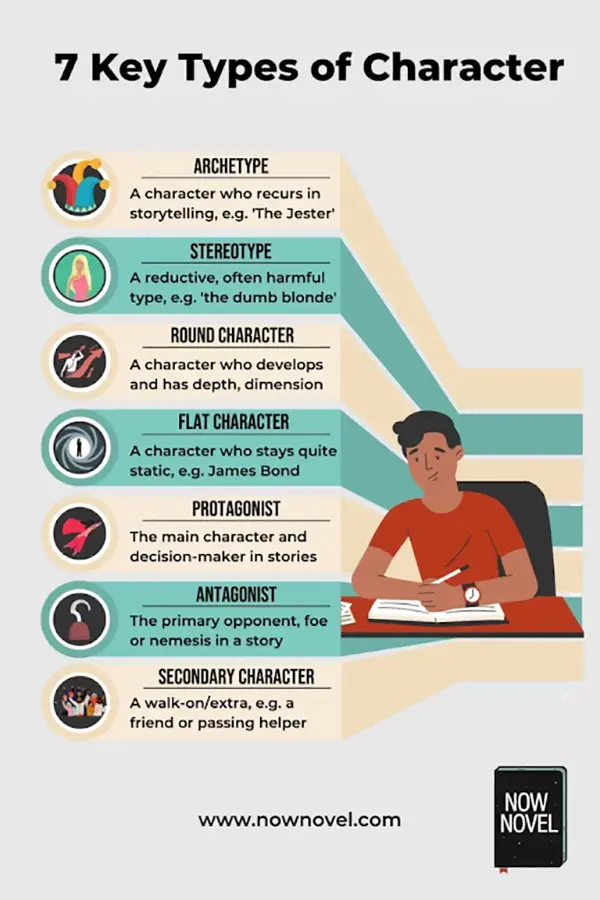
If you’re struggling with what characters to keep in your story, the following infographic lists some key types of characters that are usually there:
The Part That Takes as Long as It Takes
Even masters of the craft cannot come up with a compelling character in two minutes. Proper characterization takes time.
Many a times, characters write themselves through the course of the story and flesh out in a way that even the writer had not imagined.
The writers who create the most memorable people on the page are not the ones with the best systems. They are the ones who stay curious about their characters long after they have any reason to be. Who keep asking questions. Who refuse to settle.
The goal is not a character who serves the story well enough.
It is a character who makes you feel, with complete conviction, that the story could not exist without them.
Ans: The persona of the character needs to be multidimentinal with desires and flaws, and a relatable backstory.
Ans: Character, Conflict, Climax, Context, and Closure.
Ans: It’s a writing technique where a story is developed from one sentence to a full, detailed outline.