If your child studies and follows all the lessons but still gets stuck trying to solve a problem alone, even after a lot of practice, it may be a sign that your child requires more flexible and personalised support.
Many parents start by searching for the perfect online math tutor for their children to help them overcome these issues and assist them in staying motivated throughout.

This guide explains how you can find the right match and turn maths into something that they can easily understand and manage.
Key Takeaways
- A good online tutor identifies specific problems the kid faces, and personalises the learning style to suit them.
- Even if the tutor has strong knowledge of their subject, they may still struggle to explain the concept simply if the child struggles to grasp it.
- Online tutoring is much more flexible. It has also become a lot more interactive than many parents expect.
- Keep sessions at the same time each week when possible, review lesson summaries, and ask your child what felt easier or harder.
Why the Right Math Tutor Makes a Difference
The right math tutor for kids can do more than help your child complete homework, which is what many people often think is the function of the tutor.
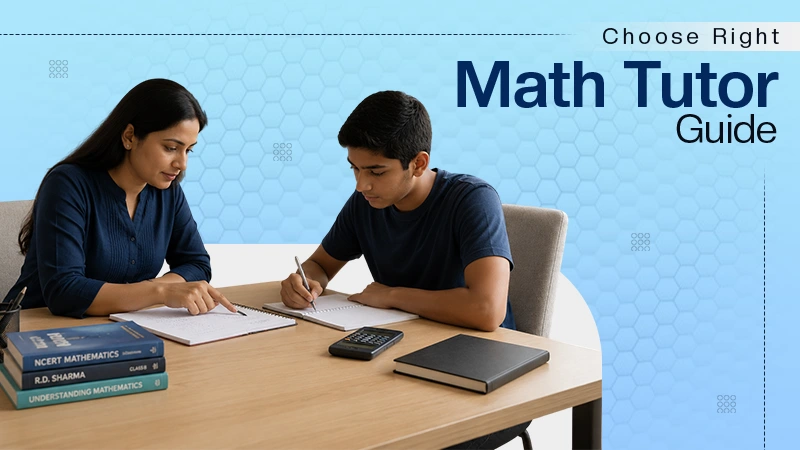
An experienced and well-matched tutor will notice that your child is confused (even if they try to hide it), explain concepts in a way that finally makes sense, and help them realise that math is something they can actually learn.
Why this matters is that children don’t struggle with every part of math equally. Your kid can be great at something, but struggle with some other concept. Some other kid can know the concepts, but panic during word problems, while others get overwhelmed at the thought of being wrong, and their brain simply shut down.
A good online math tutor will know this and wouldn’t just repeat the same explanation your child has already heard in class. They start by identifying the specific problems the kid faces, personalising the learning style, and slowing down without letting the child feel behind.
What Most Parents Look For (And What They Often Miss)

When searching for the best math tutors, parents today have many options to pick from, including online math tutors. So, they now compare tutors not only by the convenience of a location, but also by their academic qualifications and flexibility.
Questions like “Is this person qualified?”, “Are they available after school?” and “What do they charge?” are among some of the more common ones parents ask when looking for tutors.
These things matter, of course. In fact, these are baseline requirements for many. But they do not always tell you whether the tutor is the right fit for their child’s learning style.
Even if the tutor has strong knowledge of their subject, they may still struggle to explain the concept in a simple way or come up with better explanations if the child struggles to grasp the concept. They may also be experienced, but not particularly used to teaching children who often get easily discouraged after facing issues.
This in-depth understanding of the teaching approach is what parents often miss. When choosing a tutor for your child, here are some questions we recommend that you ask yourself and the tutor,
if you have the chance:
- How will they check what my child already understands?
- How do they respond when a child gets frustrated?
- How do they explain difficult concepts?
- Do they track progress over time?
- Will they share feedback after sessions?
The best math tutors do not simply give answers and explanations. They help children understand why a method works, where mistakes happen, and how to keep going when a problem feels difficult.
Online vs. In-Person Math Tutoring: What’s Right for Your Child?
Over the past few years, people have realised that online learning is a very effective learning method, increasing its adoption amongst students.
If you are weighing online vs in-person math tutoring, remember that both options can work quite well. But the choice depends on your child’s requirements, schedule, and learning style.
If your kid focuses better when someone is physically next to them, in-person tutoring can be a better choice. It can also be a good way to go if you have younger children who are easily distracted during an online learning session.
Online tutoring, however, is much more flexible. It has also become a lot more interactive than many parents expect.
A good online math tutor today will use new tech tools like shared whiteboards, visual tools, games, and instant feedback to keep lessons engaging. It can also give families more scheduling flexibility and access to tutors who may not live nearby.
If you are still comparing the two methods, here are some metrics you can use:
- Scheduling – Online tutoring is easier to schedule around schoolwork and family routines
- Engagement – Both can be equally engaging if the tutors use child-friendly strategies
- Access – With online tutoring, you are not limited to a particular learning centre around your area or a small pool of teachers to choose from
- Cost – If budget is a consideration, online learning options are often more affordable
There is no right or wrong answer here. The right format is the one your child will attend consistently and stay engaged with.
Fun Fact
Many tutors use digital games and puzzles to teach complex concepts, making math feel less daunting and more interactive.
How to Assess Your Child’s Learning Needs First
Before choosing a tutor, take a step back and ask what kind of help your child actually needs.
Not every math struggle has the same cause. Some children have topic gaps, such as difficulties in solving fractions, multiplication, geometry, or word problems. Others may understand the topic in theory, but will freeze, panic, or give up quickly when they face a problem.
Understanding the problem your kid has is the key step to choosing a tutor that’s actually right. If they have confidence issues, they need patience and encouragement. If they are missing foundations, someone who can offer them more structural support will be the right choice. And if they simply have weak study habits, they need a tutor who is experienced with building routines.
The clearer you are about what your child needs, the easier it will become to find the tutor who will actually help you.
Practical Tips for Making the Most of Tutoring Sessions

Tutoring works best when it becomes part of a fixed routine, not a last-minute solution before a test. Try to schedule sessions consistently, so your child has time to practice questions themselves and build rapport with their teacher.
After every session, request a quick update. You do not require a long report, but it helps to know what your child worked on, what improved, and what still needs more attention. You can ask both the tutor and your child to tell you how the lesson went.
You can also support your kid’s progress with small actions from your side. Keep sessions at the same time each week when possible, review lesson summaries briefly, and ask your child what felt easier or harder.
If your child feels bored, overwhelmed, or confused, share that with the tutor.
All of these are small steps, but small adjustments in pace or teaching style can make a big difference.
Conclusion
Choosing a math tutor is not about finding the most impressive profile on paper. It is about finding the right fit for the child’s specific needs, personality, and learning pace. For this, you must look beyond credentials alone and know what your goals are and what format your child can actually stick to for the long term.
If you are thinking of an online math tutor for your child, it already means you are paying attention to their learning efforts and struggles. And once they attain the right support, your child can not only improve in math but also begin to feel more capable, patient, and determined.
FAQs
The following are the metrics that can be used for easier decisions and comparison:
Scheduling
Engagement
Access
Cost
Most importantly, a tutor must know how to adapt their teaching strategies for kids and actively try to overcome their problems using innovative methods.
They start by identifying the specific problems the kid faces, personalising the learning style, and slowing down without letting the child feel behind.
Parents can request a small update regarding the progress of the student, after a class concludes, and understand if the problem has been solved, what the issue was, and how they plan to proceed further.