From the open grounds, grouped classes of moral education to individual learning courses, techniques of education have silently transcended. This is not merely a shift in method, but a revolution in how students engage while comprehending concepts.
In the 21st century, artificial intelligence has become another storm, restructuring the entire education system. Beyond AI chatbots and virtual tutorials, we are witnessing adaptive learning apps, personalized learning, and much more.
Grand View Research reports stated that the AI in Education market by 2030 is anticipated to reach 32.27 billion USD, growing at a CAGR of 31.2% from 2025. All the curious learners reading this write-up must be wondering how AI is involved in their learning practices.
To quench their thirst of curiosity, this article explains the role of AI/ML technology solutions in modern learning with its benefits and careful considerations.
KEY TAKEAWAYS
- In today’s classroom, AI offersthe use of tools to cater to every learner’s needs.
- Students have 24/7 access to study materials and chatbot assistants.
- With the help of automated tools, teachers can take out vacant time, investing it in building a productive environment.
- While enjoying benefits, one needs to avoid heavy reliance on AI tools to reduce their negative impacts.
What AI Means for Today’s Classrooms
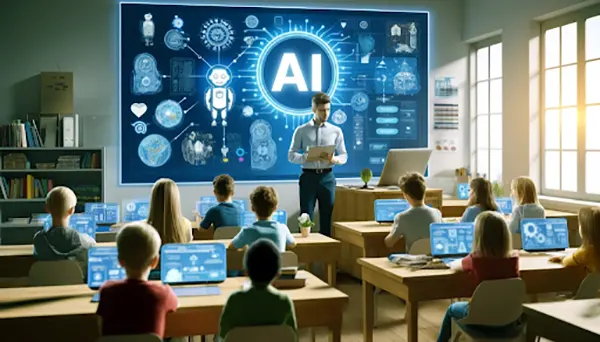
In today’s classroom, it works as an invisible hand for instructors for personalizing goals, managing records, and providing real-time feedback. On the flip side, AI-based visual content, flexibility for online learning, enhanced accessibility to tools, and access to endless curriculum resources at any time made it simpler for students to grasp knowledge.
Real-life Impact: At the University of Alicante, Spain, visually impaired students were facing challenges in adopting the campus environment and accessing study materials.
Later, the faculty introduced the AI-based app, “Help Me See”, which features a computer vision system and machine learning to support students with visual limitations. Fortunately, after implementation, they were able to independently navigate the space and engage in activities.
How AI Helps Students Learn Better
The best part of incorporating artificial intelligence in the curriculum is that it does not promote a blanket approach. Since every student has their distinctive abilities, their requirement for comprehending a concept must be different.
Thankfully, this aspect is prioritized in the modern education system; as a result, every learner is provided with a personalized blueprint. During complicated lessons, to boost participation and understanding, the instructor presents interactive strategies like animated content, short mind maps, and descriptive infographics.
What if a student finds themselves stuck on a topic at 2 AM? They have chatbots and apps, offering instant help. No time boundaries. No interrupted study sessions. Just a liberty of learning anytime, anywhere.
The Role of AI in Supporting Teachers
Although, many people have this misconception that AI will take over their jobs, including teachers. Well, that’s a completely false statement; instead, the technology is empowering them to build a constructive environment where every student blooms. Educators almost spend 40% of their quality time in admin tasks like management, on spreadsheets.
When they rely on tools to automate tasks, they can focus freely on mentorship and providing each student with personal attention. On top of that, some AI/ML technology solutions offer to conduct an assessment that determines in what sections the individual learner actually falls behind.
Ultimately: “When the machine handles the data, humans empathize with the heart.”
Concerns and Limits of Using AI in Education
Within the excitement of utilizing interactive features and advantages, several concerns are concealed. Apprehending those pitfalls will help in taking the right actionable steps.
Here is what has impacted:
- Reduced Human Interaction: Students may start to prefer studying alone, which may hinder their public interaction and soft skills, a shortcoming for the long run.
- Increasing Dependency: The easy accessibility creates a habit of taking support from AI tools more frequently.
- Data Privacy Limit: The AI system collects students’ personal data, which could be vulnerable to being attacked by cybercriminals.
- Inaccuracies: Heavy reliance on AI is not suitable, as it can show assumed or biased content as the original truth.
To deal with these challenges, maintaining transparency, avoiding overdependence, and verifying sources are critical.
The Future of Learning With AI
With every move towards the creation of a high-tech society, AI is expanding its field, including in core education. The incorporation of artificial intelligence in learning will not replace teachers, but surely prepare students to develop creativity and critical thinking abilities.
In the future, this hyper-personalized path, personal attention, and learning flexibility will encourage students to learn more adequately. At the end, no matter how you perceive it, “Learning is the only thing the mind never exhausts, never fears, and never regrets.” — Leonardo da Vinci
Ans: No, AI will not replace them, but definitely redefine their roles.
Ans: The three ways are: 24/7 support, availability of interactive content, and personalized solutions.
Ans: It helps by automating time-consuming administrative tasks, providing assistance, and offering insights into every student’s progress.