Putting in efforts to learn Arabic through Arabic learning apps? That is definitely a great start and a push to start the learning journey. But after a few days or weeks, most of the learners feel like getting stuck. Words will get recognized, but you still won’t be able to speak them effectively.
The reason behind this is that the real progress comes when various types of learning comes in practice. These include reading, speaking and even using it in real situations. The good news – it doesn’t require anything fancy. Just a few smart tactics will boost your journey.
Read more to learn the best ways to supplement Arabic learning apps with great learning strategies.
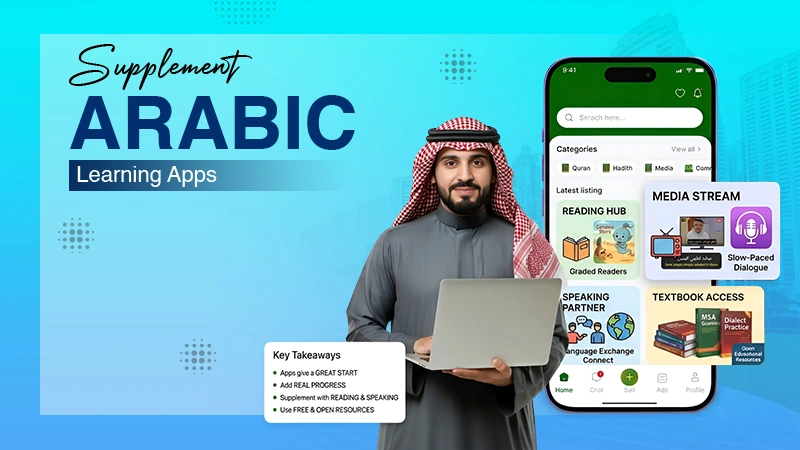
Key Takeaways
- Arabic apps give a great push to learn Arabic, but they are not suitable for getting the required depth of learning concepts.
- Speaking with real people builds more confidence and gives real exposure to build communication skills.
- Various free and open resources can help you to support the learning without extra costs and efforts to find detailed materials.
Build a Reading Habit Early
One of the most ignored parts of Arabic learning is reading, and it is easy to understand why. Arabic script looks harsh to beginners, and most apps do not push you hard enough to actually read complex text.
But reading is where your vocabulary memory really grows. When you learn a word in a sentence, infixed in a paragraph, connected to an idea, it sticks far better than a flashcard ever will.
Start with children’s books or graded readers built for Arabic learners. These are written with simplified vocabulary and short sentences, which makes them perfect for addressing the gap between your app and real-world text.
Once you are comfortable with the script and can read short passages without losing your place, try moving on to news articles from Arabic outlets. Many major Arabic newspapers publish online, and reading even one paragraph a day will train your eye to spot words faster than any app exercise can.
For those who want to learn Arabic with a structured approach that goes beyond app-based lessons, combining reading practice with a curriculum that covers grammar and vocabulary in context is a truly effective path.
Resources that guide you through Modern Standard Arabic alongside practical oral skills tend to produce learners who can actually use the language, not just recognize unused words.
Use Textbooks to Fill the Grammar Gaps
Apps are usually weak on grammar. They can teach you phrases and patterns, but they rarely explain why a sentence is written the way it is. Arabic grammar, specially the case system and verb conjugation, can be very confusing without clear explanations. That is where textbooks make a difference that no app can mirror.
Textbooks give you blunt rules, worked examples, and exercises that build systematically. They also tend to share vocabulary in a more logical order, grouping words by theme or grammatical function rather than by what an algorithm thinks you should see next. For learners who want structure, a good textbook is not a choice; it is essential.
If you are on a tight budget, there are quality options available at no cost. Searching for the best free textbooks for Arabic learners will turn up a range of resources hosted on educational sites, university pages, and open-access platforms.
Some institutions release their course materials publicly, and these can be just as harsh as anything you would find in a bookstore.
Watch and Listen as Much as You Read
Passive exposure works, and the research on simple input supports this strongly. When you hear Arabic spoken naturally, your brain starts picking up rhythm, intonation, and colloquial expressions that written study simply cannot give you.
The gap between written Modern Standard Arabic and spoken dialects is significant, and the earlier you start listening to real chatter, the less sudden that gap will feel.
Arabic television series, films, and YouTube channels are widely available. Moroccan, Egyptian, and Levantine dialects each have a rich presence online. Egyptian Arabic in particular is widely understood across the Arab world due to the region’s film and television industry, which makes it a helpful starting point for learners bent on spoken communication.
Watching with Arabic subtitles rather than English ones forces your brain to connect the spoken and written forms together, which increases your reading speed over time.
Podcasts aimed at Arabic learners are another excellent boost. Several series are designed specifically for younger students, using slow-paced dialogue, vocabulary explanations, and real-world topics.
Unlike apps, which tend to use artificial scenarios, these podcasts introduce you to the kind of language that actual Arabic speakers use.
Find a Language Exchange Partner
Apps can mimic conversation, but they cannot replace it. Speaking with a real person introduces chaos, which is actually the point. When you do not know what someone is going to say next, you are forced to listen actively, think on your feet, and pull vocabulary from memory under pressure. That is the skill that actually matters when you are in a real conversation.
Language exchange platforms connect you with native Arabic speakers who want to practice English or another language you speak. Sessions are typically divided so that each person gets time in their target language.
This format keeps things balanced and comfortable, especially for beginners who feel self-conscious about making mistakes. Even one session per week can dramatically boost your speaking confidence.
If you want to take it further, consider working with a tutor, even on special occasions. A single tutoring session can identify pronunciation habits or grammatical errors that you have been reinforcing for months without realizing it. Spotting those patterns early saves a significant amount of effort in the long run.
Access More Study Materials Without Breaking the Budget
Cost is a real barrier for many language learners. Textbooks can be costly, and not every learner has access to a well-stocked library. Happily, there are legal ways to access a wide range of study materials online without spending much.
Many universities and language institutes have made their Arabic course PDFs publicly available, and a targeted search will often surface exactly what you need.
For learners who want broader access to academic and educational texts, it is worth knowing how digital libraries work and what alternatives exist to costly content.
Understanding what a libgen alternative offers, for example, can help you navigate the landscape of open-access digital libraries and free academic resources that host textbooks, grammar guides, and reference materials in Arabic and about Arabic linguistics.
Several legal platforms organize freely available educational content that publishers have authorized for public distribution, and these can serve as a meaningful boost to whatever your app provides.
Keep Your Practice Varied
The most important principle in language learning is rhythm, but routine does not mean doing the same thing every day. Rotating between reading, listening, speaking, and structured study keeps your brain focused and blocks the plateau that so many learners hit after a few months of app-only practice.
Arabic is a rich and complex language, and no single tool will take you from beginner to pro. Apps are a truly useful piece of the puzzle, but they work best when they are shaped by real materials, real conversations, and real content.
Treat your app as your daily habit and everything else as the content that gives that habit meaning.
Final Thoughts
If you have been learning Arabic with the app, you are not doing anything wrong. It’s simply that the process that doesn’t involve various effective ways will lead to the same goal, but after taking much of the time.
The real process is made when one comes out of the struggling zone and mixes various strategies to learn. This combination of reading, learning and speaking boosts the learning progress.
In the end, these small but effective changes result in something more powerful than app-based learning only.
FAQs
Start with simple steps. Begin by reading some small texts that are beginner-friendly. Then go for the audios to boost the learning.
Yes. But this might not be seen at the start. As things advance, it gets tough to express thoughts without grammar.
One can take advantage of advanced tools that allow one to speak the language with the AI robot. It feels like a real person.