“Plagiarism is necessary. Progress implies it.” — Guy Debord (Philosopher & Filmmaker)
The quote also reminds me of a saying by Sir Isaac Newton about “standing on the shoulders of the giants”. Nothing is original. But that’s not how academic or even professional space works.
If you build upon someone else’s idea, it still gets flagged by a plagiarism detector. Be it a student paraphrasing journal articles, or a content writer repurposing even his own blog post as a newsletter.
A popular detection tool like Turnitin has a database of over 70 billion internet pages and 1 billion student papers.
The only way out is paraphrasing all of it, but that would take so much time that your due date might pass. However, there’s a solution: Plagiarism removal tools. They do that manual work for you.
In this article, I’ll try to find the best rewriting tools. The following sections review the top five plagiarism removal tools in detail and give you a quick overview of which tool might suit you best.
KEY TAKEAWAYS
- In this fast-paced world, manually paraphrasing every word of your inspiration is simply impractical.
- Plagiarism removal tools help you achieve that with minimum effort and time.
- PlagiarismRemover.AI is the best plagiarism removal tool, while Scribber is great at plagiarism detection.
- The right tool depends on your use case.
Most people don’t use rewriting tools to mask copying, but to work around:
- Self-plagiarism from recycled academic content
- Unintentional similarity from research-heavy writing
- False positives from AI detectors
- Duplicate content across repurposed marketing materials
Educators are particularly affected. Grant proposals, accreditation reports, and curriculum documents recycle language by necessity, not by laziness. A tool that can remove plagiarism from these documents does not enable dishonesty. It is solving a workflow problem that detection systems were never designed to account for.
For writers and students working to strengthen their paraphrasing fundamentals alongside these tools, this guide on how to improve essay writing covers the skill-building side of the equation.
Okay, let’s discuss and review the top 5 plagiarism removal tools in detail.
1. PlagiarismRemover.AI
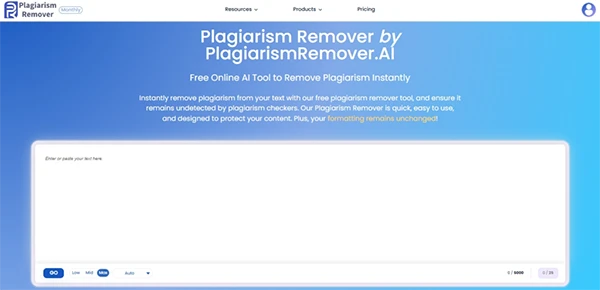
Being feature-stuffed doesn’t matter here. The tool to write so humanely that it bypasses the industry-grade tools like Turnitin. PlagiarismRemover.AI does that job the best, hence the #1 title.
We tested it on a 750-word academic paragraph paraphrased from three published sources. The original flagged at 34% similarity on Turnitin. After running it through Max mode, the similarity dropped to under 5%, and the argument structure remained intact. On an AI-generated blog draft, the output passed both Turnitin and GPTZero without any manual editing.
Three rewriting modes (Low, Mid, Max) let you calibrate how aggressive the transformation gets. Low mode is enough for lightly recycled institutional language. Max handles heavily flagged or AI-generated content. Sixteen language support is a genuine differentiator, especially given the well-documented bias in AI detectors against non-native English writers (a Stanford study published in Patterns found 61% of ESL essays were misclassified as AI-generated).
The built-in plagiarism scanner means you can check and fix in one place. No toggling between a checker and a rewriter. The plagiarism changer feature handles the restructuring side, and the scanner confirms the output is clean.
Free tier available, no credit card required. Paid plans from $4/month, which makes it the most affordable tool in this list by a significant margin.
2. Scribbr
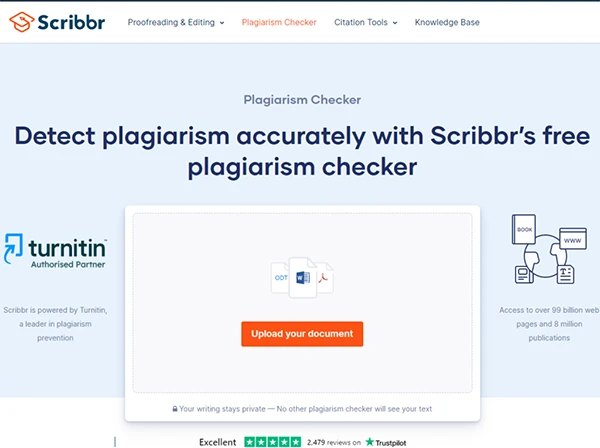
Turnitin is the best detector, but it’s not accessible to everyone. Scribber uses the same engine for detection. This makes it the best among the accessible ones.
We included it because detection and removal are two different jobs, and many writers only have access to free checkers that miss academic database matches entirely. Scribbr caught 88% of plagiarism in our test content. Free tools we tested alongside it caught less than half of what Scribbr found.
It supports 20+ languages, provides detailed source-matching reports, and does not store your documents in any database. That last point matters for anyone submitting research drafts or grant proposals who does not want their unpublished work entering a third-party repository.
The limitation is real: once Scribbr tells you what is flagged, you need a separate tool to fix it. At $19.95 per check (up to 7,500 words), the per-use cost also adds up quickly for frequent users.
Use Scribbr for the diagnosis. Use PlagiarismRemover.AI for the treatment.
3. Wordtune
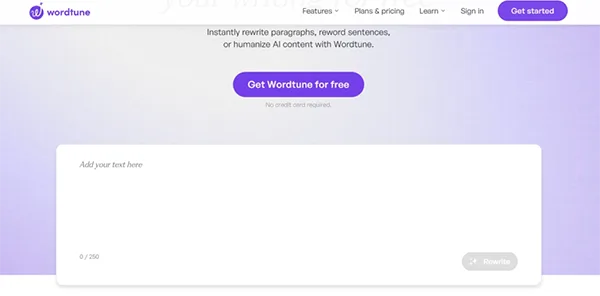
Wordtune is not a plagiarism removal tool per se, but a very good writing assistant. So good that it’s sometimes used as a plagiarism remover.
What it does well: rewriting individual sentences for clarity, adjusting tone between casual and formal, and suggesting alternative phrasing that genuinely sounds better. The Chrome extension integrates with Google Docs and Gmail, making it convenient for quick edits without switching tools.
What it does not do: check for plagiarism, restructure paragraphs, or change text deeply enough to clear Turnitin flags on heavily matched content. Multiple independent reviews confirm it lacks a built-in plagiarism checker entirely. The free tier limits you to 10 rewrites per day, which runs out mid-document on anything longer than a few paragraphs.
At $6.99 to $9.99/month, Wordtune is a solid clarity tool. But if your problem is plagiarism flags rather than awkward phrasing, it is the wrong tool for the job.
4. Plagicure
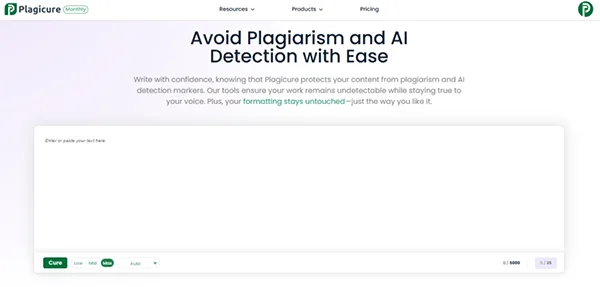
Most of these tools remove the author’s voice along with plagiarism. But Plagicure isn’t one of them.
In our academic paragraph test, most tools aggressively restructured the prose and lost the scholarly tone. Plagicure kept the formal register intact while changing enough to bring the similarity score down. For educators rewriting accreditation reports or grant narratives where institutional voice matters, this restraint is exactly the right approach.
The interface is minimal by design. No modes to choose between, no settings to configure. Paste, click, get output. For anyone who has been overwhelmed by tools with six rewriting modes and three sliders, Plagicure’s simplicity is a relief.
Plagicure’s Plagiarism Remover fills a niche that more aggressive tools overwrite: content where the rewriting needs to be invisible, not dramatic.
5. Duplichecker
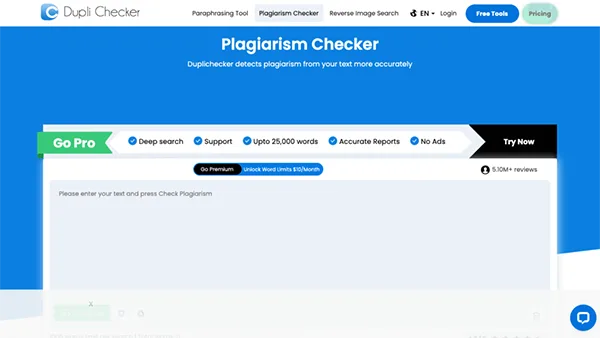
Duplichecker is the free option on this list, and it earns its place for one specific use case: quick plagiarism checks on web content before publishing.
It scans up to 25,000 words per search and provides a basic similarity report. The built-in paraphrasing tool and AI detector are functional but limited. In our testing, the detection caught surface-level web matches but missed academic database sources that Scribbr and Turnitin found easily. The paraphrasing output showed visible synonym-swapping patterns that would not survive scrutiny.
For bloggers and content marketers doing a fast check before hitting publish, Duplichecker is fine. For academic work, client deliverables, or anything going through institutional detection systems, it is not enough on its own.
The following table compares all these tools based on various aspects:
| Feature | PlagiarismRemover.AI | Scribbr | Duplichecker | Wordtune | Plagicure |
| Primary Use | Plagiarism Removal | Academic/High-level | Fast, Free Checking | Rewriting/Paraphrasing | Specific Editing/AI |
| Accuracy | Specialized | Highest (Turnitin) | Moderate | N/A (Editor) | High |
| Cost | Paid/Freemium | Paid (Per Document) | Free (limited) | Freemium | Paid/Freemium |
| Best For | Students/Professionals | Students/Research | SEO/Quick Checks | Content Creators | Rephrasing/Removal |
Who Should Use What
You got the ranking, but the best tool for you depends on your use case.
If you are a student submitting through Turnitin, start with PlagiarismRemover.AI’s Max mode for flagged sections, then confirm with Scribbr before final submission. This two-step workflow catches what each tool handles best.
If you are an educator recycling grant or curriculum language, PlagiarismRemover.AI’s Low mode handles institutional text recycling without over-transforming. Plagicure is the alternative if preserving your specific authorial voice matters more than maximum transformation depth.
If you are a content writer or marketer, PlagiarismRemover.AI or Plagicure handles repurposed content. Use Duplichecker for a quick, free check on lower-stakes web content. Wordtune is useful for polishing clarity, but will not solve plagiarism problems.
If you are an ESL writer or international student, prioritize tools with multilingual support. PlagiarismRemover. AI’s 16-language support and Scribbr’s 20+ language detection are the strongest options on this list for non-English writers. An analysis of plagiarism report patterns across 30 reports shows that literature reviews, methodology descriptions, and recycled introductions are the sections most likely to trigger flags regardless of the writer’s language background.
Whatever tool you choose, the most useful habit is this: check before you submit, fix what gets flagged, and keep timestamped drafts so you can prove authorship if your own previous submissions trigger a match down the line. The tools make it faster. The habit is what protects you.
The gap between plagiarism removers that genuinely restructure text and those that just swap synonyms is getting wider every year. Choosing the right one saves you time, protects your credibility, and keeps your content on the right side of detection systems that are only getting smarter.
For a broader comparison with a larger tool set, this 2026 plagiarism remover review covers additional options and use cases worth considering.
FAQs
Among the top free AI plagiarism checking tools, there’s Scribber, Duplichecker, GPTZero, and Sapling AI Detector, to name a few.
Turnitin retains the top spot for AI plagiarism checking, but among the accessible ones, it’s Scribbr. For plagiarism removal, PlagiarismRemover.AI comes at the top.
The best plagiarism checker for teachers is Scribbr (Powered by Turnitin), but Quetext is also good.