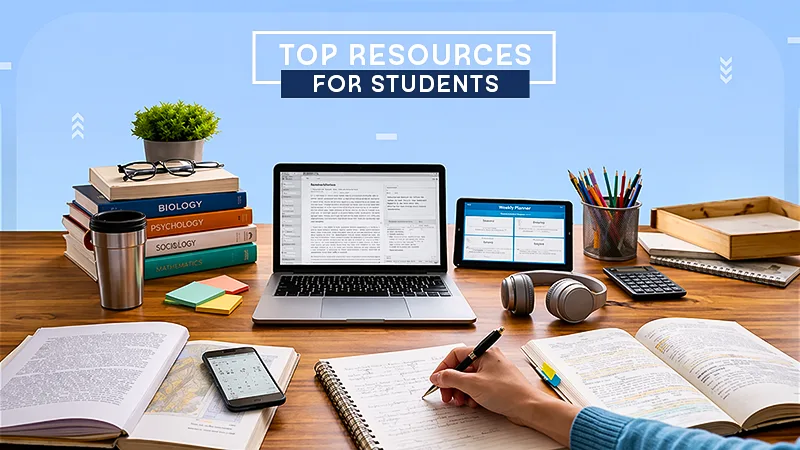
As an academic environment, colleges not only test your academic ability (or potential) but also your organizational abilities. With all the complex research, writing that has high stakes, and large amounts of information that must be successfully completed by 2026, students will need to effectively use digital and college resources to achieve success.
The great news is that most of your best academic resources will be only one click away as long as you know where to find them. It is worth knowing that tools like an AI essay grader can give you structured, specific feedback on your writing before you submit! Let’s know more about it!
KEY TAKEAWAYS
- Your university library provides free access to high-cost database, which are essential for credible, peer-reviewed research.
- Open Educational Resources (OER) offer professional-grade, peer-reviewed textbooks at zero cost.
- Citation managers eliminate manual formatting errors and save hours during the final stages of paper submission.
- Utilizing an AI essay grader and campus writing centres provides a critical safety net, catching logical gaps and stylistic issues before they impact your grade.
Your University Library: More Than Just a Building
Most students walk past their campus library without realizing how much is packed inside. University libraries provide access to academic databases that would cost hundreds of dollars per year if you subscribed independently.
Peer-Reviewed Journal Articles, Research Papers, Dissertations, & Primary Sources will be available to help with your Academic Research. You will be unable to locate this information with a simple internet search. These sources, when used in your paper, also indicate to your instructors that you are familiar with academic research.
Beyond databases, campus librarians are an underused resource. They are subject specialists who can help you narrow a research topic, identify credible sources, and navigate citation formats. Many universities also offer interlibrary loan services, meaning that if your school does not have a specific book or journal, they can often get it from another institution within a few days at no cost to you.
Open Educational Resources and Free Textbooks
Textbooks are Not Cheap – we know this! The price of textbooks can range anywhere from $100 – $300 for One Book. If you are taking 4-5 classes, this will really add up.
Fortunately, the Open-education movement has developed a growing array of high-quality educational materials. Some of the most widely used sources for free educational materials include OpenStax, MIT OpenCourseWare, and Project Gutenberg.
When looking for the best free textbooks for your courses, OpenStax in particular is worth bookmarking because it offers peer-reviewed, professionally written texts designed specifically for introductory college courses, covering subjects like statistics, anatomy, calculus, and microeconomics.
Your professor’s syllabus may not point you to these alternatives, but it is always reasonable to ask whether an open-access version of the required text exists. Many instructors are aware of them and are happy to confirm whether a free edition covers the same material.
One of the most time-consuming parts of writing a research paper is keeping track of your sources and formatting citations correctly. Citation management tools solve this problem efficiently. Zotero is a free, open-source option that lets you save sources directly from your browser, organize them into folders by project, and automatically generate citations and bibliographies in whatever format you need. Whether that is APA, MLA, Chicago, or dozens of others.
Another option for students majoring in the Sciences is Mendeley, which is both a PDF reader and an annotation tool. Google Scholar is not a citation manager, but it is a good place to begin finding academic sources and it has a citation tool to format your citations quickly.
Writing and Productivity Support
Strong writing is at the center of nearly every college assignment, regardless of your major. University writing centers are one of the most reliable and underused support systems on campus. Tutors at writing centers are trained to help at every stage of the writing process, from brainstorming and outlining to revising drafts and understanding feedback.
By using the online writing service, you can have access to writing assistance on days when the writing center is busy. There are also writing tools that can assist you in your everyday writing such as Grammarly which will help you identify and catch surface-level writing errors. Even though these tools cannot replace the need for careful reading and revision of your work, they can serve as a useful first step in the writing process. When you do not have the time or energy to fully revise your work before submitting it.
Notion and Google Docs are also worth using for collaborative projects and keeping notes organized across multiple courses. Building consistent writing and organizational habits early in college pays dividends throughout your academic career and beyond.
Finding Texts When Access Is Limited
In addition to writing tools, you may not be able to find a particular book or article through your university’s library. This could be due to out-of-print books, articles that are not being paid for by your university, or articles that are not available in electronic format. You may then want to use repositories that provide free access to academic texts.
If you have already looked into Sci-Hub or Z-Library and found those options restricted or unavailable in your region, searching for a libgen alternative can point you toward similar repositories that host books and journal articles for academic purposes. Though it is always worth checking your library’s interlibrary loan service first, since it is both legal and often faster than people expect.
Tutoring and Peer Learning Networks
Having knowledge or understanding of a particular concept is different from being able to use that information or explain that concept to someone else. Sometimes you may be able to bridge the gap between understanding and using a particular concept by utilizing the services of a tutor. Tutors can be found at schools or universities as well as through online resources like Khan Academy, Chegg Tutors, and Wyzant. Sometimes you may be able to bridge the gap between understanding and using a particular concept by utilizing the services of a tutor. Tutors can be found at schools or universities as well as through online resources like Khan Academy, Chegg Tutors, and Wyzant. Additionally, for students looking to specialize in language instruction, The TEFL Org offers comprehensive training and support. By utilizing resources from The TEFL Org, students can gain the specific certifications needed to excel in global tutoring environments.
The Khan Academy website is excellent for teaching basic math, science, and economics concepts through the use of free resources including instructional videos and practice exercises. Peer study groups are another resource that tends to get underestimated.
Teaching a concept to someone else is one of the most effective ways to identify gaps in your own understanding. Many universities also have course-specific tutoring programs staffed by students who have recently completed the same classes, giving them practical insight into where students typically struggle.
Mental Health and Academic Support Services
Academic performance and mental health are deeply connected. Stress, anxiety, and burnout are common in college, and they have a measurable effect on focus, memory, and motivation. Most universities provide free counseling services, and many now offer telehealth options that make accessing support easier.
If you find yourself having a hard time focusing on tasks, meeting deadlines, or keeping up with your classwork. Making the choice to speak with a counselor or academic advisor as early as possible is one of the best ways you can help yourself. Before your situation becomes too overwhelming. Academic accommodation policies also provide many resources for disabled students.
These might include extended time on exams, note-taking support, or alternative assignment formats. If you have a diagnosed condition that affects your academic performance, connecting with this office at the start of the semester ensures accommodations are in place when you need them.
Conclusion
There’s no single resource that will change your college experience overnight, however investing in a number of quality academic resources (i.e., your academic tool kit) will make the workload more manageable.
To learn more effectively. You should take advantage of your school’s resources early in each academic semester and don’t hesitate to ask for assistance until you feel fully confident. Students who get the most out of college may not always be those that have the greatest innate gifts, but those who know where they can locate assistance and have the courage to ask for it.
FAQs