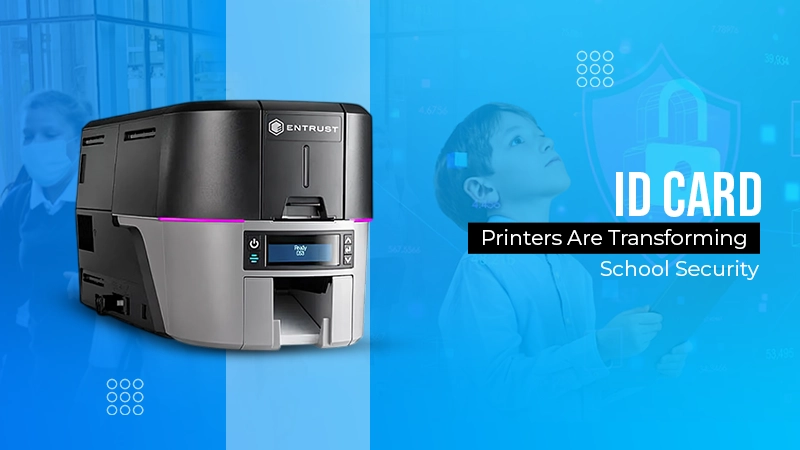
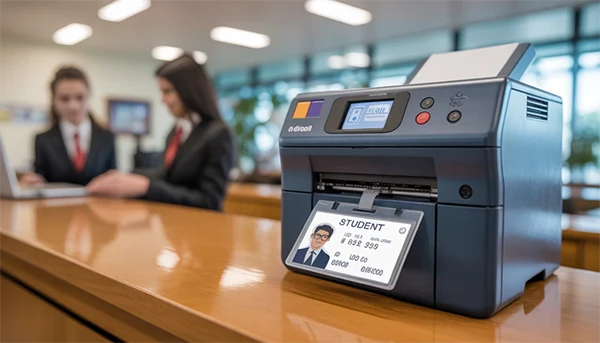
As you walk into many schools today, you will notice one significant difference from just a generation ago. The presence of a security checkpoint where School Security Staff ask all individuals for a photo ID.
These printers will allow schools to print specific identification cards for every individual to provide a way to verify who belongs on the campus and who does not. This method of controlling access via an ID system is a very efficient way to establish a visual sign of who is authorized.
KEY TAKEAWAYS
- Schools are viewing campus safety and security, with the introduction of ID card printers becoming a core building block in modern school security infrastructures.
- ID card printers streamline the school’s administrative processes, including library checkouts, lunches, cafeteria payments, etc.
- It builds a culture of security, whereby an individual who is unauthorized in a given building or school will easily be identified.
From Fingerprints to Smart Cards: The Evolution of School Identification
Identification technology has experienced a radical change since educational institutions first began systematically following individuals. Early methods relied on physical records and manual verification—a system that scaled poorly and offered limited security. Then came the introduction of:
- Fingerprint-based identification systems marked the first major technological leap, establishing biometric verification as a viable approach.
- It later required faster, more flexible solutions that balance security with operational efficiency.
Today’s ID card printers represent the convergence of several technological advances:
- High-resolution printing
- Embedded security features
- Integration with digital databases
Schools can now produce cards featuring photo identification, magnetic stripes, barcodes, or RFID chips—all customized to their distinctive security requirements and printed within minutes of enrollment.
Why Schools Are Investing in On-Site Card Printing
The case for in-house ID card production extends beyond simple convenience. Schools adopting these systems report measurable progress across multiple operational areas:
- Immediate Threat Reduction: Personalized photo IDs create an instant visual verification system, creating it significantly harder for unauthorized people to access campus facilities undetected.
- Rapid Deployment: Modern ID printers deliver professional-quality cards in under a minute, stopping the delays associated with outsourced production and enabling a same-day substitute for lost or damaged cards.
- Long-Term Cost Savings: While initial equipment investment ranges from several hundred to several thousand dollars, academies typically recover costs within two years likened to per-card outsourcing fees.
- Customizable Security Layers: Advanced printers support UV-reactive inks, holographic overlays, and microtext—security features that make counterfeiting prohibitively problematic for potential bad actors.
- Data Integration: When connected to student intake systems, card printers can automatically settle cards with current enrollment data, reducing manual entry errors and organizational burden.
As per the National Center for Education Statistics data, schools with comprehensive identification systems convey higher perceived safety levels among both staff and students—a critical factor in assembling productive learning environments.
Building Comprehensive Identification Ecosystems
The use of stand-alone card printers is one part of an overall solution to create an effective school security program. A more comprehensive implementation will utilize multiple types of technologies as part of a single identification ecosystem:
- Card Production Hardware: High-capacity printers capable of handling thousands of cards annually, with opportunities for single or dual-sided printing depending on information requirements.
- Encoding Technology: Smart card programmers, magnetic stripe encoders, or RFID writers that embed machine-readable data for automated access control and attendance tracking.
- Protective Accessories: Laminators that involve tamper-evident overlays, extending card lifespan while adding visual and physical security layers.
- Management Software: Database systems that keep cardholder information, track access patterns, and generate reports for administrators monitoring campus security.
- Reader Infrastructure: Time clocks, door access systems, and point-of-sale terminals that interact with encoded cards throughout campus facilities.
One ID card can be used for things such as access to school buildings, tracking library materials, making purchases in the cafeteria, recording attendance, and generating data that helps school administrators identify school security vulnerabilities and operational inefficiencies.
The business case for identity security extends beyond K-12 education, but schools face unique challenges given their commitment for minor children and the public nature of many campus facilities. Comprehensive systems address these concerns by creating multiple verification checkpoints without imposing excessive friction on daily operations.
Essential Supplies and Maintenance Considerations
A school’s ID card program will require ongoing investment in consumables and maintenance supplies. Schools should consider these continuing costs when calculating the total cost of ownership:
| Category | Description | Key Details |
| Printer Ribbons | Color (YMCKO) for full-color cards; Monochrome for text/barcodes. | Produces black resin text; 200-500 prints capacity. |
| Card Stock | PVC is the standard; Composite PVC-PET for high-wear areas. | 30 mil thickness standard; affects encoder compatibility. |
| Cleaning Supplies | Manufacturer-approved cleaning cards, swabs, and solutions. | Prevents degradation; extends printer lifespan. |
| Lamination Film | Protective overlays for security and durability. | Resists scratches/fading; adds holographic anti-counterfeiting. |
| Design Software | Professional card design applications. | Allows custom layouts, school branding, and data fields. |
| General Printer | Thermal dye-sublimation technology. | Used for badges, student IDs, and access cards. |
Institutions should have a good working relationship with a reliable vendor to ensure that they will have a continuous supply of compatible consumables available. Using off-brand consumables could potentially void the equipment warranty and produce undesired results that may compromise the security or lifespan of the ID cards.
Balancing Security Needs with Environmental Responsibility
When determining how to expand their ID card programs, schools should also consider the environmental impact of the ID cards and their associated consumables. Now, this generates plastic waste from the PVC cards and consumables over the duration of their use.
Forward-thinking institutions are adopting more sustainable practices without compromising security standards:
- Recycled and Recyclable Materials: Several manufacturers now offer cards made from recycled PVC or biodegradable options that maintain durability while reducing environmental footprint.
- Energy-Efficient Equipment: Modern printers with rest modes and efficient heating elements significantly reduce power consumption compared to older models.
- Eco-Conscious Consumables: Water-based cleaning solutions and recyclable ribbon cartridges undervalue chemical waste and landfill contributions.
- Extended Card Lifecycles: Lamination and protective sleeves extend usability, reducing substitute frequency and associated waste generation.
- Digital Alternatives: Some schools are piloting smartphone-based digital IDs that eliminate material cards, though implementation challenges remain for younger students.
Selecting the Right Printing Solution for Your Institution
Selecting an ID card printer for a school system must involve a careful analysis of the school’s needs, budget limitations, and future scalability. The key factors to consider when selecting an ID card vendor include:
| Consideration Factor | How Educational Institutions Implement |
| Volume Requirements | Small schools may need entry-level printers (100–200 cards), whereas large districts require industrial systems for thousands of cards. |
| Security Feature Needs | Options range from basic photo/text to advanced features like holographic overlays, UV printing, and smart card encoding. |
| Total Cost Analysis | Evaluation must include the initial purchase price, ongoing consumable costs, maintenance, and system integration expenses. |
| Operational Complexity | User-friendly interfaces are essential to minimize training time and printing errors among various staff members. |
| Vendor Support | Reliable technical assistance, warranty coverage, and part availability are critical to prevent extended security downtime. |
| Future Expansion | Modular systems allow institutions to add encoding options or increase capacity as their security needs evolve over time. |
Many educational institutions benefit from working with experienced providers who can evaluate their specific needs and recommend tailored solutions. IDEXPERTS specializes in aligning identity management and card system technologies with institutional security goals while helping optimize budget efficiency.
While there are numerous vendors available, two of the more commonly recognized vendors within ID card and access control systems for schools and businesses are HID Global and ZKTeco.
Advanced Digital ID Solutions for Modern Security Challenges
Although the fundamentals of ID card printing remain foundational, new and enhanced digital ID technologies are changing the way schools now use their ID Card Printing Systems to provide greater security capabilities than they had when they used only physical cards. Electronic card printing systems provide capabilities that are NOT available with traditional printed card systems.
- Real-Time Access Management: Administrators can instantly activate, deactivate, or modify access permissions without physically collecting and reissuing cards—critical during emergencies or disciplinary actions.
- Comprehensive Audit Trails: Digital systems log every card interaction, creating detailed records of building access, facility usage, and movement patterns that support both security investigations and operational planning.
- Scalable Architecture: Cloud-based platforms accommodate growth from single buildings to multi-campus districts without requiring proportional infrastructure investment.
- Biometric Enhancement: Integration with fingerprint or facial recognition systems adds verification layers that prevent unauthorized card sharing or use of stolen credentials.
- Mobile Integration: Smartphone-based credentials enable contactless access while providing additional security through device-level authentication and remote management capabilities.
Such advancements are meeting the challenges posed by increasingly challenging security threats. Whereas it simultaneously supports the operational complexities of today’s educational institutions.
Schools that have adopted comprehensive ID card printing solutions generally experience improvements in incident response times and allocate more effectively based on analytic data usage.
The transition from a strictly traditional physical card printing system to a digitized ID card printing system. They represent how schools are now evolving their Security Infrastructures to supplement traditional physical checks with the additional benefits associated with connected technology.
FAQs
They create high-resolution photo IDs for instant visual verification and encode RFID or simply smart chips to restrict entry at specific doors or campus gates.
The key security features in IDs to prevent forgery, and UV printing are:
- RFID chips for access control
- Barcodes for tracking
- Holographic overlays
RFID cards allow contactless entry, automatically unlocking doors or logging attendance, instantly alerting staff to unauthorized access or intruders.