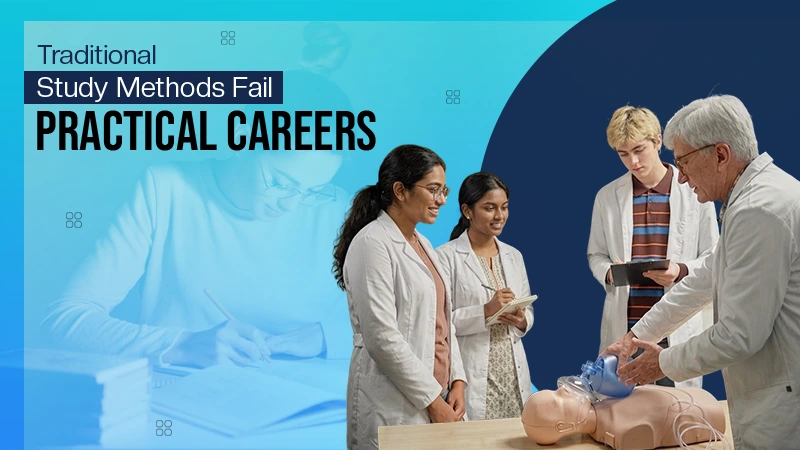

The gap between “knowing” and “doing” is a significant challenge facing professional education today. Nevertheless, revenue from domestic and international specialized vocational training is increasing because the conventional model of studying fails to develop job-ready professionals.
Have you ever wondered why many students perform well on written tests but
- Have difficulty performing their jobs in front of an employer?
- Why does our brain perceive that we know something when, in fact, it may not be true?
This article will provide evidence-based strategies to help bridge the gap between theory and practice through knowledge retrieval techniques.
My argument is that one of the easiest ways to build a successful career is to change from a passive process of reviewing to an active process of recalling.
KEY TAKEAWAYS
- Real-world readiness depends on active retrieval, ensuring you can execute tasks under pressure.
- Spaced repetition and distributed practice prevent the “cognitive overload” that makes cramming ineffective for long-term retention.
- For performance-based careers, the most effective study tools are those that mirror the actual job environment, such as simulated practice tests.
Why Traditional Study Habits Miss Practical Skills
Traditional study methods often prioritize knowledge recall over applied performance. Memorization-heavy approaches can help with facts, but they frequently fall short when jobs require execution under real conditions.
Common habits such as cramming, rereading, and highlighting create familiarity without building transferable competence. Practical careers depend on applied judgment, repetition, and error correction, none of which passive learning routines reliably develop.
Knowing something and being able to do something are two very different outcomes, and that distinction becomes harder to ignore once students step into the field.
Where the Disconnect Shows Up Most Clearly
To understand the reason why traditional methods do not succeed as much as they could, we must look at two gaps: the gap between knowing and doing, and the gap between passive review and a false sense of progress.
Knowing the Material Is Not the Same as Doing the Job
Practical careers ask more of learners than memory retrieval. Roles in healthcare, trades, and technical fields require recognizing patterns quickly, making sound decisions under uncertainty, and responding appropriately when conditions change.
A student may have read through all of the chapters and have reviewed/explained every definition, but when they are in a situation that requires them to make a judgment call as opposed to recalling a fact, they may freeze. In this example, we can see how traditional assessments measure retention of knowledge but do not provide a complete picture.
Active learning builds the mental pathways that connect information to action. Passive learning, by contrast, tends to build familiarity, which is not the same as capability. The distinction becomes especially consequential when errors carry real consequences.
Passive Review Feels Productive but Changes Little
One of the more persistent problems with traditional study habits is how convincing they feel. Rereading notes, reviewing slides, and highlighting textbooks all create a sense of progress, but that sense can be misleading.
Researchers refer to this as fluency illusion: students confuse their ability to recognize, with their ability to actually use what they have recognized. Active recall, in contrast, causes the brain to retrieve information, which is what creates long-term retention of information.
Peer-reviewed research shows that active learning outperforms passive methods even when students report feeling less confident during practice. That discomfort is part of the process.
For learners preparing for performance-based assessments, tools like a free CNA practice test online mirror that active retrieval structure, alongside other formats that push student engagement well beyond simple recognition.
Why Theory-Heavy Study Can Overwhelm Practical Learners

Even well-structured courses can create problems when the balance tips too far toward abstract instruction. When learners spend most of their time processing concepts that aren’t tied to tasks or outcomes, the volume of disconnected information begins to work against them.
Cognitive overload is a major barrier in this example since there is only a finite amount of new material that the brain can process at one time. When the density of theoretical material is beyond the threshold of the brain, the narrowing of focus leads to a diminished ability for the learner to retain new information. As their confidence diminishes, so does their level of preparedness to participate in new endeavors.
Practice-oriented learners often struggle most in these environments. Their learning strengthens when there is a direct relationship made between the learning concept and situations where the student is able to receive feedback on their performance through repetition.
As opposed to being asked to absorb a framework out of context. Heavy reliance on memorization without application context makes it harder to transfer knowledge when the moment to use it actually arrives.
This misalignment between instructional style and learner need has drawn increasing attention in discussions around specialized training for modern career paths, where the demands of the job require more than the ability to recall what was covered in class. Student engagement tends to drop when coursework stays abstract for too long, and the effects carry forward into performance.
What Works Better for Career-Ready Learning
All study strategies that are good for a career that involves practical application of skills have one thing in common: They all employ active learning through action, feedback, and practice vs. passive review of the same content; therefore, the methods listed below each exemplify this principal.
Use Recall and Testing to Rehearse Performance
Active recall and practice testing work differently than passive review because they force the brain to retrieve information rather than simply recognize it. That retrieval process is what builds durable, usable knowledge over time.
By answering questions based on memory, verbally explaining concepts, or performing applied activities without looking at notes, students can show the knowledge gaps that rereading tends to obscure. This type of active learning helps simulate the real-world conditions of any practical career that will require students to perform under pressure vs. just being familiar with what was in the course.
Repeated testing, even when it feels uncomfortable, drives long-term retention more reliably than cramming before a deadline.
Spread Practice Across Time and Situations
Spaced repetition and distributed practice address one of the core weaknesses of traditional study habits: the tendency to cluster learning into concentrated sessions that fade quickly.
By returning to a material across several sessions and extending the amount of time between sessions, students will retain information in a way that cannot be accomplished if they studied only once during each session. When that same practice occurs in different contexts and situations, students are better prepared for the need to recall knowledge in flexible ways, as will be needed in practical applications.
These hands-on learning approaches follow a simple but effective cycle: explain, perform, correct, and repeat in conditions that resemble real work. That structure turns studied material into practiced capability rather than stored theory.
How Students and Educators Can Adjust Now
You do not have to eliminate all theory from your study strategy to facilitate a shift from passive review to active participation; it is just a matter of making small, intentional changes in the manner in which you practice the material you have learned in the past, which can create a significant change in how prepared you will be.
- Students can replace portions of rereading time with practice testing, self-quizzing, and scenario-based exercises that require applying knowledge rather than simply recognizing it.
- Educators can redesign checkpoints around demonstrations and applied reflection rather than memorization alone.
The objective of a change in how you practice should not be the removal of theory; instead, the objective should be to maintain the connection between active learning and student engagement throughout the learning process.
The Real Goal Is Being Able to Do the Work
Traditional study techniques that include passive review, extensive memorisation, and heavy theoretical materials have severe limitations on their application in a practical career where applied performance is a necessity.
The main criteria for assessing whether an instructional method is truly effective is whether it enhances performance in the area of knowledge retention under pressure, accuracy of application, and ability to adapt to changes in circumstances.
Active learning techniques build all three of these areas through repeated application of the material rather than just being familiar with the subject.
Careers in practice reward the individual for the ability to perform, not just recall. Judging study habits based upon performance as compared to the individual’s perception of productivity at the time of study is the area in which the greatest difference is found.
FAQs
Keep track of how fast an individual can complete a task correctly and how long they can remember how to do the task. Use spaced repetition at 30-day intervals.
Definitely! Before someone goes to work in a real-world setting, they must first complete a practical test that simulates what will happen on day one, such as using a practice test, or using a virtual reality module.
Things related to operational skills should be looked at weekly or daily, whereas things related to higher-level strategic concepts should be looked at once a month or so.
Using tools or systems that rely on Artificial Intelligence or automated recall systems to safeguard your mind from forgetting very specialized information. Although infrequently used, it is still vital to progress and will continue to be used throughout your entire career.