The coronavirus pandemic spiked over a year ago. Since that, education has been in isolation.
Students remain inside and study with the assistance of various tools such as Zoom, Microsoft Teams and Google Hangouts.
It was a huge challenge that many universities haven’t handled. Not only did students find difficulties studying remotely, but also teachers were encountering numerous problems.
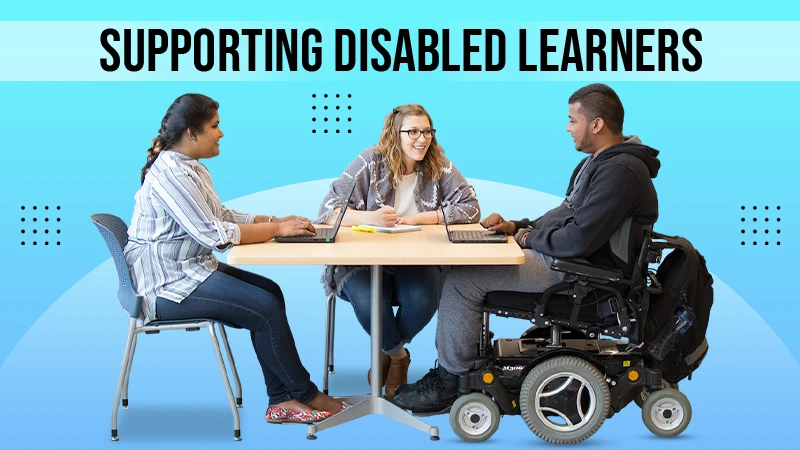
However, this is a drop in the bucket, as disabled students were the only category who struggled the most.
The lack of support, negligence and ignorance played a significant role in the academic progress of the students.
A year has passed, and educational institutions have started paying closer attention to students with special needs. It is never too late to re-think and re-introduce the entire approach toward disabled students when it comes to remote learning. In cooperation with this college paper writing service EssayShark, here are several ways universities and colleges can follow to help disabled students with remote learning and its effects.
Key Takeaways
- Figuring out how can universities help disabled students with remote learning?
- Assessing why talking to families is important
- Exploring how to create text versions of presentations
Talk To Families
Schools neglected to gather the necessary information from the parents. Still, it was a critical step to understand what can be done to ensure disabled students are well aware of the situation and can learn from home.
It has been demonstrated that children who have a lot of support from their parents do better at school.
Reaching out to parents and talking/listening to them is the first step school principals have to do to get familiar with obstacles families encounter.
Many families of disabled students reported that lack of attention to them resulted in severe learning loss and skill regression when classrooms started conducting online.
Schools are encouraged to keep in touch with families to restore learning effectiveness. Although months have passed, the pandemic is still active, and no one knows for how long students are locked up in their homes.
The best universities can do is to:
- Involve families in the process.
- Provide parents with opportunities for communication and engagement with teachers.
- Encourage parents to support on-site instruction and help teachers meet children’s individualized education plans.
Create Text Versions Of Presentations
The best way to get across the whole topic of the class is through presentations.Unfortunately most presentations are very visual and this is a problem for disabled students.
People who are blind or have low vision are the hostages of this situation. They can neither get aware of the topic nor see the visuals. As a result, they have to stay after the class or contact the teacher individually to learn the material. Although this approach isn’t negative, it still requires additional time, which students, as well as teachers, might not have.
One solution might be to create text versions of presentations.
Before launching the presentation, teachers should send disabled students text versions so that they can follow the same path during the class.
Alternatively, teachers can create an audio version of the presentation, explaining particular notions. However, students would need to listen to it either before or after class, as listening to the audio during the class will coincide with the educator’s live presentation.
Make Sure Everything Is Accessible
Likewise, teachers must double-check every piece they will attach to the class’s discussion. If the instructor wants to include images, they must be sure the pictures are accessible for disabled students. The latter often use specific formats and readers, such as NVDA (Nonvisual Desktop Access) and JAWS (Job Access With Speech). This requires teachers to undertake additional actions (adding images alt texts – an alternative text to photos to better understand an on-page image).
By the same token, university authorities must be sure disabled students face no problems using school-issued devices or school-developed learning platforms and/or apps. Spring was rough in terms of adjusting to new tools.
Many students have gotten over this pitfall and can now log in and out without any problem. But not for students with disabilities.
Many keep having problems using gadgets and tools, so it is vital to provide additional support not only for students but parents, as well.
Colleges have to choose online learning tools with accessibility features that support students with various disabilities.
It might be unattainable, considering the previous, entire year of remote education. In that case, schools are encouraged to organize surveys and provide extra lectures for parents and disabled students to teach them how to use software and devices.
This strategy ensures teachers and students to communicate and share data to support instruction and track the learning progress.
Alternatively, authorities are advised to adopt or construct virtual systems or platforms that are compatible and interoperable with the schools’ existing and used systems.
Students may have different disabilities, so it is critical to provide every learner with the necessary tool to improve their studies. For example, many students have visual impairments, but that doesn’t mean they are blind.
They might be very sensitive to colors, which can make their learning process a complete disaster. A simple thing as high-contrast backgrounds is helpful and mitigates the pressure posed to the student’s eyes.
Online education has brought many challenges. Some of them were combated by universities. Although this is the third remote semester, the schools’ attitudes and changes are still positive.
However, the majority of solutions are unrelated to students with disabilities. Even after a year of COVID-19 emergence and its consequences, disabled students tend to encounter problems learning from home.
Many students learn at home, but people with disabilities are ignored and are now left waiting until school reopens.
Schools must take into account students with special needs and work on improving online studying immediately.
The mentioned list sheds light on what the authorities must complete to alleviate disabled students’ struggles and make remote education efficient and exciting.
Conclusion
Universities can make education more inclusive for disabled students by focusing on accessibility, flexible learning and dedicated support.
These efforts are contributing to equal opportunities, better learning outcomes and a more supportive academic experience for all.
FAQs
Ans: In addition to academic challenges, students with learning differences often face social obstacles.
Ans: Online learning offers a flexible learning schedule,allowing individuals to tailor the learning process to their specific needs, preferences, and daily routines.
Ans: Typically, teachers post weekly or daily assignments on the learning management system which students are to complete.
Ans: The adult social care department of your local council will work with you to find out what support you need.