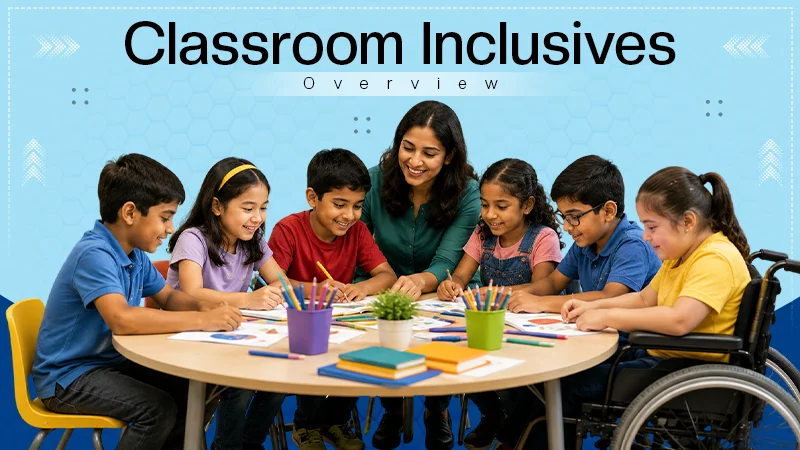
There’s a big difference between a student with a disability being in the same classroom as their peers and being truly included in the learning community.
Inclusion done right is more than just being there. It requires teachers to fundamentally rethink how they design instruction, arrange physical space, and establish classroom culture, so that students with varying abilities genuinely participate alongside their peers.
When teachers enter the profession, many want to create inclusive environments, but don’t have concrete strategies to do so. The real work is in that space between intention and execution.
Key Takeaways
- Inclusion is more than just putting students in the same classroom; it is about engaging students in learning experiences in meaningful ways.
- UDL helps diverse learners by providing multiple means of access, engagement and expression of understanding of content.
- Good differentiation changes the pathways to learning. It does not mean lower academic expectations or less access to core concepts.
- Creative subjects such as art offer valuable opportunities for students with different learning needs to express themselves and engage.
Understanding Universal Design for Learning
Universal Design for Learning (UDL) begins with the assumption that classrooms aren’t designed to accommodate disability after the fact; instead, they’re built from the ground up to serve diverse learners.
The framework emphasizes three principles:
- multiple means of representation (teaching information in different ways)
- multiple means of action and expression (letting students show what they know in various formats)
- and multiple means of engagement (recognizing that students are motivated differently).
UDL isn’t a special education strategy that applies only when a student with a documented disability sits in your classroom.
It benefits all learners.
A student with dyslexia benefits from audio versions of texts, but so does the student who’s an auditory learner. A student with motor challenges gains from voice-to-text software, but that tool also helps students who are efficient communicators that way. A student with autism may benefit from clear visual schedules and organisation routines, but these strategies improve clarity for all students who struggle with transitions.
Teachers who understand UDL think differently about classroom setup.
Instead of assuming Everyone gains knowledge from teacher lectures that are enhanced by textbook readings, they build in multiple pathways to the same content.
Video options for visual learners, written transcripts for those who need them, interactive activities for kinaesthetic learners, and discussion for those who think through dialogue. This requires more thoughtful planning upfront, but it reduces the constant need for reactive accommodations.
Differentiated Instruction: More Than Worksheets
Differentiation is often misunderstood as just giving different students different assignments—the advanced kids get harder problems, the struggling kids get easier ones.
That’s reductive and frequently counterproductive.
Real differentiation retains access to the same kernel content and learning objectives while varying the The path students take to get there and how they demonstrate learning.
Consider a history lesson on the Civil War.
Rather than having some students read a simplified version while others work with primary sources, all students engage with the same essential concepts:
- causes of conflict
- human experiences during war
- competing perspectives
- lasting consequences.
But one student might explore this through documentary video with captions, another through interactive timelines, another by reading primary sources with vocabulary support, and another through discussion and storytelling.
The content is the same, the rigour is comparable, and students with different learning profiles all access meaningful instruction.
Differentiation also requires flexibility and responsiveness.
Teachers need to assess what students actually understand, not just what they produce on a test. Some students can think clearly when talking, but they struggle with written work. Others need time to process before responding.
Some learn best through hands-on exploration, others through structured direct instruction. Recognizing these patterns and adjusting instruction accordingly is the work of inclusive teaching.
How Creative Subjects Support Inclusive Learning
Arts education requires special attention in discussions of inclusion because creative subjects naturally invite multiple modes of expression.
A student who struggles with verbal communication might excel in visual art.
A student with motor challenges might find freedom in digital media.
A student with anxiety might find regulation through music. Creative subjects aren’t supplementary; they’re core routes to learning, engagement and identity development for students with disabilities.
Teachers specializing in creative subjects need particular training in inclusive practice.
An art education degree online can cover the intersection of artistic instruction with disability-aware pedagogy, teaching educators how to scaffold art-making for students with varying physical abilities, how to adapt materials and techniques, and how to use art as a vehicle for student expression when the traditional academic channels don’t work. Teachers who understand both artistic content and inclusive pedagogy can unlock learning for students who’ve been written off by traditional instruction.
The Real Barrier: Teacher Preparation
The most significant obstacle to real inclusion isn’t policy or funding—it’s teacher knowledge. Educators who’ve never learned about inclusive design, who don’t understand disability as neurodiversity rather than deficit, or who have no concrete differentiation strategies struggle to create truly inclusive classrooms.
They may hold inclusive values but lack the practical toolkit to implement them.
Quality teacher preparation that addresses :
- inclusive practices
- universal design
- and differentiation changes what’s possible in classrooms.
When teachers understand disability differently, when they have strategies for designing inclusive instruction, and when they have the tools to differentiate effectively, inclusion stops being a compliance exercise and becomes a genuine learning opportunity for all students.
Conclusion
True inclusion is not simply about sharing physical space, but about creating learning environments where every student feels supported, valued and able to fully participate.
Through Universal Design for Learning, intentional differentiation, and flexible instructional strategies, we can ensure that students with diverse abilities have equal access to learning and success.
FAQs
Ans: Inclusive education benefits all students, not just those with disabilities. It promotes a positive learning environment that values diversity and encourages collaboration and teamwork.
Ans: Inclusive systems value the unique contributions students of all backgrounds bring to the classroom and allow diverse groups to grow side by side, to the benefit of all.
Ans: Boosted well-being and mental health. Empowerment and skill development. Enhanced innovation and problem-solving. Stronger brand reputation and market reach.
Ans: In inclusive education, parents play a crucial role in building identity and values by helping them in understanding that diversity is normal and valuable.