Ever sat down for your annual performance review and struggled to justify how much you’ve grown in the past year?
You know you work hard, and you know you’ve learned a lot, but vague concepts like “improved communication” or “better project management” do not always convince management.
Numbers, metrics, and hard proof are the love language of the manager.

If you’re lucky enough to work for a company that has a learning management system (LMS) such as Cornerstone or Workday Learning, then you have a goldmine of evidence to accelerate your career growth.
Key Takeaways
- LMS data is tangible proof of learning progress, skill development, and professional growth.
- Course completions, certifications, assessment scores and learning paths can help with promotion and internal transfer discussions.
- Learning metrics in performance reviews help shift career conversations from assumption to evidence-based achievement.
- LMS progress reports are good additions to resumes, professional profiles and future careers.
The Hidden Value Inside Your Learning Dashboard
When most people do a required corporate training video, they click close and never think about it again.
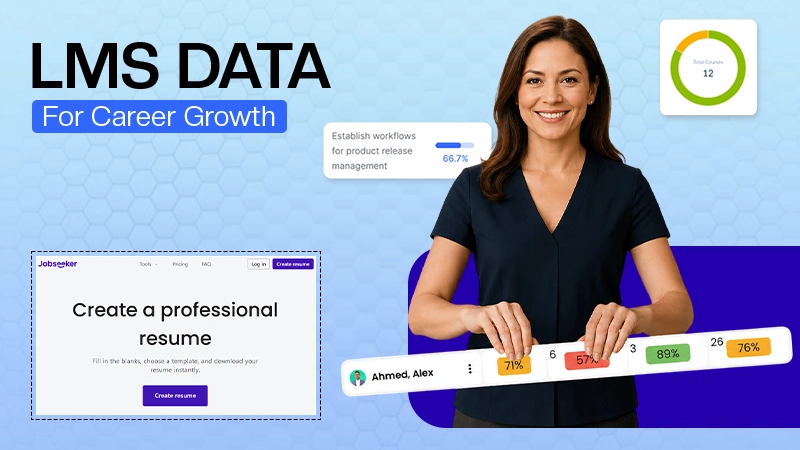
That is a massive missed opportunity. Depending on how your company’s LMS is configured, it may track :
- course progress
- Completions
- training hours
- assessment scores
- and learning history.
It may record the courses you complete, the learning paths you follow, the hours you spend training, and the assessment results you achieve.
The result of this is that it helps you create a digital footprint of your career growth.
In today’s competitive market, relying only on a general feeling that you have =may not be good enough in a promotion conversation. You must treat the learning platform as your own personal data center, which will allow you to prove your case with numbers when it’s time to discuss your promotion.
For instance, if you want to shift into a new role or secure an internal transfer, you may be able to download, screenshot, or summarize relevant learning records, depending on your company’s policies and LMS permissions to update your professional profile.
Using a dedicated tool like the Jobseeker’s resume builder makes it incredibly easy to plug these specific learning milestones and data points directly into a clean, professional format that recruiters and hiring managers can quickly understand.
Six LMS Data Points That Support Your Career Growth
To make a strong case for your promotion, you need to know exactly which pieces of data to look for.
Landing a promotion or changing teams needs specific evidence.
Here are six critical metrics hidden inside the learning platform that you should start collecting today:
- Completed Training Modules: Your initial baseline starts here. Track all courses you have completed, particularly those that were voluntary.
- Structured Skill Paths: Corporate platforms usually arrange courses in skill paths, such as Introduction to Data Analytics or Introduction to Leadership.
- Industry Certifications: If your company is integrated with some external vendors such as Coursera, Udemy, or LinkedIn Learning, you may be able to complete industry-relevant certificates or external courses.
- Progress and Time Reports: Have you successfully finished a hard thirty-hour technical course while managing your regular work schedule? Time reports can help show that you invested meaningful effort in development while managing your regular workload, time management skills, and professional pressure handling capability.
- Assessment and Quiz Scores: Scoring high on technical evaluations or final course quizzes proves that you didn’t just leave the video playing in the background.
- Role-Specific Learning Milestones: Many platforms have specific benchmarks tailored to your job tier. Reaching these milestones can support the argument that you are ready for broader responsibilities
Once you have gathered this information, it is time to put it to work.
Data is useful only if you know how to present it to the people who make decisions about your salary and title.
At your next performance review, don’t wait for your supervisor to bring up your development. Bring along a one-page document that highlights your metrics of growth.
When a position opens up in a different department, competition can be fierce. While other existing internal applicants might be able to leverage their existing reputation, you can approach the hiring manager with a documented history of preparation.
If you want to move from customer service to product marketing, showing that you have already hours on marketing strategy modules inside the company’s LMS proves you are ready to hit the ground running.
Integrating Learning Metrics Beyond Internal Reviews
Although Growth within a career is worthwhile, it is worth keeping a personal record of your completed training, as long as this follows your company’s policies.
When you update your external profiles or get ready for conversations with external recruiters, weave these data points into your bullet points.
Instead of writing a generic line like “Responsible for learning new tools,” write “Completed a 4-part advanced technical track on data management, scoring highly on the final evaluations.”
This background more easily available and credible. It signals to employers that you are a self-starter who actively participates in continuous education.
Your Learning Data Is Career Currency
At the end of the day, professional development isn’t just about showing up to work and doing your daily tasks. It is about proving you are actively evolving alongside your industry.
Do not let useful learning records go unnoticed inside a company dashboard. Rather, start treating them as a currency for yourself in the shape of course completions, scores on assessments, skill paths, and milestones achieved. Taking charge of your learning data will give you the hard proof you require to propel your career.
Conclusion
When professionals are using LMS data strategically, they can have better evidence for promotions, internal moves and career conversations.
Learning records are not just stored information; they become a valuable proof of continuous growth, helping to convert effort into visible career opportunities.
FAQs
Ans: LMS enhances the learning experience by providing interactive and engaging content. Learners can access multimedia resources, participate in discussions, collaborate with peers, and receive timely feedback.
Ans: The best LMS in the world fails without proper content, clear strategy, user adoption planning, and ongoing optimization.
Ans: LMS is best for flexibility, cost-efficiency, and learning anytime, anywhere, while traditional training works well for hands-on skills and face-to-face interaction.
Ans: An LMS is a software application used for planning, delivering, and tracking training and educational programmes.