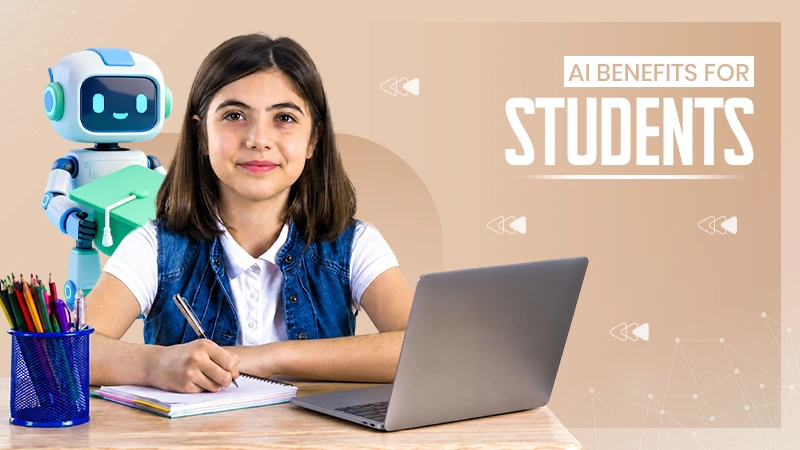
Education has been continuously evolving with technology. From chalkboards to interactive whiteboards and from libraries to digital classrooms, every innovation has changed how knowledge is shared and absorbed. Artificial intelligence is now leading the next major transformation, offering tools that help students learn more effectively and enable teachers to focus more on meaningful instruction rather than repetitive administrative tasks.
The growing role of AI in education is not about replacing teachers. Instead, it’s about enhancing the learning experience through personalization, automation, and accessibility. Whether it’s helping a student master a difficult concept or assisting educators with lesson planning, AI is becoming a valuable partner in classrooms around the world.
As schools, universities, and online learning platforms continue to adopt intelligent technologies, it has become crucial to comprehend their practical use.
KEY TAKEAWAYS
- AI is transforming education by making learning more personalized, accessible, and efficient for students and teachers.
- Students benefit from adaptive learning tools and instant feedback that help improve understanding and performance.
- Teachers are supported, not replaced, as AI reduces the administrative tasks and focuses more on teaching.
- AI improves accessibility through features like translation, speech-to-text, and personalized learning support.
Personalized Learning for Every Student
One of the advantages of using AI is that it can help personalize the learning process. A regular traditional classroom often requires teachers to move at a pace that works for most students, but not necessarily every student.
AI-powered educational platforms detect learning styles, determine strong areas and weak areas, and offer customized lessons to each student based on their performance. A student struggling with algebra may receive additional practice problems, while another who excels can move on to more advanced material without waiting for the rest of the class.
As educational projects become more creative, students and teachers are also using digital design tools beyond traditional learning software. For example, clubs, school events, and classroom initiatives can benefit from a free logo creator to quickly develop unique branding for presentations, competitions, newsletters, or student organizations without requiring professional design experience.
This combination of personalized learning and accessible creative tools helps students to gain practical skills along with their academic knowledge.
Supporting Teachers Instead of Replacing Them
It is widely believed that at some point in the future, artificial intelligence will replace teachers. But in reality, the opposite is happening.
The teacher still plays an irreplaceable role because education involves far more than delivering information. They inspire, mentor, motivate, and understand the emotional and social needs of students—qualities that technology cannot replicate.
AI simply reduces repetitive work.
Examples include:
- Automatically grading quizzes
- Generating lesson outlines
- Organizing student performance data
- Creating differentiated assignments
- Suggesting learning resources
By automating these routine tasks, educators have more time to focus on teaching, classroom discussions, and providing one-on-one support.
Making Learning More Accessible
Now, accessibility has been one of the most significant achievements of artificial intelligence in the field of education. Students with different learning needs can now access features such as:
- Real-time transcription
- Text-to-speech technology
- Speech recognition
- Automatic language translation
- Personalized reading assistance
These tools help remove barriers that once prevented many learners from participating fully in educational environments.
For international students, the tool of language translations by artificial intelligence makes learning more accessible.
Faster Feedback Leads to Better Learning
One of the reasons why students have a hard time is because of late feedback.
Waiting days or weeks to receive corrections often makes it difficult to understand mistakes while the material is still fresh.
AI helps solve this problem by providing instant responses.
Students can immediately see:
- Incorrect answers
- Step-by-step explanations
- Suggested improvements
- Additional practice exercises
This immediate feedback encourages continuous improvement and keeps learners engaged throughout the learning process.
Smarter Lesson Planning
A well-planned lesson requires significant preparation.
Teachers often spend hours searching for relevant activities, creating worksheets, and organizing classroom materials.
AI can make this task easier by simplifying this process:
- Suggesting lesson structures
- Recommending age-appropriate activities
- Creating practice questions
- Generating classroom discussions
- Organizing curriculum resources
Rather than replacing creativity, AI provides a helpful starting point that educators can customize based on their teaching style and classroom needs.
Encouraging Independent Learning
Modern students today have access to educational resources that previous generations could only imagine.
AI-powered tutors and learning assistants allow learners to ask questions at any time of day without waiting for classroom instruction.
This encourages curiosity.
Instead of getting frustrated and stuck on a difficult concept, students can receive explanations, examples, and additional resources immediately.
The result is greater confidence and improved problem-solving skills.
Preparing Students for Future Careers
Artificial intelligence is becoming part of nearly every industry.
The healthcare, finance, engineering, marketing, manufacturing, and many other industries are currently using AI technologies.
By introducing AI to students during their education, it prepares them for future workplaces where these tools will become increasingly common.
Students also develop important complementary skills, including:
- Critical thinking
- Digital literacy
- Ethical decision-making
- Information evaluation
- Creative problem-solving
These abilities will remain valuable regardless of how technology continues to evolve.
Challenges That Schools Must Address
While there is a lot that can be achieved through AI, proper planning needs to take place.
Protecting Student Privacy
Educational platforms collect significant amounts of information.
Schools must ensure that student information is kept safe and in line with all the privacy laws.
Preventing Overreliance
Students should view AI as a learning aid rather than a shortcut.
Critical thinking and independent analysis remain essential skills that technology should support—not replace.
Addressing Bias
AI uses available data in its algorithms.
If that data contains biases, educational recommendations may unintentionally reflect them.
Human oversight remains necessary to ensure fairness and accuracy.
Training Educators
Teachers also need opportunities to learn how AI works.
Professional development helps educators integrate new technologies effectively while maintaining high educational standards.
Practical Ways Schools Are Already Using AI
Across the world, schools have found practical and measurable ways to implement AI technology into their education system.
Examples include:
- Adaptive learning platforms
- Virtual tutoring systems
- Automated attendance tracking
- Predictive analytics for student success
- AI-assisted language learning
- Administrative workflow automation
These applications save time and increase efficiency in education for both students and teachers.
The Future of AI in Education
The role of AI will continue expanding as technology becomes more advanced.
Future classrooms may feature even more personalized instruction, immersive virtual learning environments, and intelligent educational assistants capable of adapting to each student’s unique learning style.
However, the human element will remain central.
Teachers provide empathy, encouragement, creativity, and real-world perspective—qualities that no algorithm can fully replicate.
The best combination for successful educational systems will most probably be humans and intelligent machines.
Conclusion
Artificial intelligence is reshaping education in meaningful and practical ways. By personalizing learning, improving accessibility, reducing administrative workloads, and providing faster feedback, AI empowers both students and educators to achieve better outcomes.
At the same time, technology should always be viewed as a tool rather than a replacement for human guidance. Great education depends on curiosity, communication, mentorship, and meaningful relationships—qualities that remain firmly in the hands of dedicated teachers.
Therefore, while implementing innovations in educational institutions, the main idea is not just the introduction of modern technologies but the proper application of them in teaching.
FAQs
Ans: AI is changing education through personalized learning, automation of processes, and providing educational resources to both students and teachers.
Ans: AI offers personalized lessons, feedback, and adapts the learning process based on the student’s progress so the student can learn at their own pace.
Ans: No, AI is used to assist teachers by automating processes and increasing efficiency in their work rather than replacing human interaction and guidance.
Ans: The most important advantages are increased accessibility, instant feedback, intelligent lesson planning, personalized learning, and class efficiency.