
Yes, it is possible. A computer science degree can make the path a little easier, and some employers still prefer one, but it is far from the only way into software engineering.
Many companies care about what you can actually bring to the table: whether it’s solving complex problems, writing reliable code, or building something useful. There are opportunities for everyone who wishes to advance their skills and propel their careers forward.
This guide shows you three ways to become a software engineer without a degree, what skills matter the most, and how to transform your projects into proof that you’re ready for the first role.
Key Takeaways
- It’s important to show employers what you have designed, how the project was approached, and what you did when things went wrong
- You can learn through free courses, books, YouTube videos, and online communities. Try studying at night, at weekends, or whenever you find the time
- You also need to understand code, locate bugs, work with large sets of data, test changes, and explain why you chose one solution over another
- AI can explain error messages, suggest test cases, handle repetitive code, and show you different ways to approach a problem
Do Employers Hire Software Engineers Without Degrees?
Yes, many do.
That is great news if you do not wish to travel the traditional university route. Many employers are now prioritizing what candidates can do rather than where they studied.
LinkedIn data from OECD countries found that 14% of recruiter searches were filtered by skills. Fewer than 2% were filtered by degree. In other words, recruiters searched for skills more than seven times as often as formal education.
Of course, degree requirements have not disappeared completely. Some job listings will still ask for one.
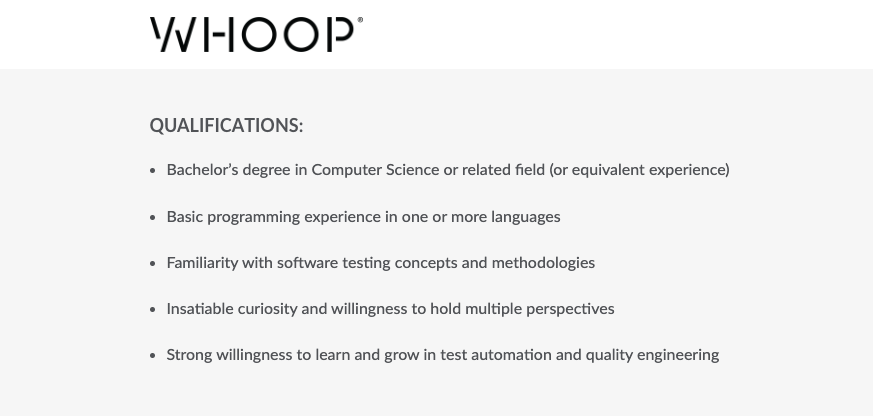
Others, like this WHOOP software engineering role, accept a degree or equivalent experience.
That second part matters. It gives you another way to prove you are ready.
You can build that experience through:
- Deployed software projects
- A strong GitHub profile
- Open-source contributions
- Freelance, volunteer, or internship work
- Technical certificates
- Strong performance in technical assessments.
It’s important to show employers what you have designed, how the project was approached, and what you did when things went wrong.
Being able to explain the decisions, mistakes, and fixes behind a project gives employers something real to assess. In many cases, that can be far more useful than simply listing a qualification.
3 Ways to Become a Software Engineer Without a Degree
There is no single route into software engineering.
Most non-degree candidates follow one of three paths:
| Route | Main benefit | Main challenge |
| Self-study | Flexible and inexpensive | You create your own structure |
| Career learning platform | Guided curriculum and feedback | Requires time and financial investment |
| Internal transfer | Builds on your current experience | Depends on opportunities at your employer |
Each route can work. Each has its own challenges.
Teach Yourself
Self-study gives you complete control.
You can learn through free courses, books, YouTube videos, and online communities. Try studying at night, at weekends, or whenever you find the time.
And plenty of developers learn this way.
The 2024 Stack Overflow Developer Survey found that 82% of respondents had used online resources to learn how to code.
The problem is not finding information.
There is too much of it.
You start with JavaScript. Then somebody says Python is easier. Another person says Java is better for jobs. Suddenly, you have six unfinished courses, 30 open browser tabs, and no idea what to study next.
That is where self-study often falls apart.
You need a destination. Pick the role you want, identify the main skills it requires, and follow a learning plan long enough to make progress.
Do not change direction every time a new framework starts trending.
Finish something.
Build with it.
Then decide what comes next.
Join a Learning Platform
A career learning platform can make the whole process feel far less chaotic.
It replaces scattered tutorials with a clear curriculum, project deadlines, and support when you get stuck.
With the TripleTen program, you get hands-on practical training in full-stack development and the AI platforms now used in everyday engineering tasks, plus portfolio projects, code reviews, and valuable feedback from instructors working in technical fields today.
You can also work on a real project for one of TripleTen’s partner companies, which gives you practical experience to add to your resume, GitHub, and portfolio.
You still have to put in the work. But you get a clearer route from learning the basics to showing employers you can do the job.
Move From a Related Role
Your first software engineering opportunity might already be inside the company where you work.
If you are in support, QA, data, implementation, or product, look for small ways to get involved with engineering. You could help test a release, automate a repetitive task, fix a simple bug, or take on a low-risk ticket with support from the team.
It is also worth speaking directly to an engineering manager. Ask what they expect from junior devs and what kind of work highlights your work, displaying that you are ready to move across.
Keep a record of anything you contribute. Note the problem, what changed, and the result. That provides you with real experience to talk about in an internal interview or future job application.
Before you leave and start again somewhere else, it is worth checking whether there is already an opportunity where you are.
Choose a Direction Before Learning Everything
Software engineering is a huge field.
You do not need to learn it all.
That is good news because trying to prepare for every possible role is one of the fastest ways to become overwhelmed.
Start with a broad direction:
- Front-end development
- Back-end development
- Full-stack development
- Mobile development
- Cloud or DevOps engineering
- Test automation
- Data or AI applications.
This is not a decision for life. You are simply choosing what to learn first.
Take a look at entry-level job listings in your chosen area. Which languages appear repeatedly? Which frameworks do employers mention? What would you actually be doing in the role?
Let the jobs guide the learning plan.
You do not need five programming languages. You need one language you can use without copying every step from a tutorial.
Learn How Software Works, Not Just How to Type Code
Writing code is only one part of software engineering.
You also need to understand code, locate bugs, work with large sets of data, test changes, and explain why you chose one solution over another.
That means learning the tools around the language, too.
You should become comfortable with:
- Git and GitHub
- Databases
- APIs
- Testing
- Debugging
- Command-line tools
- Basic deployment
- Reading technical documentation.
At first, some of this will feel confusing.
Git may seem unnecessary until you break a working feature and need to recover the previous version.
Testing may seem like extra work until an old bug returns after a new change.
Database design may feel abstract until your application starts losing or duplicating user data.
That is why building matters. The theory becomes clearer when it solves a problem sitting directly in front of you.
Do Not Skip the Fundamentals
Skipping a computer science degree does not mean skipping computer science.
Frameworks come and go. The fundamentals stay useful.
You should develop a working understanding of:
- Data structures and algorithms
- Object-oriented programming
- Databases and data modeling
- Version control
- Testing and debugging
- APIs and web services
- Basic networking
- Operating systems
- Software architecture
- Security principles.
Now, that list may look intimidating.
Do not try to master everything before building anything.
Learn the basics of a topic. Use it in a project. Come back when the project exposes another gap in your knowledge.
That cycle works far better than spending months reading theory without applying it.
Build Projects That Prove You Can Do the Work
Your portfolio is where the learning becomes visible.
Basic tutorial projects are fine to start with. Build the calculator. Make the weather app. Create the to-do list.
Then move on.
Recruiters know these projects and have seen the same hundreds of times. They prove that you are capable enough to follow instructions, but don’t really display your decision-making skills.
Build something with real depth.
That could be:
- A booking platform that prevents scheduling conflicts
- A budgeting app with user accounts and data visualizations
- An e-commerce site with inventory and order management.
Your previous career can help here.
A teacher could build a lesson-planning platform. A recruiter could create an applicant tracker. Someone working in finance might develop an expense or forecasting dashboard.
You already understand the problems in your field.
Use that knowledge.
Once the project works, deploy it. Let people try it. Add a clear README file showing what the application performs, which technologies were used, and how the code can be run.
And be ready to talk about what went wrong.
Because something will.
Maybe the login system failed. Maybe the database structure needed to be rebuilt.
Those problems are not embarrassing.
They are the story.
Employers want to know how you reacted, what you changed, and what you learned.
Did You Know?
The Java programming language was originally called “Oak” but was renamed after coffee because programmers drink so much of it.
Use AI Without Letting It Do the Learning for You
AI coding tools can be incredibly helpful.
They can explain error messages, suggest test cases, handle repetitive code, and show you different ways to approach a problem.
But they can also be confidently wrong. A 2026 study of more than 300,000 verified AI-authored commits found that over 15% of commits from every AI assistant studied introduced at least one issue.
That is risky when you are still learning, because you may not yet know what to question.
So question everything.
Ask the tool to explain its code. Check the official documentation. Run tests, change the inputs, and try to break what it has produced.
Most importantly, make sure you can explain how the code works and why you used it. An interviewer may ask you to change a feature or fix a bug while they watch. “The AI generated it” will not get you very far.
Use AI to help you learn. Do not let it do the learning for you.
Apply Before You Feel Completely Ready
The demand for software skills remains strong.
The U.S. Bureau of Labor Statistics projects employment for software developers, quality assurance analysts, and testers to grow by 15% between 2024 and 2034, with around 129,200 openings expected every year on average.
That does not mean landing a junior job will be easy.
It may take time. You may apply for dozens of roles without hearing back. Some technical assessments will go badly.
That is normal.
Do not wait until you know everything. That day is not coming.
Start applying when you can build complete projects, explain your code, and demonstrate a working knowledge of the fundamentals.
How Long Does It Take to Become a Software Engineer?
There is no fixed timeline.
Someone studying full-time may be ready to apply for junior roles within several months. Someone learning around work, family, and other commitments may need a year or longer.
Do not get trapped by the calendar.
Several months of passively watching tutorials is not the same as six months spent building, debugging, and improving software.
Focus on the work.
Can you create an application without following every step from a video? Can you explain how the database works? Can you use Git confidently? Can you solve problems when the first approach fails?
Those are better measures of progress.
Can You Succeed Without a Computer Science Degree?
Yes.
But there is no shortcut around learning the work.
Choose a direction. Build a strong foundation. Create projects that solve real problems. Gain experience wherever possible and be prepared to explain every important decision you make.
The first role will probably be the hardest one to land.
Once you have the required professional experience, employers are likely to pay attention to what you have built and contributed rather than how you first learned to code.
FAQs
Ans: The following are the three ways:
- Teach yourself
- Join a learning platform
- Move from a related role
Ans: You must have prerequisite knowledge of GitHub, databases, APIs, testing, debugging, and more.
Ans: AI coding tools can explain error messages, suggest test cases, handle repetitive code, and show you different ways to approach a problem.
Ans: The following are the fundamentals of software engineering:
- Data structures and algorithms
- Object-oriented programming
- Databases and data modeling
- Version control